
What to Play in the Car When the Drive Starts Feeling Long
No supplies needed: choose 20 Questions, Categories, Story Builder or humming-based Name That Tune, with 11 more oral options for the car.
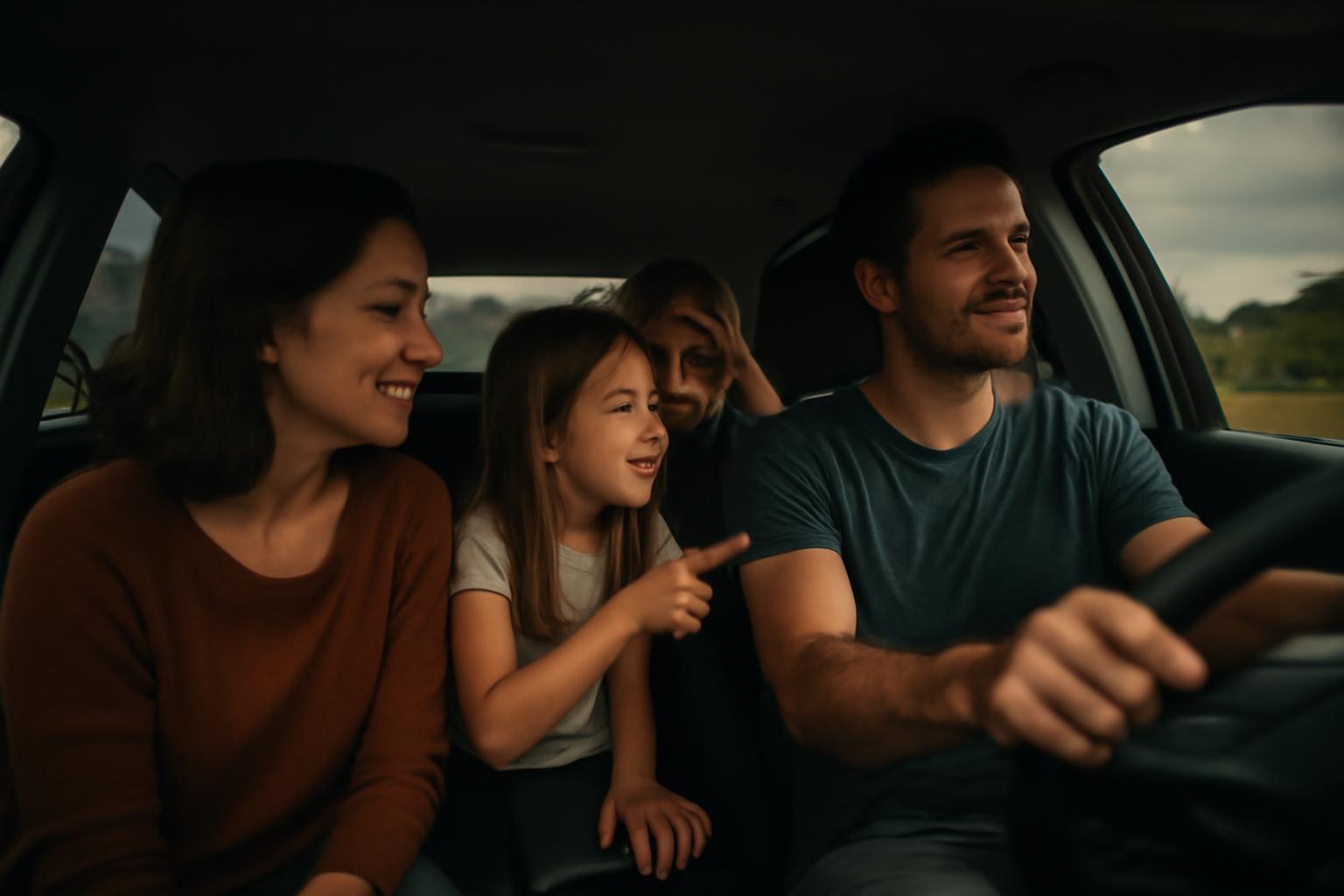
The most useful fun car travel games are not necessarily the ones with elaborate rules or a stack of printables. They are the games that fit the passengers, available supplies, light outside, shared interests, and appetite for noise or competition.
This guide covers 25 familiar game families and several common variations.
Choose a game that fits the moment
Use this table to find a workable option before reading the full rules. Group descriptions refer only to passengers. “Flexible” means the game can be cooperative, competitive, or noncompetitive depending on the house rules.
| # | Game or game family | Format | Passenger configuration | Visibility | Style | Noise | Preparation |
|---|---|---|---|---|---|---|---|
| 1 | 20 Questions | Oral-only | Pair or group | Not required | Flexible | Low | None |
| 2 | Would You Rather | Oral-only | Pair or group | Not required | Noncompetitive | Low–medium | None |
| 3 | Who Am I / Press Conference | Oral-only | Group with a clue-giver or “reporters” | Not required | Flexible | Medium | None |
| 4 | Virtual Hide and Seek | Oral-only | Pair or group | Not required | Flexible | Low | None |
| 5 | Categories | Oral-only | Pair or group | Not required | Flexible | Medium | None |
| 6 | Two Truths and a Lie / Would I Lie to You? | Oral-only | Storyteller and guessers | Not required | Flexible | Medium | None |
| 7 | The Question Game | Oral-only | Pair or group | Not required | Flexible | Medium | None |
| 8 | I Spy | Observation | Pair or group | Roadside, interior, or parked view | Flexible | Low–medium | None |
| 9 | The Alphabet Game | Roadside observation | Solo passenger or group | Required | Flexible | Medium | None |
| 10 | License Plate Games and Wordplay | Roadside observation | Solo passenger or group | Required | Flexible | Medium | Optional checklist or map |
| 11 | Road Trip Bingo | Paper or printable | Solo passenger or group | Required | Flexible | Low–medium | Cards and markers |
| 12 | Roadside Scavenger Hunt | Paper or printable | Solo passenger or group | Required | Flexible | Medium | Prepared list |
| 13 | Count the Cars / Car Color Search | Roadside observation | Solo passenger or group | Required | Flexible | Low–medium | None |
| 14 | Non-contact Slug Bug | Roadside observation | Pair or group | Required | Competitive | Medium | None |
| 15 | Story Builder | Oral-only | Pair or group | Not required | Cooperative | Medium | None |
| 16 | Fortunately/Unfortunately | Oral-only | Pair or group | Not required | Cooperative | Medium | None |
| 17 | In My Suitcase / Going on a Picnic | Oral-only | Pair or group | Not required | Flexible | Low–medium | None |
| 18 | Geography / The Name Game | Oral-only | Pair or group | Not required | Flexible | Medium | None |
| 19 | Rhyme Time | Oral-only | Pair or group | Not required | Flexible | Medium | None |
| 20 | The Counting Challenge | Oral-only | Group | Not required | Cooperative | Low–medium | None |
| 21 | Twenty One | Oral-only | Pair or group | Not required | Competitive | Low | None |
| 22 | Name That Tune / The Singing Game | Oral or device-assisted | Pair or group | Not required | Flexible | Medium–high | None, or passenger-controlled audio |
| 23 | Road Trip Trivia | Oral, paper, or device-assisted | Pair or group | Not required | Flexible | Low–medium | Optional questions |
| 24 | The Movie Game / Six Degrees | Oral-only | Pair or group with shared film knowledge | Not required | Flexible | Medium | None |
| 25 | Title Rephrasing | Oral-only | Pair or group | Not required | Flexible | Medium | None |
The fastest no-preparation shortlist
If nobody wants to choose from the full menu, start with:
- 20 Questions
- Would You Rather
- Categories
- Story Builder
- Fortunately/Unfortunately
- The Counting Challenge
- Name That Tune by humming
Choose according to the demands of the game rather than relying on untested age labels. I Spy requires visual tracking. Memory chains require recall and sustained attention. Geography and movie games depend on shared knowledge. Bingo may require reading and marking. Storytelling asks passengers to improvise, while singing games require a willingness to perform.
Rules vary across published collections. Road Trip Bingo may use a line, an X, or a full board as its winning pattern. Alphabet and License Plate games also have several common formats. Agreeing on the winning condition before starting is more useful than arguing later about which version is “official.”
Set ground rules before the first round
Editorial rule for this guide: visual searches, reading, writing, scorekeeping, and device operation belong to passengers—not the person driving.
This is a conservative house policy, not a claim that every oral game is proven safe for driver participation or that one rule creates a complete safety standard. In this guide, the driver does not take an active game role. Passengers pause the game whenever traffic, navigation, weather, or road conditions require the driver’s full attention.
Before starting, settle these points:
- Who can opt out? Anyone. A passenger may decline to tell a personal story, sing, bluff, answer a sensitive prompt, or continue after elimination.
- How do roles rotate? Change the clue-giver, question reader, scorekeeper, or music operator after each round.
- What ends the round? Choose a destination, stretch of road, number of turns, question limit, shared target, or winning pattern.
- What resolves disputes? Decide how to treat ties, duplicate answers, borderline clues, long pauses, and difficult alphabet letters.
- How competitive should it be? Scores are optional. Passengers can instead combine sightings, permit hints, or work toward a shared target.
Choose an oral game when it is dark, roadside visibility is poor, or a passenger does not want to read, write, look down, or concentrate on passing objects. This is a format choice, not medical guidance.
For Slug Bug or Punch Buggy, remove physical contact. A passenger can call “Beetle,” claim a point, or tap the vehicle ceiling rather than another person. Published non-contact variations likewise replace hitting with a point or ceiling tap.
Bluffing games need one additional rule: reveal the truth at the end of every round. Two Truths and a Lie, Would I Lie to You?, and invented-news variations should not leave passengers wondering which claims were fictional. Players may use entirely invented, non-personal material instead of disclosing personal experiences.
No-supply guessing and conversation games
These games can start immediately. Familiar animals, foods, household objects, occupations, and well-known characters make accessible subjects. To increase the challenge, narrow the category, reduce the permitted questions, prohibit obvious clues, or use a destination-related theme.
1. 20 Questions
- Setup: One passenger privately chooses a person, place, animal, or object.
- Turns: Everyone else asks questions that can be answered yes or no.
- Finish: The group must identify the answer using no more than 20 questions; otherwise, the chooser reveals it. This limit and question format are part of the familiar published rules for 20 Questions.
- Example: “Is it alive?” “Would we normally find it indoors?”
- Variation: Play as one team, restrict answers to a category, or let each passenger make an individual final guess.
Questions should narrow the field.
2. Would You Rather
- Setup: One passenger presents two alternatives.
- Turns: Each person chooses one and may explain the choice.
- Finish: End after everyone has answered or after the group’s chosen number of prompts.
- Example: “Would you rather visit a snowy mountain or a tropical island?”
- Variation: Before answers are revealed, passengers can predict which option the group will choose most often.
Use light, non-personal prompts when passengers have different comfort levels. Anyone may pass or give an answer without explaining it. The game works as a conversation prompt; it does not need voting, scoring, or debate.
3. Who Am I or Press Conference
- Setup: In Who Am I, one passenger chooses a secret identity. In Press Conference, the answering passenger does not know the fictional identity or accomplishment assigned by the group.
- Turns: Who Am I uses yes-or-no questions. In Press Conference, the “reporters” ask suggestive questions that gradually disclose the assigned role.
- Finish: The player identifies the person or role and, where applicable, the fictional accomplishment.
- Example: “Were you known for exploring?” or “How did you train the penguins for your moon mission?”
- Variation: Restrict identities to animals, occupations, fictional characters, or people familiar to everyone.
Press Conference requires at least one answering passenger and other passengers who can act as reporters. Questions should contain usable clues rather than private jokes or obscure references.
4. Virtual Hide and Seek
- Setup: One passenger imagines hiding somewhere in a familiar home.
- Turns: The others ask yes-or-no questions about the location.
- Finish: Someone identifies the hiding place.
- Example: “Are you upstairs?” “Could you see the kitchen from there?”
- Variation: Use a familiar school, hotel, grandparent’s house, fictional building, or other shared setting.
The imaginary-house version is documented in a collection of low-tech car challenges. Choose a setting everyone can picture well enough to ask meaningful questions.
5. Categories
- Setup: Choose a category such as fruits, animals, cities, movies, or things found in a kitchen.
- Turns: Passengers give distinct answers in rotation.
- Finish: Decide beforehand whether repetition, an incorrect answer, or a long hesitation ends the round.
- Example: For “things at a beach”: sand, towel, shell, umbrella.
- Variation: Work toward a shared total, use alphabetical order, or require answers beginning with a chosen letter.
Broad categories allow passengers with different knowledge bases to contribute. Narrow categories such as “movies set in space” demand more specialized shared knowledge. Rotate who chooses the subject so one person’s interests do not control every round.
6. Two Truths and a Lie or Would I Lie to You?
- Setup: A passenger gives three statements, one of which is untrue, or tells a single story that may be true or invented.
- Turns: The others ask follow-up questions and then vote.
- Finish: The storyteller clearly reveals the truth.
- Example: “I have slept in a tent, ridden a horse, and met an astronaut.”
- Variation: Use fictional characters, imaginary trips, or invented events instead of personal experiences.
Personal disclosure is optional. Entirely fictional material lets passengers participate without sharing private information, although the speaker must still reveal which statement or story was designated untrue.
7. The Question Game
- Setup: Choose a topic or begin with any question.
- Turns: Every response must itself be a question.
- Finish: A statement ends the round. Repeated questions, long hesitation, and off-topic answers count only if the group adopts those rules in advance.
- Example: “Where are you going?” “Why do you want to know?” “Shouldn’t I be curious?”
- Variation: Remove elimination and count how many valid questions the group can produce in succession.
Strict timing creates a faster competitive version. Allowing pauses and corrections creates a more forgiving cooperative version.
Roadside observation games for daylight stretches
Every game in this section depends on some form of visibility. Searching, reading, and recording are passenger tasks under this guide’s editorial rule. After dark, during poor weather, or on visually sparse roads, switch to an oral game.
8. I Spy
One passenger chooses a visible object and gives a broad clue: “I spy something red” or “I spy something round.” Others guess, and the spy adds clues until someone identifies it. The correct guesser becomes the next spy.
Fast-moving scenery can make an object disappear before anyone succeeds. A published I Spy account notes this limitation and suggests choosing objects in the vehicle, a parking lot, or a rest area instead of relying on passing scenery (Jen33Travel).
Before beginning, decide whether the object must remain visible throughout the round. If not, the spy should confirm that it was visible when selected and provide enough clues to keep the answer fair.
9. The Alphabet Game
Two common versions use different targets:
- Letter version: Find individual letters from A through Z on signs, buildings, or license plates.
- Word or object version: Find a visible word or object beginning with each successive letter.
Passengers can race individually or complete the alphabet together. Before starting, decide whether license plates count, whether one sign can provide several letters, and how to handle difficult letters such as Q, X, and Z.
A cooperative skip rule can prevent a stalled round. For example, allow an agreed number of skips or accept a word containing the required letter instead of beginning with it. These are house rules, not universal standards.
10. License Plate Games and Wordplay
License plates support several distinct games:
- Spot as many states, provinces, territories, countries, or other jurisdictions as possible.
- Keep a total or mark each new jurisdiction on a checklist.
- Shade sightings on a printed map.
- Add optional bonuses for plates the group considers unusual on the route.
- Form words, phrases, or sentences from visible plate letters.
Define what counts before play. Does a parked vehicle count? Can everyone claim the same plate? Does a personalized plate receive a bonus? In wordplay, must the letters remain in their displayed order?
There is no need to find a universal version. Consistency within the current round is enough.
11. Road Trip Bingo
Prepare cards containing likely roadside sights: a bridge, animal, fuel sign, construction cone, unusual vehicle, restaurant, billboard, water tower, or named landmark. Passengers mark an item when they see it.
Published rules use different winning patterns. One version uses five spaces in a row or a full board in a harder mode, while other versions permit a line or an X (Road Trip Bingo rules). Choose the pattern before distributing the cards.
Passengers may use individual cards, or the vehicle can work from one shared card. If several cards are used, decide whether everyone may mark the same sight.
12. Roadside Scavenger Hunt
Prepare a short list suited to the expected route. Possible entries include:
- An animal
- A bridge
- A motorcycle
- An unusual truck
- A fuel-price sign
- A body of water
- A named landmark
- A vehicle carrying bicycles
Each passenger can have a list, or everyone can contribute to a shared hunt. Decide whether repeated examples count and whether another passenger must verify each sighting.
A destination or route theme can focus the list. Urban trips might use transit signs and building types, while rural routes might use barns, farm equipment, animals, and water features.
13. Count the Cars or Car Color Search
Select one vehicle color or type—red cars, convertibles, pickup trucks, motorcycles—and count sightings over a clearly defined stretch.
End the round at a rest stop, town, highway change, or another chosen point. The fixed boundary keeps the count from becoming an indefinite score. Passengers can maintain separate totals, combine every sighting, or predict which vehicle type will appear most often.
14. Non-contact Slug Bug
Passengers earn a point for spotting a Volkswagen Beetle. The first clear verbal call claims the sighting. No hitting, poking, or touching another person is part of this version.
If the group wants a physical signal, use a ceiling tap rather than passenger contact. Decide whether parked Beetles, older models, and repeated sightings count. The objective is the spotting challenge, not preserving the physical-contact rule associated with some versions.
Word, memory, and storytelling games
These games replace roadside searching with imagination, recall, coordination, or wordplay. Passengers can make most of them cooperative by allowing a correction, giving hints, combining answers, or working toward a shared target.
15. Story Builder
- Setup: Choose an opening sentence.
- Turns: Each passenger adds one sentence to the same story.
- Finish: Stop at a natural ending or after an agreed number of rounds. A published variation suggests three turns per person as one possible endpoint (Story Time rules).
- Example: “The suitcase began to shake just as we crossed the bridge.”
- Variation: Nominate three nouns that must appear in the story.
The three-noun format is sometimes called Triple Threat. Words such as “lighthouse,” “pancake,” and “dragon” create a constraint without dictating the entire plot.
The goal is continuity rather than catching imperfect grammar or minor contradictions. If the story becomes difficult to follow, one passenger can summarize what has happened before the next turn.
16. Fortunately/Unfortunately
- Setup: Begin a story with a neutral event.
- Turns: Passengers alternate sentences beginning with “Fortunately” and “Unfortunately.”
- Finish: Stop at a satisfying conclusion or after the agreed number of rounds.
- Example: “Fortunately, we found the missing map.” “Unfortunately, it was drawn by a pirate who hated roads.”
- Variation: Reverse the direction of play whenever someone introduces a new character.
This is naturally cooperative because everyone contributes to one narrative. The alternating positive-and-negative structure is the defining rule; scoring is unnecessary.
17. In My Suitcase or I’m Going on a Picnic
- Setup: The first passenger says, “In my suitcase, I packed…” and names an item.
- Turns: Each person repeats the complete list in order and adds one item.
- Finish: End after a chosen number of rounds or when the group has used its permitted corrections.
- Example: “A hat”; then “a hat and a book”; then “a hat, a book, and a camera.”
- Variation: Add items alphabetically.
Traditional competitive play may remove a passenger after a mistake. A cooperative version can permit a shared correction or allow others to supply a forgotten item. Decide whether the exact order matters before beginning.
18. Geography or The Name Game
- Setup: Choose places or another category.
- Turns: Each answer must begin with the final letter of the previous answer.
- Finish: A duplicate, invalid answer, or hesitation ends the round only if the group adopts that condition.
- Example: Canada → Argentina → Australia.
- Variation: Use animals, foods, fictional characters, or destinations.
Decide whether repeated answers are allowed and how to treat multiword names, punctuation, and silent final letters. Rotating categories prevents one passenger’s specialist knowledge from dominating every game.
19. Rhyme Time
- Setup: Choose a simple word.
- Turns: Passengers offer distinct rhyming words.
- Finish: Stop when the group reaches its chosen target or cannot find another accepted rhyme.
- Example: Light, night, sight, flight.
- Variation: Build a sentence or short story using the collected words.
Invented words count only if the group agrees. The game does not need elimination; passengers can simply collect as many accepted rhymes as they can.
License Plate Wordplay
This is the verbal branch of the License Plate Games entry in the comparison table. A passenger reads visible letters and challenges the group to make a word, phrase, or sentence from them. For “BRT,” answers could include “bright,” “bring red towels,” or “bears ride trains.”
Locating and reading plates remains a passenger task. If plates are no longer visible, one passenger can nominate remembered or invented letters so the word game can continue without roadside observation.
20. The Counting Challenge
- Setup: The group tries to count from one to 20 without assigning turns.
- Turns: Anyone may say the next number, but the group may not establish a fixed order.
- Finish: Reaching 20 completes the challenge.
- Reset: If two passengers speak simultaneously or the pause exceeds five seconds, the group returns to one. Those conditions appear in a published version of the Counting Challenge.
- Variation: Adopt a lower target, prevent one passenger from speaking twice in succession, or permit one mistake without resetting.
Although the game uses numbers, it is primarily a coordination challenge. Passengers must judge when to speak without relying on a predetermined sequence.
21. Twenty One
- Setup: Begin at one.
- Turns: Each passenger says one, two, or three consecutive numbers before play moves to the next person.
- Finish: The passenger forced to say 21 loses the round. These turn and finish rules are documented in a published Twenty One game description.
- Example: One passenger says “one, two”; the next says “three, four, five.”
- Variation: Change the final number or reverse the objective so saying the final number wins.
Twenty One is distinct from the Counting Challenge. It has assigned turns, permits several numbers in one turn, and revolves around avoiding 21. The Counting Challenge has no assigned order and asks the group to reach 20 together.
Music, trivia, and pop-culture games
These games suit passengers interested in songs, films, books, or shared knowledge. They are not automatically screen-free. Humming, remembered questions, and spoken clues need no device; recorded excerpts, radio scanning, apps, and online question banks are device-assisted.
22. Name That Tune and The Singing Game
Name That Tune
One passenger hums or sings a melody while everyone else guesses. Passengers may award a point for the title and optional additional credit for the performer or genre. In a score-free version, the correct guesser chooses the next song.
Recorded play can use a radio or music device operated by a passenger. Published versions distinguish between electronic and vocal play, making humming or singing the no-device fallback.
The Singing Game
Choose a word or theme. Passengers take turns singing a short lyric fragment containing it. For “road,” someone might offer one recognizable line featuring that word. A full performance is unnecessary.
Decide whether repeated songs count, how exact the lyric must be, and whether humming is acceptable. Anyone may pass rather than sing.
23. Road Trip Trivia
- Setup: Select destination trivia, general knowledge, or a shared interest.
- Turns: A passenger asks the questions and tracks answers if the group wants scores.
- Finish: End after the prepared set or when the agreed target is reached.
- Example: Ask about national capitals, animals, sports, food, films, or places on the itinerary.
- Variation: Use teams, multiple-choice answers, hints, or a cooperative target.
A passenger can prepare questions beforehand, read from cards, or operate a device. Without materials or connectivity, passengers can take turns asking remembered questions.
Keep the subjects broad enough for the current group. Trivia based entirely on one person’s specialist interest may work as a teaching round with clues, but it is less suitable for direct competition.
24. The Movie Game or Six Degrees of Kevin Bacon
- Setup: Name an actor.
- Turns: Connect that actor to another through shared films and co-stars.
- Finish: Reach the target actor within the agreed number of links.
- Example: Actor A appeared with Actor B in one film; Actor B appeared with Actor C in another.
- Variation: Connect movies through actors, or choose a different target performer instead of Kevin Bacon.
The format requires shared knowledge of casts and films. If passengers have different viewing habits, allow hints, television credits, animated voice roles, or a broader entertainment category.
Disputes about a credit can be set aside for later verification rather than requiring device use during the round.
25. Title Rephrasing
- Setup: Choose a movie, book, show, or song title.
- Turns: Replace its important words with synonyms or near-synonyms.
- Finish: The first correct guess wins the clue and gives the next one.
- Example: “Conflict among the celestial bodies” could clue Star Wars.
- Variation: Use one medium, work in teams, or remove scores.
A clue should preserve enough of the original title’s structure to be solvable. If nobody recognizes it, reveal the answer and move on rather than extending the round indefinitely.
Match the game to night driving, small groups, and mixed ages
When darkness, weather, or an empty landscape removes the roadside options, switch to oral games:
- 20 Questions
- Would You Rather
- Who Am I
- Virtual Hide and Seek
- Categories
- Story Builder
- Fortunately/Unfortunately
- In My Suitcase
- Geography
- Rhyme Time
- The Counting Challenge
- Twenty One
- Humming-based Name That Tune
- Spoken trivia
- Movie connections
- Title Rephrasing
Observation games depend on visible surroundings. Oral guessing, memory, storytelling, trivia, and conversation games do not.
For two passengers, remove elimination and alternate roles:
- Take turns choosing the answer in 20 Questions.
- Alternate spy and guesser in I Spy.
- Hum one song each in Name That Tune.
- Trade clues in Title Rephrasing.
- Build a Story Builder narrative one sentence at a time.
- Work toward a shared Categories total.
The Counting Challenge requires a group large enough for uncertainty about who will speak next. Press Conference also needs an answering player plus other passengers who can act as reporters. These are functional requirements, not claims that a particular group size has been tested as superior.
For one child traveling with adults, use familiar subjects, brief rounds, optional clues, and cooperative targets. This approach avoids relying on unsupported age rankings. Adults can also model the first turn before asking the child to lead.
For mixed-age groups, rotate who chooses the category. One round might use animals, the next songs, then foods, places, or fictional characters. This gives different knowledge bases a turn without claiming that one format is universally more suitable.
Passengers who prefer not to read or look down can choose storytelling, conversation, memory, guessing, or music. This is a practical format choice, not a medical recommendation. Any accessibility adaptation should be selected by the travelers rather than presented as validated guidance for a particular disability.
Quiet variations for low-energy stretches include:
- Whispered 20 Questions
- Low-volume trivia without buzzers or shouted answers
- A score-free memory chain
- Written category exchanges only while parked
- Soft humming instead of recorded music
- A cooperative story with short sentences
Combine everyone’s sightings, set one shared target, permit hints, give the group a correction, or remove elimination. The change can be as simple as replacing “Who loses?” with “Can we complete the challenge together?”
Prepare a small game kit without overpacking
Verbal games need nothing. Bingo, scavenger hunts, maps, journals, Hangman, score sheets, and other paper games require preparation or supplies.
A minimal passenger game kit might contain:
- Printed bingo or scavenger-hunt sheets
- A state, province, territory, or other jurisdiction checklist
- A small notebook
- Writing tools
This is a packing suggestion, not a claim that loose materials are proven safe or convenient in every moving vehicle. Travelers must decide what can be managed in their seating arrangement and current conditions.
Common printable formats include car bingo cards, scavenger lists, license-plate maps or trackers, Battleship-style grids, and travel-journal pages. These formats appear in the MomsMinivan printable activity index. Journaling, drawing, cards, and crafts differ from oral games because passengers must look down and manage materials.
Every prepared activity has a no-print substitute:
| Prepared activity | No-print substitute |
|---|---|
| Bingo card | One passenger names target items for everyone to remember |
| Scavenger sheet | Build a short oral list together |
| License-plate map | Keep one shared count from memory |
| Travel journal | Tell a beginning, middle, and end story about the day |
| Trivia cards | Ask remembered questions |
| Written Hangman | Play 20 Questions with a secret word |
| Score sheet | Play cooperatively or announce only the current score |
Avoid planning the trip around exact engagement times. Use a flexible sequence instead: begin with an observation game while daylight and scenery cooperate, change to words or guessing when interest fades, use music or trivia later, and keep a quiet oral option available for low-energy stretches.
Frequently asked questions
What car travel games need absolutely no supplies?
No-supply oral options include 20 Questions, Would You Rather, Who Am I, Virtual Hide and Seek, Categories, Two Truths and a Lie, the Question Game, Story Builder, Fortunately/Unfortunately, memory chains, Geography, Rhyme Time, the Counting Challenge, Twenty One, and humming-based Name That Tune.
I Spy, the Alphabet Game, Count the Cars, non-contact Slug Bug, and license-plate wordplay also require no packed materials, but they depend on something suitable being visible.
Which car games work after dark or when there is little to see outside?
Choose games driven by speech, memory, music, or shared knowledge. Strong options include 20 Questions, Would You Rather, Categories, Virtual Hide and Seek, Story Builder, Fortunately/Unfortunately, memory chains, Rhyme Time, the Counting Challenge, Twenty One, humming-based Name That Tune, trivia, movie connections, and Title Rephrasing.
These games do not require visible signs, vehicles, plates, or landmarks.
How do you play Road Trip Bingo, and what counts as a win?
Prepare cards containing likely roadside sights and have passengers mark items as they spot them. Before play, choose a horizontal, vertical, or diagonal line, an X, or the full board as the winning pattern. Published versions differ, so the group’s pre-agreed rule determines the result.
For cooperative play, use one shared card and try to complete the selected pattern before a planned stop.
What games can two people play in the car?
Two passengers can play 20 Questions, Would You Rather, Virtual Hide and Seek, Categories, the Question Game, I Spy, the Alphabet Game, License Plate Games, Story Builder, memory chains, Geography, Rhyme Time, Twenty One, Name That Tune, trivia, movie connections, and Title Rephrasing.
Alternate clue-giver and guesser roles, and replace elimination with shared targets if preferred.
Can familiar road-trip games be played cooperatively?
Yes. Passengers can combine sightings in the Alphabet or License Plate Game, work from one bingo or scavenger card, set a shared Categories or Rhyme Time target, permit a correction in a memory chain, give hints in 20 Questions, or build one continuous story.
The Counting Challenge is already cooperative: the group succeeds by reaching 20 together. Name That Tune can become score-free by letting each correct guesser choose the next song.
Choose two or three games that fit the passengers and current conditions rather than packing an oversized activity plan. Keep observation, recording, and device tasks with passengers, and use oral games as the flexible fallback after dark or when no supplies are available. Clear winning conditions, cooperative targets, non-contact rules, and permission to opt out can make familiar games easier to use on a real drive.