
Denver to Breckenridge: Distance, Route and Drive Time
Plan the Denver-to-Breckenridge drive with realistic time ranges, the standard I-70 route, traffic considerations and winter traction rules.
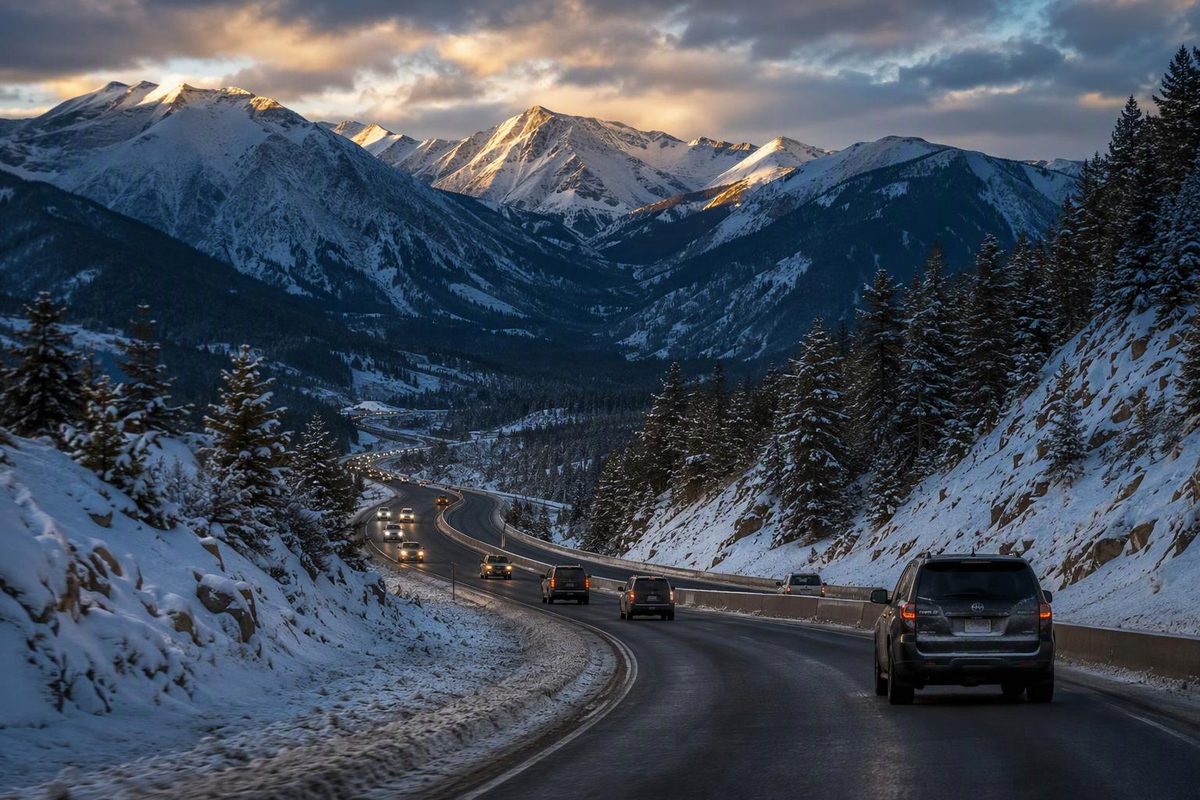
Breckenridge is about 80 miles from central Denver by road. In clear weather and light traffic, allow roughly 1.5 to 2 hours each way. From Denver International Airport (DEN), the trip is about 104 miles and approximately 2 hours before delays or stops. The Breckenridge Tourism Office publishes the same city and airport estimates.
Choose your starting point and trip type to see the applicable distance and planning range.
Denver–Breckenridge Trip Range
Central Denver to Breckenridge
About 80 miles one way
Traffic, snow or a crash can add considerably more time.
View all published trip ranges
| Trip | Distance | Plan for |
|---|---|---|
| Central Denver, one way | About 80 mi | 2–3 hr |
| DEN, one way | About 104 mi | 2.5–3.5 hr |
| Central Denver, round trip | About 160 mi | 4–6+ hr |
Source: Breckenridge Tourism Office distance and base-time estimates; practical allowances shown in the article. Ranges are not fixed ETAs.
Denver–Breckenridge Distance And Drive Time
| Trip | Distance | Light Traffic | Plan For |
|---|---|---|---|
| Central Denver to Breckenridge | About 80 miles | 1.5–2 hours | 2–3 hours |
| Denver airport to Breckenridge | About 104 miles | About 2 hours | 2.5–3.5 hours |
| Denver–Breckenridge round trip | About 160 miles | 3–4 hours | 4–6 hours or more |
These planning ranges are not guaranteed arrival times. A crash, snowstorm, road closure or peak weekend traffic can add considerably more time. The distinction matters because a navigation app’s uncongested estimate describes driving time, while a practical itinerary also needs room for changing road conditions, stops and congestion.
The 80-mile figure applies to a trip beginning in central Denver. Your actual mileage will vary with the starting address, the road used to reach I-70 and the destination within Breckenridge. The 104-mile airport estimate is more useful for someone going directly from DEN rather than first visiting central Denver.
For a same-day trip from central Denver, the round-trip road distance is about 160 miles. Under favorable conditions, that represents three to four hours behind the wheel. A safer schedule reserves four to six hours or more for the driving portion, especially when the trip falls on a ski-season weekend, a holiday or a day with uncertain mountain weather.
The Standard Route Uses I-70 And CO 9
From Denver, take I-70 west into the mountains. The route passes Golden and Idaho Springs, climbs toward the Eisenhower–Johnson Memorial Tunnel and then descends into Summit County. Leave I-70 at Exit 203 in Frisco, then follow CO 9 south for about nine miles into Breckenridge.
This is the normal direct highway route rather than a leisurely alternative through the mountains. Most of the distance is covered on I-70, but the final approach leaves the interstate at Frisco. Drivers should watch for Exit 203 rather than assuming I-70 continues directly into Breckenridge.
The mileage can make the drive appear comparable to an ordinary 80-mile freeway journey. The road itself is more demanding. It includes long grades, high-elevation weather and a major mountain crossing. CDOT characterizes the I-70 Mountain Corridor as a challenging drive and provides road reports and camera access through its I-70 travel page.
Mountain conditions can also change between Denver and Summit County. Dry pavement near the city does not establish what conditions will be near the tunnel, Frisco or Breckenridge. Check the corridor rather than relying only on the weather visible at the starting point.
Ninety Minutes Is A Best-Case Estimate, Not A Schedule
The low end of the published driving range is roughly 1.5 hours from central Denver. That is useful as a light-traffic estimate, but it is too narrow for a firm appointment, ski lesson, lodging check-in or return flight. It leaves little tolerance for a stop, congestion or deteriorating road conditions.
A two-to-three-hour one-way allowance from central Denver is more practical for routine planning. From DEN, use approximately 2.5 to 3.5 hours rather than treating the two-hour estimate as a promise. These ranges still cannot account for an active crash, closure or severe storm.
Starting at the airport also changes the nature of the trip. The published airport distance is about 104 miles, compared with about 80 miles from central Denver. Anyone collecting baggage, renting a vehicle or waiting for other passengers must account for that separately; those activities are not part of the stated highway driving time.
The same distinction applies on the return. A nominal three-to-four-hour central Denver round trip can take four to six hours or more when realistic margin is included. The added allowance should remain uncommitted rather than being filled with another tightly timed activity.
Weekend Direction Determines The Main Traffic Risk
Westbound congestion builds as travelers leave Denver for the mountains. Eastbound congestion builds as they return. Weekends and holidays are the main concern, although the exact pattern changes with the season, weather and incidents on the road.
The regional GoI70 travel forecast says the corridor’s heaviest volumes occur around holidays and on January and February weekends. Weekend traffic can occur throughout ski season, and weather or crashes can sharply increase delays. The forecast is updated on Thursdays for the coming weekend.
For a winter day trip, leaving early can reduce exposure to westbound traffic. The return may still be slower, particularly on a Sunday afternoon when mountain visitors are heading toward Denver. An early outbound drive therefore does not guarantee an equally quick drive home.
The issue is not limited to winter skiing. Summer holidays, road work and fall-color traffic can also produce long queues. A clear forecast removes one source of uncertainty, but it does not remove demand-related congestion or incident risk.
Before committing to a departure time, compare the GoI70 weekend forecast with CDOT’s live corridor information. The forecast is useful for expected traffic patterns; road reports and cameras show what is occurring closer to departure. Neither turns a planning range into a fixed ETA, but together they give a better basis than distance alone.
Winter Trips Require A Vehicle And Tire Check
Colorado’s traction law is in effect on the I-70 Mountain Corridor between Morrison and Dotsero every year from September 1 through May 31, regardless of the weather at the moment of departure.
Under CDOT’s traction-law guidance, AWD and 4WD vehicles must have at least 3/16 inch of tread on qualifying winter, mud-and-snow or manufacturer-rated all-weather tires. A vehicle that does not meet the applicable standards must use chains or an approved alternative traction device on at least two drive tires.
Four-wheel drive by itself is not enough to establish compliance. The tire markings and tread depth also matter. A driver borrowing or renting a vehicle should not infer the tire specification from the vehicle class or exterior badging.
If the plan depends on chains or another traction device, confirm that the equipment is approved and correctly sized before reaching the mountain corridor. A rental vehicle adds another constraint: the device must also be permitted under the rental agreement. Equipment that cannot be installed or is contractually prohibited is not a workable contingency.
During a severe storm, CDOT can activate the stricter Passenger Vehicle Chain Law. Every vehicle must then use chains or an approved alternative traction device. CDOT describes that requirement as the final safety measure before a highway closure.
That escalation changes the decision from ordinary trip preparation to whether the trip should proceed at all. If a major storm coincides with the drive, postponing or using a shuttle may be more practical than taking an unfamiliar vehicle onto I-70. A legal minimum does not eliminate the difficulty of grades, limited visibility or rapidly changing pavement conditions.
Immediately before leaving, open current road reports and cameras from CDOT’s I-70 page. Check again before the return drive because conditions may have changed while you were in Breckenridge. The relevant information is the state of the full corridor, not only conditions in Denver or at the destination.
A Day Trip Works When The Return Remains Flexible
Breckenridge is a reasonable day trip from Denver when the weather is stable and the schedule avoids peak traffic. The 80-mile one-way distance is short enough to leave substantial time in town, on trails or skiing when the road moves normally.
The deciding factor is usually not mileage but schedule tolerance. A day trip works best when a delayed arrival does not ruin a reservation and a slow return does not create a hard conflict. If the day depends on both drives staying near the minimum estimate, the itinerary has little resilience.
Preserve at least four hours for the round-trip drive from central Denver on a same-day visit. That is the bottom of the practical round-trip allowance, not a worst-case ceiling. Use considerably more margin on busy weekends or when snow is forecast.
A traveler whose primary goal requires arriving at a precise morning time may be better served by staying closer to Breckenridge the previous night. The same applies when a Sunday-afternoon return must connect with an inflexible evening commitment. The route can be straightforward while the timing remains uncertain.
For a casual visit, the flexibility is easier to manage. An early start, a check of the corridor and an adjustable return time create room for the drive to take longer than the light-traffic estimate. If conditions deteriorate before departure, the day trip can be postponed without disrupting a larger itinerary.
Parking Once Reduces Driving Within Breckenridge
Once in Breckenridge, parking once and using local transit can simplify the visit. The tourism office lists the Breckenridge Free Ride, Main Street Trolley and Summit Stage among its car-free transportation options.
Local parking and transit time are separate from the Denver-to-Breckenridge highway estimate. Reaching town does not mean the vehicle is parked or that everyone has arrived at the final stop. Check current parking information and bus schedules before leaving Denver so the arrival plan does not depend on finding an unspecified space.
This approach is particularly useful for a day trip with several stops around town. It avoids repeatedly moving the vehicle after the mountain drive and makes the return departure easier to organize. It does not shorten I-70, but it can keep local circulation from consuming more of the limited time at the destination.
Use Conditions, Not Mileage Alone, For The Go Decision
For a routine trip from central Denver, start with about 80 miles and 1.5 to 2 hours, then plan on two to three hours. From DEN, start with about 104 miles and two hours, then reserve 2.5 to 3.5 hours. For a central Denver round trip, expect about 160 miles, with four to six hours or more kept available for driving.
Before departure, make three separate checks: the GoI70 traffic forecast, CDOT’s live reports and cameras, and the vehicle’s traction compliance. Each answers a different part of the trip decision. Forecast traffic affects scheduling, live reports show current corridor conditions, and the vehicle check determines whether the planned transportation is suitable for the seasonal requirements.
If all three support the trip, the standard I-70 and CO 9 route is direct and a same-day visit is practical. If severe weather, a closure or unsuitable equipment changes that assessment, the published 80-mile distance does not make the drive dependable.