
Slow a Spreading Windshield Crack Without Making Repair Harder
Tape and careful driving only buy time; professional resin repair or replacement addresses the damage itself. Protecting it for now is not a repair.
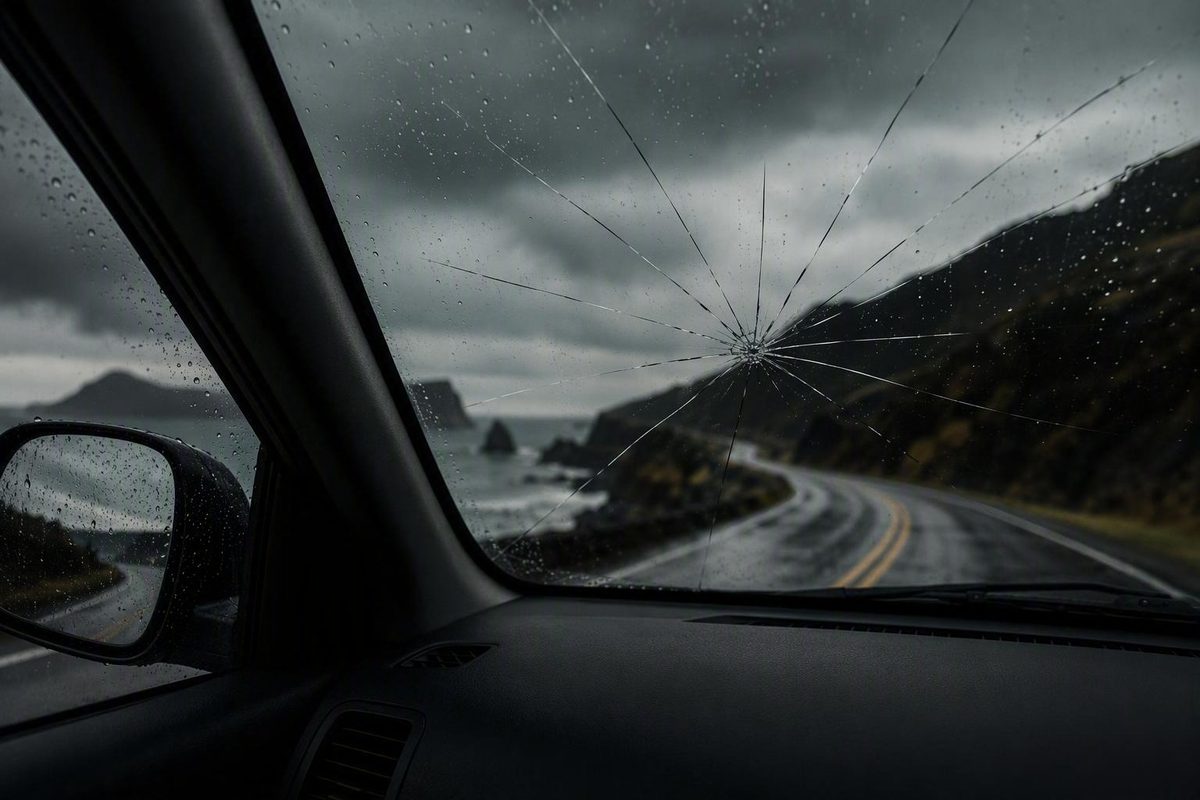
No temporary measure can guarantee that a windshield crack will stop expanding. You may be able to buy time by keeping clean, dry damage uncontaminated, moderating temperature changes, and reducing vibration, but professional resin repair is the usual way to stabilize damage that remains repairable. Damage that cannot appropriately be repaired requires windshield replacement.
The immediate priorities are simple: protect your view, do not press on the glass, avoid abrupt heating or cooling, drive only as conditions warrant, and arrange an auto-glass assessment promptly.
This article provides general information for motorists. It cannot diagnose the damage or determine whether a particular windshield is safe to drive, repairable, or due for replacement.
What to do in the first few minutes
If you have just found a chip or crack, park safely in shade or a garage when practical. Do not touch the damaged area, test it with your finger, press tape firmly into it, or push on the glass from inside the vehicle.
Look at the damage without pressing on the windshield:
- Does it obstruct or distort your view?
- Is it touching an edge of the windshield?
- Is it branching or visibly getting longer?
- Are there multiple impact points?
Any of these conditions warrants prompt professional guidance rather than reassurance that you can continue driving normally. Do not try to determine visually which glass layers are affected; depth and layer involvement require technician assessment.
Keep the damaged area clean and dry. If it is already clean, dry, and outside the driver’s field of view, you can place transparent packing tape lightly over the exterior damage to reduce the entry of water, dust, and road debris.
Tape does not hold the windshield together, restore its strength, or guarantee that the crack will stop growing. It is only a temporary contamination-control measure while service is arranged. Do not put tape where it interferes with visibility, and do not press hard enough to flex the glass.
If the crack begins lengthening while you are moving:
- Keep your attention on traffic rather than watching the crack.
- Reduce speed smoothly without braking or steering abruptly.
- Avoid potholes, rough shoulders, and sudden maneuvers.
- Pull over in a safe location.
- Contact an auto-glass professional or roadside service before continuing a long drive.
Safelite’s temporary-crack guidance similarly recommends avoiding abrupt temperature changes and road stress, keeping clean damage protected, and seeking professional attention rather than treating temporary precautions as a repair (Safelite’s windshield-crack guidance).
A compact first-response checklist:
- Protect visibility: Do not cover an area you need to see through or continue normally when damage obstructs your view.
- Stabilize temperature: Move into shade when practical and change cabin temperature gradually.
- Minimize vibration: Avoid rough roads, sudden maneuvers, and unnecessary driving.
- Prevent contamination: Keep clean, dry damage lightly covered if doing so will not obstruct vision.
- Book an inspection: Do not wait for the crack to prove that it can spread.
Why a small crack can expand without warning
A typical windshield is laminated glass: two glass layers bonded around a plastic interlayer. When an impact damages the outer glass, the chip or crack becomes a point where stress can concentrate. Expansion, contraction, vibration, pressure from driving, and movement of the vehicle body may then extend the damage (Auto Glass Now’s explanation of laminated windshields and crack growth).
Common aggravating factors include:
- Abrupt changes between hot and cold
- Potholes, speed bumps, gravel roads, and rough pavement
- Vehicle-body flex over uneven surfaces
- Moisture entering the damaged area
- Dust and debris collecting in the crack
- Slamming a door, hatch, or trunk
- Pressure and vibration during driving
- Automatic washes and high-pressure water
Temperature matters because different parts of a windshield can heat or cool at different rates. Directing very cold air at sun-heated glass or intense defroster heat at frozen glass can add stress around an existing weak point. There is no supported universal temperature threshold at which a crack must spread, so an exact temperature-change figure should not be treated as a rule.
Contamination matters for a different reason. Water, dirt, and other debris can enter the damaged area. Even if they do not immediately lengthen the crack, they may make a clean professional resin repair more difficult later.
Damage close to an edge deserves particular attention. Auto-glass provider guidance associates edge-adjacent cracks with greater stress and a tendency to progress more quickly, although a technician must still assess the individual windshield and damage pattern (Auto Glass Now’s discussion of edge damage and crack growth).
Do not rely on a predicted timeline. A crack may appear unchanged for a period and then extend after a pothole, temperature change, or ordinary drive. Available guidance does not establish a universal number of safe hours, days, or miles.
Clear tape: contamination control, not a repair
Clear tape may help keep moisture, dust, and debris out of clean damage. It does not structurally stabilize the windshield.
Use tape only when all of the following are true:
- The damage is clean.
- The glass and damaged area are dry.
- The tape will remain outside the driver’s field of view.
- Applying it will not require pressure on the glass.
- You are using it while arranging an inspection, not instead of one.
Transparent packing tape is preferable to opaque tape because it is easier to see through and makes changes around the damage easier to notice. Cut a piece large enough to cover the exterior damage, lay it down lightly, and avoid rubbing or forcing it into the crack. Do not use tape that creates glare, wrinkles, or an obstruction in any area needed for safe visibility.
If the damage contains water or visible dirt, do not automatically seal it. Trapping contaminants may hinder later resin bonding. Keep the vehicle sheltered if practical and ask an auto-glass provider how to proceed.
It helps to separate three different responses:
- Tape limits contamination. It is a short-term protective cover.
- Resin may stabilize repairable damage. A technician introduces purpose-made resin into suitable damage and cures it.
- Replacement removes damaged glass that should not be repaired. This may be necessary because of the damage’s depth, location, pattern, edge involvement, number of impact points, or effect on visibility.
Tape belongs only in the first category. It should not be used to justify postponing an assessment indefinitely.
How to reduce heat, cold, vibration, and pressure
Until the windshield is inspected, the goal is to avoid preventable stress. None of these precautions can guarantee that the crack will remain stable.
| Situation | Do | Don’t |
|---|---|---|
| Parking and climate controls | Use shade or a garage when practical. Change cabin and windshield temperature gradually. | Leave the windshield in intense sun when shelter is readily available, or aim immediate maximum heater, defroster, or air-conditioning output at the damage. Commercial provider guidance recommends gradual temperature changes rather than concentrated hot or cold airflow (Chip Pro Autoglass’s temperature precautions). |
| Road choice, handling, and trip planning | Choose smoother pavement when reasonable. Accelerate, brake, steer, and cross speed bumps gently. Limit unnecessary high-speed and long-distance travel. | Take rough or pothole-heavy roads unnecessarily, drive aggressively, or assume one particular speed or distance is universally safe. Rough roads, bumps, vibration, and higher-speed pressure are identified as potential aggravating factors. |
| Washing and vehicle closures | Wait for assessment before washing the windshield. Close doors, the hatch, and trunk softly. | Use an automatic or high-pressure car wash, press on the glass while cleaning, or slam doors and other panels. Water pressure, physical pressure, and trapped moisture may worsen damage or complicate repair. |
In hot weather
Park in shade when practical. If the vehicle has been sitting in the sun, begin cooling the cabin gradually rather than immediately directing maximum air conditioning at the windshield.
The purpose is to reduce abrupt, uneven contraction around the damaged area—not to reach one supposedly safe temperature. No particular cabin setting guarantees that a crack will remain stable.
In freezing weather
Warm the cabin and windshield gradually. Never pour hot water onto a frosted or iced windshield because the abrupt temperature difference can add stress to already damaged glass.
You may still need the defroster for visibility. The prudent response is not to sacrifice visibility but to increase heat progressively instead of immediately applying intense output to one portion of the glass.
On the road
Choose smoother roads when a reasonable alternative exists, cross speed bumps gently, and leave enough following distance to reduce the need for abrupt braking or steering. Avoid unnecessary high-speed or long-distance driving because wind pressure, vibration, and road impacts may aggravate damaged glass. No particular speed can be declared universally safe.
Close doors, the hatch, and trunk softly. Skip automatic and pressure washes until the windshield has been assessed.
These are stress-reduction measures, not crack-stopping technology. Suggestions such as opening side windows or covering the entire vehicle are not supported consistently enough to present as proven ways to control a windshield crack.
When driving should be minimized or stopped
There is no responsible blanket answer to whether you can drive with a cracked windshield. The risk depends on the crack’s location, extent, branching, rate of change, effect on visibility, and professionally assessed depth.
Treat the situation as urgent if the damage:
- Is actively spreading
- Reaches or closely approaches an edge
- Has branches or a spiderweb pattern
- Crosses the primary sight line
- Creates glare, refraction, or visual distortion
- Includes multiple chips or cracks
- Changes after a minor bump or temperature shift
- Raises any concern about depth or layer involvement that has not been professionally assessed
Damage that obstructs or distorts the driver’s view should not receive generic reassurance about continued driving. If you cannot see the road, signs, pedestrians, cyclists, or surrounding traffic clearly, do not treat tape or slower driving as an adequate solution. Safelite advises addressing actively spreading, edge-adjacent, or view-obstructing cracks before driving (Safelite’s driving and crack-safety guidance).
If a crack grows while you are driving, reduce speed smoothly, avoid jolts, and pull over safely. Contact an auto-glass technician or roadside service. For severe or uncertain damage, ask whether the vehicle should be driven to a shop, handled by a mobile technician, or transported. A universal towing rule would ignore meaningful differences among windshields, damage patterns, and vehicles.
Cracked-windshield laws and vehicle-inspection requirements vary by jurisdiction. Check the official rules that apply where the vehicle is registered and where you are driving rather than relying on guidance written for another state or province. Commercial automotive guidance also cautions that driving and inspection requirements are jurisdiction-specific (AutoZone’s windshield-crack guide).
Repair or replacement: use the damage pattern, not one length rule
Do not decide repairability with a ruler alone. A technician considers:
- Shape and crack pattern
- Overall size
- Depth
- Location
- Proximity to an edge
- Cleanliness and moisture
- Branching
- Number of impact points
- Whether the driver’s primary view is affected
- Which glass layers are damaged
Small, fresh, clean, simple damage away from the edge and the driver’s primary sight line is more likely to be considered for resin repair. That is a screening description, not a promise of eligibility.
Edge-reaching, branching, deep, multiple, actively growing, or view-obstructing damage is more likely to require replacement or urgent assessment. Safelite identifies shape, size, depth, location, multiple damaged areas, edge-spanning cracks, and penetration through both glass layers as factors in repair-versus-replacement decisions (Safelite’s repair and replacement criteria).
A driver should not try to confirm laminate condition or layer involvement by appearance alone. A technician must determine the damage’s depth and which layers are affected.
Published size comparisons conflict. AAA uses a crack covered fully by a dollar bill as a general repair-screening example, while emphasizing that a glass technician should make the actual decision. AAA also notes that resin repair can leave a visible mark even when the damaged area has been stabilized (AAA’s repair and replacement guidance).
Other provider guidance mentions limits around three inches, six inches, or a range between the two. These are provider-specific screening rules rather than universal technical standards, and they can vary with crack type, equipment, location, contamination, and technician practice (Soldier Glass’s provider screening guidance).
Professional repair generally involves introducing purpose-made resin into suitable damage and curing it. The intent is to fill and stabilize the damaged area against further progression. A successful repair may still leave a mark, shadow, or optical blemish; structural stabilization and cosmetic invisibility are not the same outcome.
Use this matrix only for non-diagnostic triage. The final decision belongs to the technician examining the actual windshield.
| Likely repair candidate | Urgent professional assessment | Likely replacement candidate |
|---|---|---|
| Small, fresh, simple chip or short crack | Damage close to an edge | Crack reaching or spanning an edge |
| Clean and dry damage | Damage changing in length | Technician-confirmed penetration through both glass layers |
| One uncomplicated impact area without branching | Uncertain depth or layer involvement | Deep or extensively branched damage confirmed during assessment |
| Away from the primary sight line | Damage creating glare or visual distortion | Damage materially obstructing the driver’s view |
| No visible progression | Multiple nearby impact points | Multiple or overlapping damaged areas |
| Damage not touching an edge | Dirt or moisture in the damage | Damage a technician determines cannot be filled appropriately |
A “likely repair candidate” still needs professional evaluation. Conversely, a crack that exceeds one provider’s size guideline is not automatically beyond repair everywhere. Location, depth, contamination, and pattern may matter more than a single length measurement.
DIY resin kits and household fixes
Purpose-made windshield resin kits are different from superglue, clear nail polish, silicone, and other household substances.
A DIY resin kit may be considered only when the damage is small, fresh, simple, and explicitly covered by the kit manufacturer’s instructions. It should not be used to delay professional attention to spreading, branched, edge-reaching, multiple, uncertain-depth, or view-obstructing damage.
Although kit designs differ, the broad process may involve:
- Preparing or cleaning the area exactly as directed
- Positioning the supplied applicator or injection device
- Applying the included windshield resin
- Curing it under the conditions specified by the manufacturer
- Removing excess material as instructed
Do not substitute a generic procedure for the instructions supplied with the product. Temperature, curing method, applicator placement, preparation, and eligible damage patterns can differ among kits.
Poor application may trap air, leave bubbles or optical distortion, create an inadequate seal, or make a later professional repair more difficult. If you expect to pursue professional resin repair, ask the technician before injecting anything yourself. Consumer guidance on DIY kits similarly warns that incorrect application can leave bubbles, impair visibility, or allow damage to keep spreading (Mossy Nissan Poway’s comparison of DIY kits and professional service).
Avoid these improvised methods:
- Superglue
- Clear nail polish
- Silicone or household sealant
- Drilling at the end of the crack
- Heating the glass or crack
- Pressing material into the damaged area
Even commercial advice that discusses superglue or nail polish as emergency measures warns that these substances can make later professional repair difficult or impossible (Only 1 Auto Glass’s warning about improvised sealants).
A DIY kit should not be assumed to restore the windshield’s original strength, permanently repair every small crack, or perform like professional resin injection. Suitability depends on the exact damage, the product, and correct application.
Booking service, checking insurance, and protecting ADAS functions
Arrange an assessment promptly rather than waiting to see whether the crack grows. When contacting an auto-glass provider, be ready to describe the damage and, if requested, provide clear photographs from inside and outside without pressing on the glass.
Ask the provider:
- Is this damage suitable for resin repair, or is replacement recommended?
- What factors led to that recommendation?
- Could a visible mark or optical blemish remain after repair?
- What warranty applies to the work?
- Is mobile service appropriate for this damage and location?
- Does my insurer require authorization or a particular claim process?
- If replacement is needed, what glass specification will be installed?
- Does the vehicle require calibration of windshield-mounted cameras or sensors?
- Can the provider perform the required calibration, or will another facility handle it?
- What documentation will I receive?
If your policy may provide glass coverage, contact the insurer before authorizing work. Coverage, deductibles, authorization requirements, and claim procedures depend on the individual policy and jurisdiction. Repair is generally less expensive than replacement, but costs vary with the damage, location, vehicle design, glass type, embedded technology, and calibration needs (Independent Glass Association’s consumer guidance).
Do not assume comprehensive coverage will pay the entire amount. Confirm the deductible, covered service, approved provider requirements, and authorization procedure directly with the insurer. Whether a claim affects future premiums is policy- and insurer-specific and should be addressed to the insurer rather than inferred from general glass-repair advice.
Vehicles with windshield-mounted cameras or sensors may require advanced driver-assistance system recalibration after replacement. Mobile replacement capability by itself does not establish that a provider can perform every required calibration accurately; AAA advises owners to verify calibration capability when windshield-mounted technology is involved (AAA’s guidance on windshield sensors and calibration).
After service, keep:
- The itemized invoice
- The repair or replacement warranty
- Glass specification or part information
- The calibration report, if applicable
- Insurer authorization and claim records
If the crack appears during a road trip, do not rely on tape and careful driving for the remainder of a long journey. Look for a qualified local shop or mobile provider. Ask whether a technician can assess the damage where the vehicle is parked and whether any required calibration can be completed or appropriately referred.
Frequently asked questions
Will clear packing tape keep a windshield crack from getting bigger?
Not reliably. Clear packing tape can help keep moisture, dirt, and debris out of clean, dry damage, which may preserve the possibility of a cleaner resin repair. It does not hold the windshield together, restore strength, or structurally stop the crack.
Use it lightly on the exterior only when it will not obstruct the driver’s view. Do not seal wet or dirty damage without asking an auto-glass provider, and do not treat tape as a reason to postpone inspection.
Can I use the heater, defroster, or air conditioner with a cracked windshield?
Yes, when needed for visibility and comfort, but change the temperature gradually. Avoid directing an immediate, intense blast of hot or cold air at the damaged area.
On a cold day, increase cabin heat and defrost output progressively. On a hot day, cool the cabin gradually instead of aiming maximum air conditioning at sun-heated glass. Never pour hot water on frosted glass.
How long can a windshield crack stay stable before it spreads?
There is no universal answer. A crack may appear unchanged for a period or extend suddenly after a temperature change, pothole, vibration, or ordinary drive. No evidence-based waiting period establishes that a cracked windshield will remain stable for a particular number of hours, days, or miles.
Schedule an assessment based on the damage you have now—not on whether it has already demonstrated visible growth.
Can a long or edge-reaching windshield crack be repaired?
Possibly in some circumstances, but it needs prompt professional evaluation. Provider screening limits conflict, so no single length is a universal cutoff. Edge contact, branching, contamination, sight-line location, multiple impacts, and technician-assessed depth or layer involvement can outweigh length alone.
Edge-reaching, deep, branched, actively growing, or view-obstructing damage is more likely to require replacement. Penetration through both layers of laminated glass is also treated as a replacement indicator in the supplied provider guidance, but a technician must determine whether that penetration has occurred.
Does windshield replacement require camera or ADAS recalibration?
It may. If the vehicle has a camera or sensor mounted on or aimed through the windshield, replacement can affect its position or optical path. Ask the provider to check the vehicle manufacturer’s procedure and determine whether static calibration, dynamic calibration, or both are required.
Do not assume that every mobile replacement provider can complete every calibration. Request documentation showing what was performed.
The action hierarchy is straightforward: keep clean and dry damage uncontaminated, moderate windshield temperature gradually, reduce vibration and pressure, and arrange an auto-glass assessment promptly. Tape and careful driving only buy time; professional resin repair or replacement addresses the damage itself. Do not continue a long trip without professional guidance when a crack is spreading, touching an edge, branching, obstructing vision, or raising concern about deeper glass-layer involvement.