
When a Windshield Crack Means You Should Stop Driving
The practical danger may be rapid visibility loss, extensive spidering, sagging or severe distortion rather than a dramatic shower of glass.
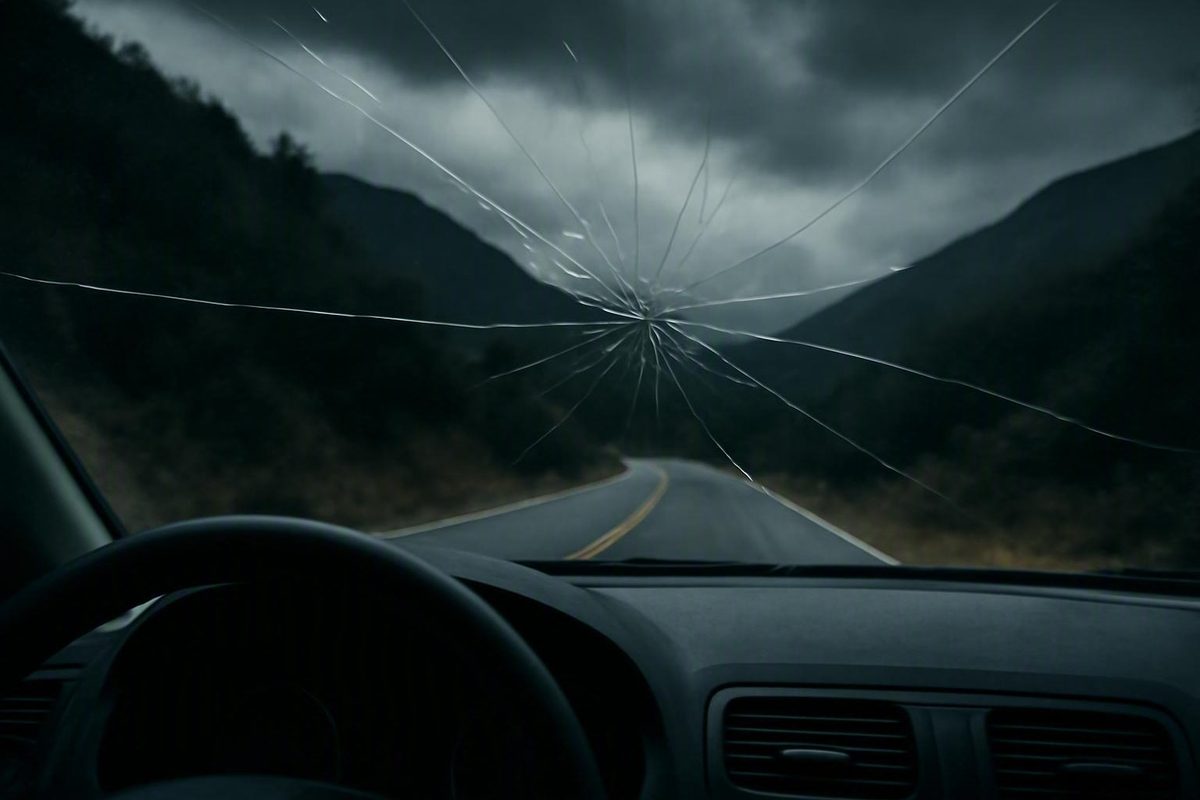
The short answer: assess the crack before you keep driving
Driving with a cracked windshield can be dangerous, but a crack does not automatically make every vehicle undrivable. The immediate concern depends on:
- Whether the damage blocks the driver’s view
- Whether it creates glare, double images, or optical distortion
- Whether it is growing or branching
- Whether it reaches or appears to start at an edge
- Whether there are multiple damaged areas
- Whether the glass appears to sag, flake, loosen, or otherwise worsen
Visibility comes first. Damage in the driver’s primary viewing area can obscure vehicles, pedestrians, signs, lane markings, or other hazards. Even when the crack does not completely hide an object, reflected light and distortion can make the road harder to interpret. Those effects may become more pronounced in rain, darkness, low sun, or oncoming headlights. Commercial automotive guidance identifies sightline obstruction, glare, spreading damage, and edge or camera-area damage as reasons for prompt assessment, although it does not establish a universal safe crack size or driving period. Toyota of Bristol discusses visibility and glare concerns associated with windshield cracks.
Use this three-level decision framework:
- Stop driving and arrange help. Do this when the damage substantially blocks or distorts your view, rapidly spreads into the viewing area, develops extensive spidering, or leaves the glass sagging, flaking, or visibly unstable. If this happens while moving, pull over as soon as you can do so safely.
- Consider only a limited trip to nearby service. This may be reasonable when the damage is small and stable, lies outside the driver’s viewing area, causes no glare or distortion, does not appear to be spreading, and has no other severe warning signs. This is a conditional judgment, not proof that the windshield is safe.
- Arrange prompt inspection. Even if a chip or short crack does not seem to impair immediate driving, do not treat it as harmless or postpone assessment indefinitely.
There is no universally safe distance, speed, number of days, or crack-length cutoff. Location and optical effects may matter more than length alone, while depth can be difficult to judge from the driver’s seat. Do not assume that you can determine whether one or both layers of laminated glass are affected.
If you discover damage while parked, inspect it from inside and outside without pressing on the glass. Sit in your normal driving position and look through the affected area toward objects at different distances. Consider the conditions you will actually encounter, not only how the crack appears in a shaded driveway.
If there is meaningful uncertainty about your view, rapid spreading, edge involvement, or the condition of the glass, choose mobile glass service or roadside help rather than testing the vehicle on the road.
This is a conservative triage guide, not an engineering inspection. Most available consumer guidance in the supplied evidence comes from automotive-glass companies, dealerships, or related service organizations with commercial interests. Their recommendations can help identify warning signs, but they are not universal engineering, manufacturer, or legal standards.
Stop-driving warning signs
Do not begin or continue a trip merely because the windshield remains in one piece. Base the decision primarily on what the damage is doing to your vision and whether it appears to be worsening.
Avoid driving, or pull over as soon as it is safe, when:
-
The crack, chip, or star break substantially blocks the driver’s sightline
-
The crack visibly expands while the vehicle is moving
- Branches spread into extensive spidering across the viewing area
- The affected glass sags, flakes, bows inward, or appears loose
- Rain, headlights, or low sun make it impossible to see the road clearly through the damaged area
- Multiple damaged areas leave too little clear glass for an unobstructed view
Commercial glass guidance also treats edge-reaching cracks, multiple cracks, spidering, sagging, and distortion as serious warning signs. Edge involvement alone is not established here as a universal rule that every vehicle must immediately stop, but it is a strong reason not to assume that even a short trip is prudent. Auto Glass Now describes laminated glass and warning signs associated with severe crack patterns.
Do not rely on length alone. A shorter crack in the driver’s viewing area may be more disruptive than a longer one elsewhere. The pattern, location, apparent growth, optical effects, and number of damaged areas can be more useful for immediate triage than a popular size rule.
Weather and lighting can change the decision. Damage that looks unobtrusive while the car is parked may scatter low-angle sunlight. At night, branches can catch approaching headlights. Rain and road spray add reflections and reduce contrast, while fog, snow, and a dirty windshield further reduce the clear area available to the driver.
If a crack suddenly spreads into your viewing area while you are moving:
- Keep your steering inputs smooth.
- Ease off the accelerator rather than braking abruptly unless traffic conditions require it.
- Signal and move toward a safe parking area, shoulder, or exit as conditions allow.
- Use hazard lights when appropriate.
- Stop once you are safely out of moving traffic.
- Arrange roadside assistance or mobile glass service if your view remains impaired.
If the windshield remains physically in place but you can no longer see the road clearly, that is still a stop-driving condition. Do not lean sideways, peer around the crack, or continue merely because the destination seems close.
Avoid pressing the damaged area to see whether it flexes. Do not tap it, trace it with a hard object, or use extreme climate-control settings as a test. A visual check is useful for triage, but it cannot reliably establish the depth or technical repairability of the damage.
Damage near a windshield-mounted camera requires a separate judgment from human visibility. If the driver’s view remains clear but a dashboard warning appears or a driver-assistance feature behaves abnormally, do not rely on the affected feature. Consult the owner’s manual and arrange prompt vehicle-specific assessment. Without manufacturer guidance for the particular vehicle, an ADAS warning alone should not be presented as a universal stop-driving rule.
Can you drive a short distance to a repair shop?
A brief trip to a nearby glass technician may be reasonable only in a narrow, lower-risk situation. All of the following should be true:
- The chip or short crack appears small and stable
- It is outside the driver’s primary viewing area
- It produces no noticeable glare, double image, or distortion
- It is not visibly growing or branching
- There are no multiple cracks or widespread spidering
- The glass is not sagging, flaking, or visibly unstable
- Weather and lighting provide good visibility
- The route is short and avoids unnecessary exposure
If the damage appears to reach an edge, seek urgent professional advice before assuming that a service trip is appropriate. Mobile service is the more conservative choice when available.
Even in a lower-risk case, the trip is not a declaration that the windshield is safe. It is a limited judgment that reaching nearby professional service may be preferable to routine continued use. Commercial sources differ in how strongly they discourage any continued driving, but they agree that sightline obstruction, spreading damage, and severe patterns require prompt attention. Ceramic Pro summarizes common urgent-warning and limited-driving considerations.
Passenger-side damage may present less immediate obstruction than a crack directly in front of the driver, but “passenger side” does not mean harmless. The crack can spread toward the driver’s view, create reflected glare, approach an edge, or lie within the viewing area of equipment mounted behind the windshield.
Choose mobile service or roadside assistance instead of driving when the route would involve:
- Freeway or sustained high-speed travel
- Heavy rain, snow, fog, or road spray
- Night driving or strong headlight glare
- Low sun directly ahead
- Extreme heat or cold
- Rough pavement, construction, or numerous potholes
- A remote road with limited safe stopping places
- Damage that has changed since you first noticed it
- Uncertainty about whether your view will remain clear
If a limited service trip appears reasonable, go directly. Do not combine it with commuting, shopping, school pickup, or other errands. Avoid a long detour to a preferred provider when a closer qualified option or mobile technician is available.
Call the provider before leaving. Describe the location and pattern, whether it appears to touch an edge, whether it has grown, and whether the vehicle has equipment mounted behind the windshield. A photograph may help the shop prepare, but it cannot guarantee repairability or establish that driving there is prudent.
No evidence supplied here supports promises that a cracked windshield is safe for a certain number of miles, days, or highway speeds. A crack that appears stable while parked may still change after a pothole, temperature swing, or another debris strike.
The practical question is not merely whether the vehicle can move. It is whether you can maintain a clear, undistorted view and whether a direct trip to nearby service is preferable to having service come to the vehicle. If the answer is uncertain, do not drive it.
Why a small chip or crack can get worse
Once windshield damage exists, ordinary driving can provide opportunities for it to spread. Supported triggers include:
- Road vibration
- Potholes and sharp bumps
- Vehicle-body flex on uneven surfaces
-
Another stone or debris strike
-
Rapid changes in glass temperature
Temperature differences matter because the windshield may not heat or cool evenly. Very hot defroster air directed at deeply chilled glass can warm the inner surface quickly. Aggressive air conditioning against a windshield heated by strong sun creates the opposite contrast. Commercial automotive-glass guidance warns that heat, climate-control changes, road vibration, potholes, and additional impacts may enlarge existing damage. Speedy Glass summarizes common crack-propagation conditions.
While waiting for service:
- Increase heat or air conditioning gradually.
- Avoid immediately directing maximum-temperature airflow at the damaged area.
- Close doors, the hood, hatch, and trunk gently.
- Avoid rough roads and potholes where a safe alternative exists.
- Leave additional following distance behind traffic likely to throw gravel or debris.
- Do not scrape directly across the damage with a hard tool.
- Do not press on the crack while cleaning the glass.
These precautions may reduce avoidable stress, but they cannot stabilize the windshield or guarantee that the crack will remain unchanged. Treat them as temporary risk reduction while arranging service, not as permission for routine use.
Delay may also change the available service options. A compact chip or limited crack may be eligible for resin repair, depending on its shape, depth, location, and spread. If the damage lengthens, branches, reaches an edge, or develops additional impact points, replacement may become the more appropriate option.
Do not attempt to stop a significant crack by drilling into the windshield. Do not use a consumer resin product on spreading, edge-reaching, multiple, or sightline damage as a substitute for professional assessment. The supplied evidence does not establish that a do-it-yourself treatment can verify restored optical quality or technical suitability.
Repair or replacement: what determines the answer
Repairability is not the same as driving safety. A technician might determine that a blemish can accept resin, yet its position or the mark remaining after repair could still make it distracting in the driver’s view. Conversely, damage outside the sightline may be unsuitable for repair if it is deep, extensive, connected to an edge, or part of multiple damaged areas.
A technician generally considers:
- Shape: chip, bull’s-eye, star break, combination break, or linear crack
- Size: the central impact area and the spread of any branches
- Location: driver’s viewing area, passenger side, edge, or camera zone
- Depth: which parts of the laminated assembly appear affected
- Spread: whether the damage is isolated, branching, or lengthening
- Number: one impact point or several damaged areas
- Vehicle requirements: glass specifications and equipment mounted to or looking through the windshield
For eligible damage, repair generally involves preparing the area and injecting specialized resin. The goal is to fill the break and limit further progression. Repair does not necessarily make the blemish disappear. AAA explains general repair-versus-replacement considerations and the possibility of a visible mark after resin repair.
Factors that may favor repair include limited, shallow damage away from the primary sightline and away from problematic edge locations. Factors that may favor replacement include:
- Deep or extensive damage
- A crack connected to an edge
- Substantial spreading or branching
- Multiple damaged areas
- Severe spidering
- Placement where a remaining blemish would interfere with vision
The final decision depends on technician assessment and any applicable vehicle procedure. Safelite, for example, describes shape, size, depth, material, location, edge involvement, and multiple damage points as service-screening factors, but its criteria are provider practices rather than universal standards. Safelite outlines its repair-and-replacement screening process.
Consumer guidance often mentions a quarter-sized chip, a crack shorter than a dollar bill, or three- and six-inch limits. These measurements come from different providers and do not agree. Treat them as rough descriptions for an appointment request—not proof that a windshield is:
- Safe to drive with
- Technically repairable
- Legally compliant
- Suitable for a particular repair process
- Compatible with manufacturer requirements
A technician may reject a relatively small repair because of its location or depth. Another provider may use different screening criteria. No single measurement settles the safety or repair decision.
Ask the technician:
- Is repair technically appropriate for this damage?
- Will a visible mark or distortion remain?
- Is the damage in the driver’s critical viewing area?
- Does it involve the windshield edge?
- Are there signs that it is deeper than it appears?
- Are there multiple impact points?
- Does the manufacturer specify particular glass or installation procedures?
- Could camera or ADAS calibration be required after replacement?
- What work and calibration documentation will I receive?
Prompt assessment can preserve options. The objective is not simply to choose the least expensive immediate procedure; it is to restore a clear viewing surface using a process appropriate for the damage and the vehicle.
Why you should address the damage before a road trip
A road trip is the wrong setting in which to test how stable a windshield crack may be. Long-distance driving adds repeated vibration, changing pavement, temperature cycles, debris exposure, and more opportunities for weather or glare to reveal an optical problem.
Have the damage inspected—and repaired or replaced as appropriate—before departure. A chip that might have been repairable near home can spread during the trip and require replacement in an unfamiliar town.
A long drive can expose the glass to several changes in one day: a cool morning, direct afternoon sun, strong air conditioning, rain, construction, potholes, and sustained road vibration. None guarantees that the crack will spread, but each can provide an opportunity for existing damage to worsen. Speedy Glass recommends inspecting chips, star breaks, long cracks, pitting, edge damage, glare, and distortion before a road trip. Its road-trip guidance also warns that vibration, temperature changes, potholes, and debris may enlarge damage.
Highway conditions can test visibility differently from a parked inspection. Changing sun angles may illuminate fracture lines. Rain can produce reflections around the impact point. At night, headlights may scatter through branches. A mark that seemed unobtrusive in a driveway may become distracting during a curve, descent, or lane change.
Before departure, inspect the entire windshield from inside and outside for:
- Chips and impact pits
- Star-shaped breaks
- Long or branching cracks
- Damage meeting an edge
- Multiple damaged areas
- Pitting or abrasion that worsens glare
- Haze, double images, or distortion
- Loose or visibly damaged molding or seals
- Damage near a forward-facing camera
- Wiper wear that leaves the glass difficult to see through
Clean the glass so dirt is not mistaken for damage, but avoid forceful pressure on a cracked area. Check the view from your normal seating position and consider the likely travel conditions, including darkness, low sun, rain, mountain cold, desert heat, or construction zones.
A windshield review belongs alongside broader pre-departure checks. Road Listings recommends checking tires, fluids, and battery condition and carrying basic roadside equipment before a long drive. Its long-trip checklist covers those general preparations, but emergency equipment does not make damaged glass safe.
Mobile inspection is especially sensible if reaching a shop would itself require severe weather, poor visibility, extreme temperatures, highway travel, or a remote route without safe stopping areas.
If the damage cannot be assessed or addressed before departure, postponing the journey, changing vehicles, or using another form of transportation may be the prudent choice.
Windshield cameras and ADAS after replacement
Some vehicles have forward-facing cameras or other driver-assistance equipment mounted near the windshield or looking through a defined area of glass. Damage in that area deserves prompt assessment, but it does not automatically establish that every affected windshield must be replaced.
The answer depends on:
- The location of the damage
- Whether it creates optical distortion
- The vehicle and equipment involved
- The glass and installation procedure
- The manufacturer’s instructions
If a dashboard warning appears or a driver-assistance feature becomes unavailable or behaves abnormally, do not rely on that feature. Consult the owner’s manual and arrange appropriate service. Human visibility remains the immediate driving priority.
Windshield replacement can alter the position or view of equipment mounted behind the glass. Depending on the vehicle and procedure, inspection or calibration may be required afterward. Vehicle-specific documentation—not a general article—should determine the required work. Toyota dealership guidance, for example, advises assessing damage near camera areas and following applicable recalibration procedures after replacement. Toyota of Bristol discusses this vehicle-specific ADAS consideration.
Ask the glass provider or repair facility:
- Does this vehicle have equipment mounted to or viewing through the windshield?
- Does the manufacturer require calibration or another verification procedure after replacement?
- Can the provider perform and document the required work?
- Is additional diagnostic or alignment work necessary?
- Is calibration included in the estimate?
- Does the insurer require separate authorization or documentation?
- What warnings or abnormal behavior should prompt a return visit?
Ask which manufacturer procedure applies to the exact make, model, equipment, and repair.
AAA notes that vehicles with windshield-mounted cameras or sensors often require ADAS calibration after windshield replacement, but that does not mean every vehicle or replacement requires the same process. AAA includes calibration among the factors to consider when planning replacement.
After service, obtain an invoice or report showing whether calibration was required and, if so, that it was completed. Check for new dashboard warnings before leaving. During normal use, pay attention to assistance features that behave differently or become unavailable. Do not test them by deliberately approaching vehicles, pedestrians, lane boundaries, or other hazards.
Ask about them before authorizing replacement rather than discovering afterward that another facility or appointment is needed.
Driver-assistance features do not replace a clear windshield or an attentive driver. Whether or not the vehicle has ADAS, damage that interferes with human vision remains the immediate concern.
Legal and insurance questions depend on where you live
Safety, legality, and repairability are separate questions:
- Safety: Does the damage interfere with vision or show serious warning signs?
- Legality: Does the vehicle comply with the rules where it is driven, registered, or inspected?
- Repairability: Can a technician appropriately repair the damage, or is replacement indicated?
A crack may be technically repairable yet still leave an unacceptable mark in front of the driver. Damage might not violate a particular local rule but still be imprudent to ignore. Conversely, a small mark may matter under a jurisdiction’s inspection requirements because of its location.
This evidence pack does not contain current official statutes, inspection manuals, or regulator guidance for every U.S. state, Canadian province, or territory. It therefore cannot support a nationwide legal rule or a state-by-state summary. Check the current official source for the jurisdiction involved, such as:
- The state or provincial motor-vehicle agency
- The current official vehicle-inspection manual
- The applicable statute or regulation
- An official transportation or law-enforcement publication
Confirm that the material applies to the vehicle class and location. Do not rely solely on a glass company’s national summary, an old forum post, or a search-result excerpt. Do not assume that a crack automatically results in a failed inspection, ticket, fine, or impoundment; the governing rule and circumstances determine the consequence.
Insurance is also policy-specific. Safelite’s consumer overview similarly qualifies coverage by policy terms, deductible, and state law rather than promising payment. Safelite summarizes the policy-dependent nature of windshield coverage.
Before authorizing work, ask the insurer or review the policy for:
- Whether comprehensive coverage is active
- Whether glass has a separate deductible
- Whether repair and replacement are treated differently
- Whether a claim must be opened before service
- Whether photographs or an inspection are required
- Whether provider restrictions apply
- What glass and installation materials the policy covers
- Whether required ADAS calibration is covered
- Whether calibration needs separate authorization
- What invoices and calibration records must be retained
- How a repair claim would affect any later claim involving the same windshield
These are questions to ask, not assumptions about how every policy operates.
Do not delay a stop-driving decision while negotiating coverage. If your view is impaired or the damage is rapidly worsening, secure the vehicle and address immediate safety first.
How long can you safely drive with a cracked windshield?
There is no guaranteed safe period or mileage.
If the crack blocks or distorts your view, rapidly spreads into the sightline, develops extensive spidering, or leaves the glass visibly unstable, stop driving as soon as it is safe.
A small, stable blemish outside the viewing area may permit a limited trip to nearby service under good conditions. That does not make routine commuting or an extended delay safe. Arrange prompt assessment.
Can a cracked windshield suddenly shatter while driving?
Windshields are generally laminated rather than designed to break like tempered side glass. The glass layers are bonded to a plastic interlayer intended to retain broken fragments. As a result, a damaged windshield does not normally behave like a side window scattering loose pieces throughout the cabin. Auto Glass Now explains the distinction between laminated windshields and tempered side glass.
An existing crack can nevertheless spread suddenly after a bump, temperature change, door slam, vehicle-body flex, or another impact. The practical danger may be rapid loss of visibility, extensive spidering, sagging, or severe distortion rather than a dramatic shower of glass.
If the damage suddenly impairs your view, slow smoothly, pull over safely, and arrange assistance.
Is a small crack on the passenger side safe to drive with?
Not necessarily. Passenger-side damage may present less immediate visibility risk than a crack directly in front of the driver, but location alone does not prove safety.
Check whether it is growing, produces glare or distortion, has radiating branches, approaches an edge, or lies near windshield-mounted equipment. If it remains stable, stays outside the viewing area, and has no severe warning signs, a direct trip to nearby service may be reasonable under good conditions. Keep the trip minimal.
Can hot weather, a defroster, or air conditioning make a windshield crack spread?
Rapid temperature changes may worsen existing damage. Examples include directing very hot defroster air at deeply chilled glass or using aggressive air conditioning against a windshield heated by strong sun. Road vibration, potholes, debris, and door slamming may add further stress.
Use climate controls gradually while awaiting service. Avoid pouring hot or cold water on the glass, and do not use extreme temperature changes to test the damaged area. These precautions may reduce avoidable stress but cannot guarantee that the crack will remain stable.
Does insurance cover a cracked windshield and ADAS calibration?
It may, but coverage is not automatic. Comprehensive insurance can include eligible glass repair or replacement, while the amount paid depends on the policy, deductible, applicable law, claim process, and provider requirements. Calibration may be included, separately authorized, or subject to documentation.
Ask specifically about the glass deductible, repair-versus-replacement terms, provider restrictions, calibration authorization, and required invoices or reports. If replacement is performed, obtain documentation of any manufacturer-required calibration.
The final decision rule is simple: do not drive when windshield damage impairs your view, spreads rapidly into the sightline, develops extensive spidering, or leaves the glass sagging, flaking, or visibly unstable. Treat edge-reaching and multiple damage as reasons for urgent assessment rather than assuming a trip is safe. A small, stable blemish outside the sightline may permit a careful trip to nearby service, but no mileage or time limit is guaranteed. Minimize driving, avoid temperature shocks and rough-road stress, arrange prompt professional assessment, verify official local rules and insurance terms, and ask about vehicle-specific ADAS procedures if the windshield must be replaced.