
How Much Your Tundra Can Actually Tow
Individual configurations can be rated lower, and loading may cause payload, axle, tire, hitch, or combined-weight limits to become controlling first.
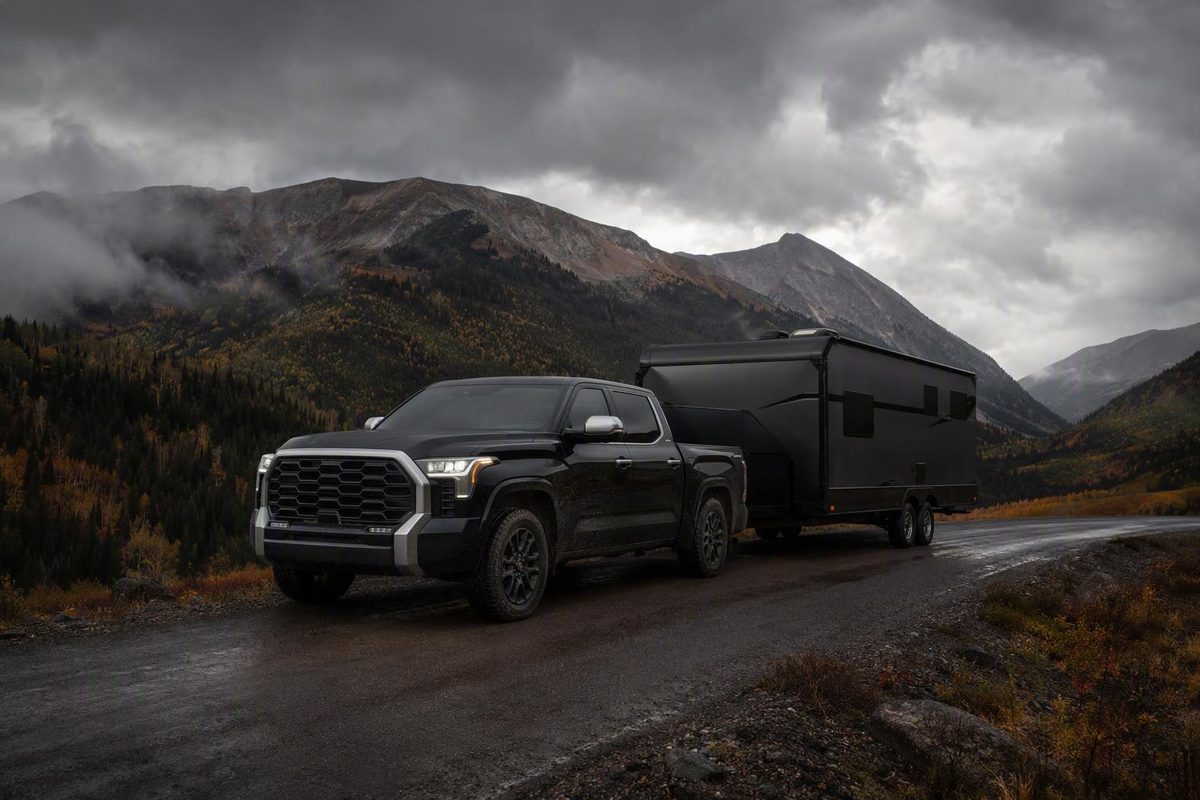
Methodology: This guide uses Toyota’s current 2026 towing page for the model-wide claim and pictured-truck example. Dealer and editorial sources are used only for attributed feature lists, verification guidance, or documented conflicts. The Owner’s Manual, model-year Toyota documentation, and labels for the individual truck remain controlling.
The direct answer: up to 12,000 pounds for the 2026 Tundra
Toyota advertises a maximum 2026 Tundra tow rating of up to 12,000 pounds. That is the ceiling for the model line—not the rating of every 2026 Tundra and not necessarily what a particular truck can tow after passengers, cargo, accessories, and hitch equipment are added.
Toyota’s pictured example makes the distinction clear: a 2026 Limited Hybrid CrewMax with the TRD Off-Road Package and a 5.5-foot bed has an 11,170-pound towing capacity as shown, which is 830 pounds below the headline maximum. Toyota’s page does not identify the exact cab, bed, drivetrain, powertrain, and equipment combination that earns the full 12,000-pound rating. Toyota also says towing capability depends on vehicle loading and equipment.
| Number | What it means |
|---|---|
| Up to 12,000 lb | Toyota’s advertised maximum for the 2026 model line |
| 11,170 lb as shown | Rating of Toyota’s pictured Limited Hybrid CrewMax configuration |
| Your truck’s limit | The lowest applicable vehicle, axle, tire, hitch, loading, or trailer-component limit |
The practical answer to “What is the tow rating of a Toyota Tundra?” is therefore:
- 2026 model-wide advertised maximum: Up to 12,000 pounds.
- Specific Tundra configuration: Potentially lower, depending on how the truck was built.
- Individual loaded truck: Potentially constrained by payload, axle, tire, hitch, or combined-weight limits before reaching its configuration’s trailer-weight rating.
Do not automatically apply the 2026 figure to a 2025 or older Tundra. Use Toyota documentation for the truck’s actual model year and configuration.
Advertised maximum, configuration rating, and loaded-truck limit
Three different concepts are commonly compressed into the phrase “tow rating.” Separating them prevents a promotional maximum from becoming a planning assumption.
1. The advertised maximum is the largest figure associated with the model line. It indicates what at least one properly configured version can achieve; it does not establish the rating of a truck selected from a dealer lot or used listing.
2. The configuration rating applies to a defined combination of model year, powertrain, drivetrain, cab, bed, trim, options, vehicle weight, and towing equipment. Two trucks with the same trim badge can differ in several of those respects. Trim name alone is not enough to establish a tow rating.
3. The loaded-truck limit reflects the ratings that apply after accounting for the people and equipment carried on the trip. Occupants, cab and bed cargo, accessories, and hitch hardware all add load to the truck. Trailer tongue weight adds another truck-side load through the hitch.
Toyota’s pictured Limited Hybrid proves that an individual 2026 configuration can sit below the model-wide ceiling. It does not establish that every Limited Hybrid shares the pictured truck’s rating.
Configuration differences matter because powertrain, drivetrain, cab, bed, options, equipment, and vehicle weight can change the assigned rating or the capacity remaining for other loads. A Cars.com 2026 towing guide identifies those factors as relevant to the rating, although its configuration details should not replace Toyota documentation for the actual vehicle.
Generalized charts can help narrow a search. They may show that a particular cab or drivetrain deserves closer examination, or warn that a trim is unlikely to reach the model maximum. But a chart without complete configuration details and footnotes is a starting point—not authorization to tow at the largest number in its row.
How to verify the rating of a specific Tundra
Treat verification as a documentation exercise. The objective is not to find the largest Tundra number online; it is to identify every limit that applies to the truck, hitch, tires, and trailer you will use.
1. Identify the truck precisely
Record:
- Model year
- Powertrain
- Two-wheel drive or four-wheel drive
- Cab type
- Bed length
- Trim
- Factory towing equipment
- Factory options that affect vehicle weight
- Dealer-installed and owner-installed equipment
- Tire size, type, and load specification
- Receiver and hitch-component identification
Do not rely solely on an advertisement or trim badge. If a used-truck listing omits the cab, bed, drivetrain, or towing equipment, obtain those details before evaluating a trailer.
2. Consult the correct Toyota documentation
Use the Owner’s Manual and applicable towing information for the truck’s exact model year. Read the definitions, equipment requirements, warnings, tables, and footnotes—not only a summary number.
A third-party configuration guide can help identify what to investigate, but its coverage may be incomplete. For example, Check My Tow advises confirming the door-jamb label, Owner’s Manual, and model-year towing guide rather than relying on its compiled table alone.
If the applicable rating remains unclear, ask a Toyota dealer to identify the documentation for the vehicle. Provide the VIN and complete configuration rather than requesting a generic trim-level number.
3. Separate label values from documentation values
Inspect the certification and tire-and-loading labels on the truck. Photograph or transcribe the values so that you can use them while comparing trailers.
Vehicle labels may provide:
- Vehicle-specific payload or occupant-and-cargo allowance
- Gross Vehicle Weight Rating (GVWR)
- Front Gross Axle Weight Rating (front GAWR)
- Rear Gross Axle Weight Rating (rear GAWR)
- Tire size, load information, and specified inflation information
The Owner’s Manual or applicable Toyota towing documentation may be needed to identify:
- Maximum trailer-weight rating for the configuration
- Gross Combined Weight Rating (GCWR), when documented
- Required towing equipment
- Vehicle or hitch tongue-weight limits
- Loading qualifications and operating instructions
4. Verify the towing hardware and trailer
Record the ratings and requirements for:
- Receiver
- Ball mount
- Hitch ball
- Trailer coupler
- Weight-distributing equipment, if specified for the setup
- Safety chains and attachment points
- Electrical connector
- Trailer brakes and brake controller
- Trailer tires, axles, and suspension
- Trailer GVWR
- Any tongue-weight limits specified by the vehicle, hitch, receiver, or trailer manufacturer
Do not assume that every component shares the truck’s headline capacity. Evaluate each component under the instructions and ratings supplied by its manufacturer.
5. Build one limit sheet
Place every applicable value on a single page. Do not select whichever number is largest: the lowest applicable limit governs the load or part of the combination it controls.
A trailer can be below the truck’s trailer-weight rating while the loaded truck exceeds GVWR or rear GAWR.
Before towing, confirm that the truck and trailer are compatible, correctly connected, properly loaded, and equipped as required. Toyota directs owners to follow the Owner’s Manual and never exceed the vehicle’s published capacities; an authorized dealer guide reproduces the same compatibility, loading, equipment, and rating cautions in its towing disclaimer. Review the towing qualifications summarized by Toyota of Irving.
Why payload and tongue weight can become the real constraint
Trailer tongue weight is applied to the truck through the hitch. It must be considered with occupants, cab and bed cargo, accessories, and hitch hardware.
That is why a Tundra can have enough published trailer-weight capacity for a trailer but insufficient remaining payload for the planned trip.
Use this calculation framework:
Vehicle-specific payload allowance minus occupants minus cargo in the cab and bed minus added accessories minus hitch hardware carried by the truck equals payload remaining for trailer tongue weight
Separately compare the loaded combination with GVWR, front and rear GAWR, GCWR when documented, receiver limits, tire limits, total trailer weight, and trailer-component ratings.
Hypothetical example
Assume strictly for illustration—not as a universal Tundra specification—that a particular truck’s label provides a 1,500-pound payload allowance.
| Load placed on truck | Hypothetical weight |
|---|---|
| Occupants | 500 lb |
| Bed and cab cargo | 200 lb |
| Accessories and hitch hardware | 150 lb |
| Total before trailer tongue weight | 850 lb |
The payload remaining for tongue weight would be:
1,500 − 850 = 650 pounds
Now assume the truck has a documented 10,000-pound tow rating, while the selected trailer weighs 8,000 pounds loaded and places 900 pounds of measured tongue weight on the truck.
The trailer is 2,000 pounds below the hypothetical tow rating, but its tongue weight exceeds the remaining payload by 250 pounds. The combination fails the payload calculation even though it passes the simple trailer-weight comparison.
Those must be checked against the applicable ratings, using measured loaded weights when necessary.
It shifts that load to the truck and consumes truck payload.
Do not apply a single tongue-weight percentage or arbitrary safety margin to every trailer. Use the instructions for the actual truck, trailer, hitch, and loading system, then verify the resulting loaded condition.
Match the truck to the trailer’s loaded condition
Depending on how the trailer manufacturer defines the figure, travel-ready weight may also include:
- Food and luggage
- Water or fuel
- Batteries
- Propane
- Tools and recovery equipment
- Installed options
- Dealer-added equipment
- Camping, boating, or work cargo
Use the trailer’s measured loaded weight when available. If the trailer has not yet been purchased or loaded, use a conservative estimate based on the equipment and cargo you expect to carry, while remaining within the trailer’s own ratings.
Total trailer weight is only one side of the match. You also need the loaded tongue weight.
Campers of similar length can have different construction, tanks, batteries, slide-outs, options, and cargo allowances. Boats that appear comparable can differ in hull, engine, fuel, equipment, and trailer weight.
Questions such as “Can a Tundra tow a 30-foot camper?” or “Can it tow a large boat?” therefore cannot be answered from category or length alone. The necessary inputs are the exact Tundra configuration, the loaded truck, and the trailer’s loaded total and tongue weights.
Trailer-matching worksheet
Truck identification
| Field | Your value |
|---|---|
| Model year | |
| Powertrain | |
| Drivetrain | |
| Cab | |
| Bed | |
| Trim | |
| Factory towing equipment | |
| Added equipment or accessories |
Published truck and component limits
| Limit | Published value | Source or label location |
|---|---|---|
| Maximum trailer-weight rating | ||
| Payload allowance | ||
| GVWR | ||
| Front GAWR | ||
| Rear GAWR | ||
| GCWR, if documented | ||
| Receiver rating | ||
| Ball mount and hitch-ball rating | ||
| Front tire limits | ||
| Rear tire limits | ||
| Vehicle or hitch tongue-weight limit |
Planned truck load
| Item | Weight |
|---|---|
| Driver and passengers | |
| Cab cargo | |
| Bed cargo | |
| Accessories | |
| Hitch hardware | |
| Loaded trailer tongue weight | |
| Total load applied to truck |
Trailer condition
| Item | Weight or rating |
|---|---|
| Advertised empty or dry weight | |
| Installed options | |
| Water, fuel, batteries, or propane | |
| Cargo and travel equipment | |
| Estimated or measured loaded trailer weight | |
| Estimated or measured loaded tongue weight | |
| Trailer GVWR | |
| Trailer axle and tire limits |
Compare the completed worksheet with every applicable limit. If ordinary packing changes could determine whether the combination complies, obtain measured loaded weights before departure.
Towing equipment helps control the trailer but does not raise the rating
Toyota identifies Trailer-Sway Control as standard on the 2026 Tundra. It is an assistance feature, not permission to exceed the truck’s towing, payload, axle, tire, hitch, or trailer-component limits. Toyota’s 2026 towing page identifies both the standard feature and the applicable towing cautions.
The same distinction applies to other towing equipment. None independently rewrites the rating assigned to the truck.
Each component has a specific role:
- Receiver: Provides the truck-side attachment and must be installed and rated for the application.
- Ball mount and hitch ball: Connect the receiver to the coupler and must be compatible in size, fit, and rating.
- Electrical connector: Carries trailer-lighting and, when applicable, braking or auxiliary circuits.
- Trailer-brake controller: Operates compatible electric trailer brakes and must be configured according to its instructions.
- Mirrors: Must provide visibility appropriate for the trailer’s width and shape.
- Cameras and backup guidance: Can assist with alignment or reversing but do not replace clearance checks.
- Sway-control systems: Can assist with trailer movement but do not correct an overloaded or incompatible combination.
Dealer and editorial feature lists should be treated as shopping checklists, not configuration-level Toyota specifications. Toyota of North Canton, for example, lists an integrated brake controller, Class IV receiver, 7-pin/4-pin wiring, available load-leveling rear suspension, and available Trailer Backup Guide among 2026 towing-related equipment. Availability still needs to be verified on the individual truck. See the dealership’s attributed feature list.
Before departure, confirm that every required component is:
- Present.
- Compatible with the other components.
- Correctly installed and connected.
- Rated for the load.
- Adjusted according to its manufacturer’s instructions.
- Required or permitted for the applicable rating and trailer.
A “tow package” is not a blanket capacity increase. It may provide equipment needed to use a particular rating, but it does not override vehicle-specific payload, GVWR, GCWR, axle, tire, hitch, or trailer limits.
Why this guide does not publish a definitive trim-by-trim history
The evidence reviewed for this guide does not include complete first-party Toyota configuration tables for 2025 or earlier model years. Publishing a simplified historical chart would therefore imply more certainty than the available documentation supports.
Dealer and editorial summaries commonly report the same recent model-wide ceiling, but some of their detailed figures and configuration descriptions conflict:
- DARCARS 355 Toyota separates gasoline and hybrid Limited figures, but its page also alternates between two engine-displacement descriptions and displays towing footnote markers without the corresponding visible qualifications. Review the DARCARS 355 Toyota chart and terminology.
- Desert Toyota and McGee Toyota publish differing presentations for some Limited, Platinum, and 1794 Edition figures, illustrating why a trim badge alone should not be treated as a configuration rating. See McGee Toyota’s configuration-dependent chart.
- The Cars.com 2026 article assigns the maximum to one cab-and-bed arrangement in its narrative and a different arrangement in its detailed table. That internal conflict makes the article unsuitable as final authority for a specific truck.
- Toyota of Irving reports an upper 2022 rating below the figure used by other dealer and third-party summaries. Its own disclaimer also emphasizes that configuration, equipment, and loading matter.
These disagreements are not merely editorial details. A reader could mistake a trim-level maximum for the rating of every truck carrying that badge, or apply a historical figure without seeing the omitted qualifications.
Missing footnotes create another problem. Several dealership charts show markers beside their ratings without reproducing the associated conditions in the visible material. Those unseen notes may contain equipment, configuration, or loading qualifications essential to interpreting the number.
For a 2025 or older truck:
- Confirm the model year and complete configuration.
- Use Toyota documentation applicable to that year.
- Read the vehicle’s labels.
- Verify the installed towing equipment.
- Check the receiver, tires, hitch components, and trailer ratings.
- Account for the load carried by the truck.
- Measure the loaded combination when estimates are insufficient.
Omitting a definitive historical chart is a safety and accuracy decision. It does not mean older ratings cannot be determined; it means they should be determined from documentation applicable to the actual truck rather than reconstructed from conflicting summaries.
Pre-departure towing check for a road trip
Confirming the numbers is only the first stage. Before departure, verify that the truck and trailer are loaded, connected, and functioning as planned.
Before hitching
- Measure the loaded truck and trailer when needed, or use conservative estimates until measurements are available.
- Confirm total loaded trailer weight and loaded tongue weight.
- Include occupants, cab cargo, bed cargo, accessories, and hitch hardware in the truck-side calculation.
- Compare the loaded condition with payload, GVWR, front and rear GAWR, GCWR when documented, tire limits, receiver limits, and other applicable ratings.
- Check the trailer’s GVWR, axle, tire, and component ratings.
- Resolve missing or contradictory information before leaving.
While connecting
- Follow the hitch and coupler manufacturers’ instructions.
- Confirm that the ball, ball mount, and coupler are compatible.
- Seat and latch the coupler completely.
- Install required locking or retaining devices.
- Attach safety chains to the specified points and route them as instructed.
- Connect the electrical plug and any required breakaway equipment.
- Raise and secure the jack and stabilizing equipment.
- Inspect visible hitch components and fasteners for damage or looseness.
Before moving
- Test the trailer lights.
- Test required trailer brakes and the controller according to their instructions.
- Set the mirrors for appropriate rearward visibility.
- Secure doors, hatches, ramps, awnings, steps, and cargo.
- Check truck and trailer tires using their applicable labels and manufacturer instructions.
- Walk around the complete combination once more.
They can make operation more demanding, however, so route and operating decisions still need to reflect actual conditions.
If routine trips repeatedly place the combination close to one or more applicable limits, reassess the truck-and-trailer match. There is no universal cutoff for every route or trailer, but a setup with little flexibility for passengers, cargo, or changing trip loads may not suit its intended use.
Printable Tundra towing checklist
- [ ] Exact model year, powertrain, drivetrain, cab, bed, and trim identified
- [ ] Owner’s Manual and applicable Toyota towing documentation checked
- [ ] Vehicle labels photographed or copied
- [ ] Configuration-specific tow rating recorded
- [ ] Payload allowance recorded
- [ ] GVWR recorded
- [ ] Front and rear GAWR recorded
- [ ] GCWR recorded, if documented
- [ ] Receiver and hitch-component ratings verified
- [ ] Truck and trailer tire limits verified
- [ ] Trailer GVWR and component ratings verified
- [ ] Loaded trailer weight measured or conservatively estimated
- [ ] Loaded tongue weight confirmed
- [ ] Occupants, cargo, accessories, and hitch hardware included
- [ ] Every load is within its applicable limit
- [ ] Coupler, safety chains, wiring, and breakaway equipment connected as instructed
- [ ] Trailer brakes and lights tested
- [ ] Mirrors adjusted
- [ ] Truck and trailer cargo secured
- [ ] Route, weather, fuel stops, and applicable road restrictions reviewed
Frequently asked questions
Can every Toyota Tundra tow 12,000 pounds?
No. That figure is the advertised maximum for the 2026 model line, not a universal rating. Individual configurations can be rated lower, and loading may cause payload, axle, tire, hitch, or combined-weight limits to become controlling first. The 2026 model-wide maximum is also reported by Cars.com, which cautions that configuration affects capacity.
How do I find the tow rating for my exact Tundra?
Identify the model year, powertrain, drivetrain, cab, bed, trim, options, and towing equipment. Then consult the applicable Toyota documentation, inspect the certification and tire-and-loading labels, and verify the receiver, hitch, tires, and trailer components. Record all applicable limits rather than relying on the largest number found online.
Does trailer tongue weight count against Tundra payload?
Yes. Tongue weight is applied to the truck through the hitch and must be considered with occupants, cab and bed cargo, accessories, and hitch hardware. A trailer can be below the truck’s tow rating while causing the loaded truck or a component to exceed another applicable limit.
Should I use a trailer’s dry weight when deciding whether a Tundra can tow it?
Not by itself. Compare the truck with the trailer’s measured loaded weight when available, or use a conservative estimate that includes expected equipment and cargo. Evaluate loaded tongue weight as well; total trailer weight alone does not establish compatibility.
Does Trailer-Sway Control or a tow package increase the Tundra’s tow rating?
No. Sway control and towing hardware may assist the driver or provide equipment required for a particular setup, but they do not independently increase the truck’s published rating or override payload, axle, tire, hitch, or trailer-component limits.
The bottom line: Toyota’s advertised 2026 Tundra ceiling is not a universal Tundra rating. The defensible limit for a particular combination is the lowest applicable limit found after identifying the exact truck, accounting for occupants and cargo, checking payload and tongue weight, and verifying the hitch, axles, tires, and trailer components.
Complete the worksheet before choosing or loading a trailer, especially for repeated towing or a long trip. The Owner’s Manual, applicable Toyota documentation, component instructions, and vehicle-specific labels take precedence over any online article.