
How to Navigate an All-Way Stop Without Guessing
For a tie on crossing roads, the driver on the left generally yields to the driver on the right. Three state guides name no universal first mover for a four-car tie.
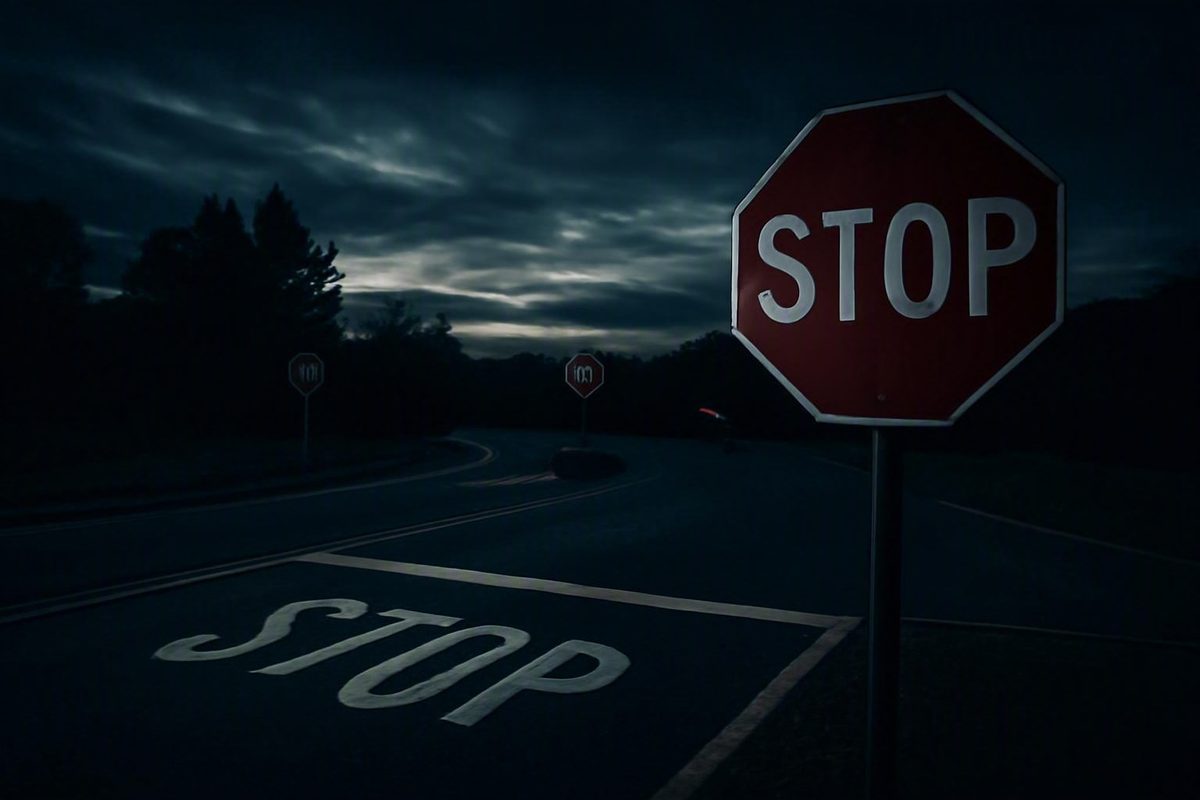
A reliable 4 way stop procedure follows a consistent sequence: stop completely in the correct place, scan every approach, identify who stopped first, resolve simultaneous arrivals and conflicting paths, and move only when the intersection and your exit are clear.
Official guidance from California, Pennsylvania, and North Carolina supports this general framework. It does not establish a uniform rule for every U.S. state or Canadian province, however. Use this article as a practical driving sequence, then check the current official handbook or traffic code for the jurisdiction where you are driving.
The five-step four-way stop procedure
At a four-way stop—commonly called an all-way stop—stop signs control every approach. This differs from a two-way stop, where cross traffic may not have to stop.
Here is the procedure in its shortest usable form:
- Make a complete stop in the correct place. Stop at the marked limit or stop line. If there is no line, stop before the crosswalk; if there is neither, stop before entering the intersection as local rules direct.
- Scan every approach. Look left, right, and ahead, including the corners and crosswalks, for vehicles, pedestrians, and bicyclists.
- Identify the stopping order. The vehicle that arrived and completed its stop first generally proceeds first.
- Resolve ties and path conflicts. When vehicles on intersecting approaches stop at approximately the same time, the driver on the left generally yields to the driver on the right. When opposing vehicles stop together, a left-turning driver generally yields if the turn conflicts with opposing through traffic.
- Check your route and exit, then proceed. Confirm that no person or vehicle is entering unexpectedly and that enough space is available beyond the intersection for your entire vehicle.
Pennsylvania’s official driver manual describes the same core sequence: all vehicles stop, the first vehicle to reach the intersection should move first, and the driver on the left yields when two vehicles arrive together. It also emphasizes that a driver must stop or yield when necessary to avoid a crash, even if somebody else was legally required to wait. See Pennsylvania’s official intersection guidance.
The important principle is that expected priority remains conditional. Being next in the normal sequence does not authorize you to enter in front of a pedestrian, bicyclist, emergency response, vehicle moving out of turn, or queue that leaves no room on the far side. The procedure identifies who should yield; it does not guarantee that everyone will do so.
Begin observing before you reach the stop line. Note which vehicles are already stationary, which are still approaching, and which drivers appear ready to turn. That early observation makes it easier to reconstruct the order once you have stopped.
Immediately before moving, conduct another scan:
- Left: Is a driver rolling through or starting unexpectedly?
- Right: Is another vehicle about to claim the same space?
- Ahead: Is opposing traffic continuing straight or turning across your route?
- Crossings: Is a pedestrian or bicyclist entering your path?
- Exit: Can your entire vehicle clear the intersection?
If the situation is unclear, remain stopped. A few extra seconds of patience are preferable to entering on an assumption.
Where to stop and what counts as arriving first
The generally supported stopping-position order is:
- At the marked limit or stop line.
- If there is no line, before the crosswalk.
- If there is neither a line nor a crosswalk, before entering the intersection as local law directs.
California’s official handbook uses this order. It also instructs drivers at intersections with stop signs on all four corners to stop before applying the normal right-of-way rules and to look left, right, and ahead for vehicles, bicyclists, and pedestrians. Review the California Driver’s Handbook.
A complete stop means the vehicle has fully ceased moving. A slow roll is not a complete stop, even if the driver looks both ways and believes the intersection is empty. Approach under enough control to finish braking at the proper position rather than after crossing the line or entering the crosswalk.
There is no supported basis here for prescribing one universal number of seconds that every driver in the United States and Canada must remain stationary. A deliberate pause can be useful because it creates time to scan and remember the order, but it should not be confused with a universal legal minimum. Check the applicable law and licensing-test standard if a particular duration is claimed.
As a practical rule, track stopping order
For an ordinary all-way-stop decision, note who completed a stop first, not who:
- first became visible;
- was moving fastest toward the intersection;
- reached the general vicinity while still rolling;
- crossed the line without stopping; or
- appeared likely to arrive first.
Suppose Car A begins slowing well before the line while Car B approaches quickly. If Car A completes its stop first and Car B stops afterward, Car A is generally first in the sequence. Car B’s greater speed or more aggressive approach does not rewrite the stopping order.
A simple mental note can help: “Blue car stopped; pickup still moving; I am next.” Keep scanning while you stop because a pedestrian, bicycle, or previously hidden vehicle may change the situation.
Do not apply this procedure until you have confirmed that every approach is controlled. At a two-way stop, vehicles on the cross street may have no stop sign and may continue through without stopping. Look for the signs or an “ALL WAY” or “4-WAY” plaque rather than assuming the intersection type from another driver’s behavior.
What if the stopping point has poor visibility?
Trees, parked vehicles, snowbanks, buildings, curves, or large vehicles can obstruct the view from the initial stopping position. Make the required stop first. After that, follow the local handbook’s instructions for obtaining a safe view without interfering with pedestrians or cross traffic.
Do not assume that one “stop and creep” technique is lawful everywhere. Poor sight distance calls for more caution, not a rolling stop.
Who goes first when vehicles arrive at different times or together
Arrival order resolves many four-way-stop situations, but not all of them. First decide whether the stops were clearly staggered or approximately simultaneous. Then consider the right-side tie rule and whether the intended routes conflict.
| Situation | General procedure | Important qualification |
|---|---|---|
| Car A stops clearly before Car B | Car A generally proceeds first | A must still confirm that the route and exit are clear |
| Two vehicles stop at approximately the same time on crossing roads | The driver on the left generally yields to the driver on the right | This resolves a tie; it does not override a clearly earlier stop |
| Opposing vehicles stop together | Compare their intended paths | They may move together only if the routes do not conflict |
| Three vehicles appear to stop together | Apply local yielding rules and identify conflicting movements | Do not invent a universal clockwise rotation |
| Nobody can identify the order reliably | Avoid a competing start and wait for a safe yielding pattern | Every relevant approach and crossing must be accounted for |
North Carolina’s Department of Transportation describes the basic pattern as first arrival first, followed by the vehicle on the right when vehicles arrive simultaneously. It also advises drivers to signal and continue watching for pedestrians and other vehicles. See NCDOT’s all-way-stop guidance.
Scenario 1: one vehicle clearly stops first
Car A stops completely. Car B is still approaching and stops afterward. Car A generally proceeds first, assuming its path is safe.
The later arrival does not move ahead merely because it is turning right, traveling straight, or positioned to Car A’s right. The right-side rule is a tie-breaker; it does not defeat a clearly established earlier stop.
Scenario 2: two vehicles stop together on crossing roads
Suppose Car A approaches from the south and Car B from the east. They stop at approximately the same time. From Car A’s perspective, Car B is on the right, so Car A yields.
The clearest way to remember the rule is from the yielding driver’s perspective:
In a tie on intersecting approaches, the driver on the left yields to the driver on the right.
Do not reverse the rule by asking only whether you can see a vehicle somewhere to your right. It applies to an actual or approximate tie, not every encounter.
Scenario 3: arrival order is uncertain
Real intersections rarely provide stopwatch-perfect evidence. One driver may stop behind a large vehicle, another may roll slightly, and a third may be watching a pedestrian. If you cannot identify the order confidently, do not manufacture certainty.
Remain stopped and observe what every relevant conflicting approach does. One driver waiting does not establish that another driver, cyclist, or pedestrian will remain clear. Proceed only when the complete route—including crosswalks and the far-side exit—is accounted for.
If you and another driver begin moving toward the same space, stop and let the conflict dissolve. Once the other movement clears, reassess the intersection rather than assuming the old sequence still applies.
What about three simultaneous arrivals?
Do not invent a universal rotation. Apply the local yielding rules, determine which paths conflict, and avoid competing entries.
With three vehicles, each driver’s relationship to the others can become confusing, particularly when the stops were merely close rather than identical or when one driver intends to turn. The objective is not to force the vehicles into a neat theoretical order. It is to prevent two drivers from claiming the same space.
Turn signals help reveal intended movement, but they do not determine who stopped first or grant priority. A signal may be late, forgotten, or incorrect, so compare it with lane position, wheel angle, speed, and actual movement.
An overhead diagram is the clearest way to study these situations. Label each vehicle, note when it stopped, draw its intended route, and mark the vehicle or movement to which it must yield. That separates three questions drivers often combine:
- Who stopped first?
- Was there an approximate tie?
- Do the intended routes conflict?
Straight, right, and left turns at the same stop
Do not begin with a blanket rule such as “straight always goes first” or “right turns always go first.” Begin with arrival order, then examine whether the proposed paths intersect.
If one vehicle stopped clearly before the others, it generally proceeds first if the movement is safe. Movement type becomes especially important when opposing vehicles stop at approximately the same time.
Opposing vehicles going straight
Two vehicles directly opposite each other may commonly proceed straight at the same time because their normal paths do not cross. NCDOT also recognizes simultaneous opposing movements when they are compatible, while directing drivers to signal and watch for pedestrians and other traffic. Read NCDOT’s official overview.
Before moving together, both drivers should confirm that:
- neither vehicle is actually turning;
- lane markings permit the movement;
- no pedestrian or bicyclist is crossing either path;
- a wide or large vehicle will not encroach;
- visibility is sufficient; and
- both vehicles have room to clear the intersection.
A missing or incorrect signal can turn an apparently compatible movement into a conflict. Watch what the opposing vehicle actually does.
Straight versus left turn
When opposing drivers stop together and one intends to continue straight while the other turns left, the left-turning driver generally yields to the opposing through vehicle. The left turn crosses the through vehicle’s path.
The left-turning driver should signal before moving, wait while the through vehicle proceeds, and check the intersection again before turning. Conditions may have changed while the driver was waiting.
Right turn versus opposing left turn
An opposing right turn and left turn can conflict depending on road width, lane count, permitted destination lanes, vehicle size, pavement markings, and local law. The left-turning driver may need to yield to the opposing right turn when both movements require the same space.
Potential conflicts include:
- a narrow receiving road;
- one usable destination lane;
- a truck or trailer making a wide turn;
- snow or construction narrowing the roadway;
- a bicycle beside the right-turning vehicle;
- pedestrians crossing the receiving road; and
- markings that direct both vehicles into overlapping paths.
If you cannot verify that the paths are separate, treat them as conflicting and move one at a time.
Two simultaneous turns
The official state guidance reviewed for this article does not establish a universal rule allowing two opposing left-turning vehicles to proceed together at every intersection. Their paths may be compatible in one layout and unsafe in another. Turn radius, lane count, medians, sight lines, vehicle size, and vulnerable road users can all affect the answer.
Apply the same standard to any pair of turns: simultaneous movement is appropriate only when the routes are lawful, clearly separated, and safe from start to finish.
Signal early enough to communicate your intention, but never base the entire decision on another driver’s indicator. Compare the signal with the vehicle’s position and actual movement.
For training, three overhead diagrams are especially useful:
- two opposing vehicles continuing straight;
- one opposing vehicle going straight while the other turns left; and
- an opposing right turn and left turn aimed toward the same receiving road.
Each diagram should show the complete swept path of the vehicles, not merely an arrow at the center of the intersection.
What to do in a true four-vehicle tie
The California, Pennsylvania, and North Carolina materials reviewed here do not specify one universal first mover for a perfect four-vehicle tie. That is a limitation of the reviewed evidence, not proof that no jurisdiction has additional instructions.
Do not assume that all traffic must rotate clockwise. Do not treat the most assertive driver as legally or practically entitled to go first.
Use this bounded defensive fallback:
- Remain fully stopped.
- Do not make a competing move merely to break the stalemate.
- Observe every relevant approach, crosswalk, and intended movement.
- Determine whether a clear yielding pattern has developed.
- Proceed cautiously only when all conflicting routes are accounted for and your exit is clear.
Pennsylvania’s manual frames intersection rules in terms of who must yield and emphasizes that drivers must still act to avoid a crash when somebody else fails to wait. That principle is especially important when the arrival order is uncertain. Review Pennsylvania’s intersection rules.
A hand wave, nod, eye contact, or headlight flash may communicate that one driver intends to wait. It does not confirm what another lane will do, establish that a crosswalk is empty, or transfer responsibility for checking your route.
Treat the gesture as one piece of information—not as a command.
If another driver begins moving, wait rather than trying to enforce the expected sequence. If two apparently nonconflicting vehicles start, continue observing. Their movement may reveal a pedestrian, bicycle, or vehicle that was previously hidden.
Consult the current official state or provincial handbook for any jurisdiction-specific treatment of simultaneous arrivals.
Pedestrians, bicyclists, emergency vehicles, and blocked exits
The ordinary vehicle sequence is only one part of the decision. Crosswalk activity, bicycles, emergency response, an officer directing traffic, or downstream congestion may require you to remain stopped.
Pedestrians
Check every crosswalk and corner before entering. Your exact duty depends on the crossing, pedestrian signal, vehicle movement, and local law; it should not be reduced to a claim that pedestrians have priority in every imaginable situation.
California’s handbook states that pedestrians have the right-of-way in marked and unmarked crosswalks and directs drivers to look for pedestrians before entering an intersection. Those statements describe California’s rules and should not be assumed to reproduce the exact law elsewhere. See the California DMV’s pedestrian and intersection guidance.
When turning, look through the windshield and toward the crosswalk beside the vehicle. A pedestrian may remain outside your direct forward view until the turn begins. Do not become so focused on vehicle arrival order that you overlook the crossing.
Bicyclists
Watch for bicyclists whose movement could affect your route, and yield when required by the applicable law.
Do not assume that a practice observed in one jurisdiction applies elsewhere.
Pay particular attention to bicycles positioned beside larger vehicles. A right-turning driver may conceal or cross a bicyclist’s path, and a bicycle behind a truck or SUV may become visible only as the larger vehicle starts moving.
Emergency vehicles and traffic officers
Emergency-vehicle procedures vary by jurisdiction. If an emergency vehicle using active warning equipment approaches or enters the scene, do not rely on the ordinary four-way-stop order. Avoid moving into its route, remain predictable, and follow the applicable local instructions.
Directions from a traffic officer may replace the ordinary stop sequence. Watch the officer rather than taking cues from nearby drivers, and do not move until the instruction applying to your approach is clear.
Rules for school buses, dark or malfunctioning signals, and flashing signals also vary. Do not assume that every unusual signal condition is treated as a four-way stop throughout North America. Check the current local handbook.
Blocked exits
As a defensive practice, do not enter when congestion, construction, a train crossing, or a stopped queue prevents you from clearing the intersection.
Identify a space on the far side large enough for your entire vehicle. Account for a trailer, bicycle rack, or long vehicle body. If the rear of the vehicle would remain in the intersection or crosswalk, wait behind the stop line until enough room opens.
The available path includes the exit, not merely the space immediately in front of your bumper. Entering too early can leave you blocking cross traffic or a pedestrian crossing when the next movement begins.
Defensive driving when someone takes the wrong turn
Expected priority is not an absolute entitlement. Another driver may roll through, lose track of the order, misunderstand a signal, or move deliberately out of turn. Your immediate task is to avoid sharing the same space.
If another vehicle starts unexpectedly:
- remain stopped if you have not entered;
- brake smoothly if you have begun moving;
- do not accelerate to beat the other driver;
- do not use your vehicle to enforce the expected order; and
- reassess the entire intersection after the vehicle clears.
Courtesy gestures require the same caution. A waving driver can communicate only that driver’s apparent intention. The gesture cannot confirm every pedestrian, bicyclist, blind spot, lane, or vehicle that could affect your movement.
Before accepting an opening, check:
- the near side of the waving vehicle for a bicyclist;
- the far side for another lane or vehicle;
- every crosswalk along your route;
- opposing traffic that may turn;
- vehicles approaching behind the waving driver; and
- the available space beyond the intersection.
If the waving vehicle blocks your view, remain stopped until you can determine that the complete movement is safe.
Common four-way-stop errors
Rolling through the stop. The vehicle never fully stops, making both compliance and arrival order uncertain.
Losing track of the sequence. The driver watches only the vehicle directly ahead and misses another approach.
Failing to signal. Other road users expect one movement and then encounter another.
Trusting a signal without verifying movement. A forgotten, premature, or incorrect indicator creates a false picture of the intended route.
Prolonged indecision followed by a sudden start. Other drivers conclude that the hesitant vehicle is yielding, only for it to accelerate once they move.
Applying the right-side rule to every encounter. A driver yields to a later arrival merely because that vehicle is on the right, even though no tie occurred.
Assuming straight traffic always outranks every turn. Arrival order and the actual path conflict still matter.
Entering without room to clear. The driver becomes stranded in the intersection or crosswalk when downstream traffic stops.
Following another vehicle through. Each driver must make the required stop and conduct an independent assessment.
Competing with a mistake. A driver who expected to go first accelerates when somebody else moves out of sequence.
Immediately before moving, make a distinct final scan left, right, and ahead. Confirm that every conflicting vehicle expected to wait is still waiting, inspect the crossings, and look through your intended route to the available exit.
Questions about fault, citations, penalties, or liability after a collision cannot be answered from the general sequence alone. Those conclusions depend on the jurisdiction, physical evidence, witness accounts, and circumstances of the event.
Why local law still matters
Several principles recur in the official state guidance reviewed for this article:
- every vehicle stops at an all-way stop;
- vehicles generally proceed in stopping order;
- the driver on the left generally yields to the driver on the right in an applicable tie;
- a left-turning driver yields when the turn conflicts with opposing through traffic; and
- expected priority does not remove the need to avoid a collision.
That agreement does not create one uniform North American traffic code. Definitions, statutory language, exceptions, licensing standards, and enforcement practices vary by jurisdiction.
The official sources also frame the procedure differently:
- California tells drivers to stop and apply intersection right-of-way rules while checking for vehicles, bicyclists, and pedestrians.
- Pennsylvania expressly emphasizes yielding and collision avoidance, including when another driver fails to wait.
- North Carolina describes arrival order, right-side ties, signals, and compatible opposing movements.
Check the current official handbook or traffic code for the state or province where you are driving, particularly for:
- pedestrian duties at marked and unmarked crossings;
- bicycle-specific stop rules;
- emergency-vehicle procedures;
- directions from traffic officers;
- dark, flashing, or malfunctioning signals;
- school-bus requirements;
- an obstructed view from the initial stopping position;
- multi-lane intersection rules; and
- any claimed minimum stop duration.
This is especially important when traveling across state or provincial borders. A technique taught for a licensing test in one place may not reproduce the precise legal standard somewhere else.
Commercial driving-school and law-firm explanations may illustrate common scenarios, but they do not replace an official handbook or current traffic code. The compact reminder is: know the ordinary sequence, but obey the signs, signals, officers, and current local law.
Frequently asked questions
Is a four-way stop the same as an all-way stop?
Usually, the terms refer to the same ordinary situation: stop signs control every approach, and every approaching driver must stop.
Always verify the signs. Without that confirmation, you may be facing a two-way stop where cross traffic does not stop.
Do I have to remain stopped for three seconds?
Not as a universal rule established by the official guidance reviewed here. The vehicle must come to a complete stop, meaning it fully ceases moving.
A brief, deliberate pause is still useful because it gives you time to scan, record the stopping order, and confirm the exit. Treat that as an observation technique, not as a substitute for checking the law or road-test standard in your jurisdiction.
Who goes first if all four vehicles arrive at exactly the same time?
The official state materials reviewed here do not establish one universal first mover for a perfect four-vehicle tie. Do not assume that traffic must rotate clockwise, and do not treat aggression as priority.
Remain stopped, avoid a competing start, and observe every relevant approach and crossing. Proceed only after a clear yielding pattern develops and the complete route is safe. Check the local handbook for any jurisdiction-specific instruction.
Should I go if another driver waves or flashes me through?
Not automatically. A wave or headlight flash may indicate that one driver intends to wait, but it does not guarantee priority or prove that the route is clear.
Check all approaches, lanes, crosswalks, blind spots, and the far-side exit yourself. If the other vehicle obstructs your view, remain stopped until you can assess the movement safely.
Can two vehicles opposite each other proceed at the same time?
Yes, when their paths are genuinely nonconflicting and conditions are safe. Two opposing vehicles continuing straight can commonly proceed together.
If one opposing driver is going straight and the other is turning left, the left-turning driver generally yields. Do not assume that two opposing turns are always compatible; lane geometry, vehicle size, pedestrians, bicyclists, and local rules can change the answer.
The practical sequence is straightforward: stop fully in the correct place, remember who stopped before you, yield to the right in an applicable tie, yield when a left turn conflicts with opposing traffic, check pedestrians and the available exit, and move only when the entire path is safe. When the order is ambiguous, patience—not improvisation—is the appropriate response.