
Stop or Keep Moving? What to Do When a Tire Goes Flat
Do not plan to travel even one or two miles on a conventional flat. Emergency repositioning and verified run-flats follow different limits.
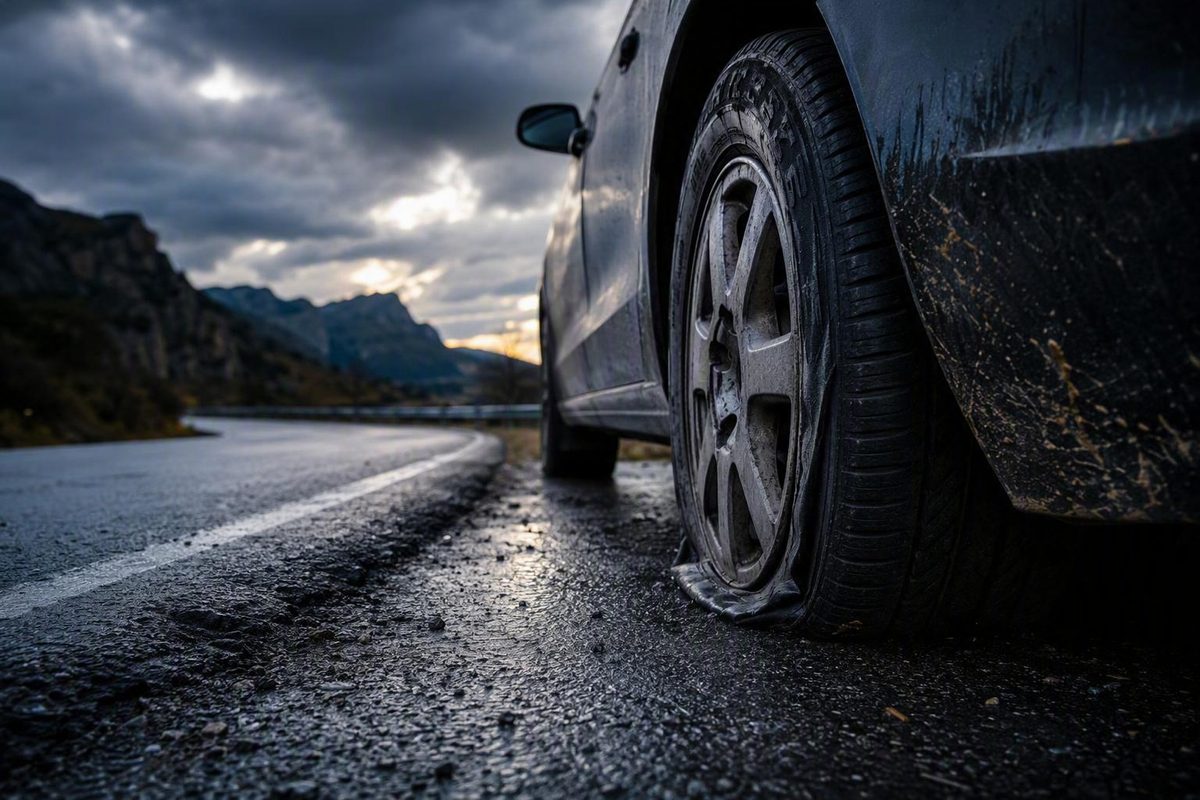
If you are asking, “How far can I drive on a flat tire?” use this conservative planning rule for a conventional tire: zero additional travel miles. That is a safety recommendation, not a universal technical specification. If the vehicle is already somewhere safe, do not drive it home, to a gas station, or to a tire shop. Install a suitable spare or use approved emergency equipment if conditions allow; otherwise, call for roadside assistance.
The exception is emergency repositioning. If staying where you are creates an immediate danger—such as remaining in an active traffic lane—move the vehicle only as far as necessary to reach a safer position, then stop. Commercial guidance describes anything from a few feet to a few hundred feet or more, but none of those figures is guaranteed under every combination of tire damage, vehicle load, road surface, and traffic conditions. Tech Tire Repairs advises drivers not to continue for additional miles and to stop at the nearest safe location (flat-tire roadside guidance).
Run-flat tires are a separate category. Many have commonly cited maximums near 50 miles at about 50 mph or less, but those figures are conditional ceilings—not promises or targets. The specifications for the installed tire and vehicle control.
The short answer: do not plan to drive on a conventional flat
Do not plan to travel one or two miles on a conventional flat tire. If the car is in a driveway, parking lot, or another protected location, leave it there. Driving around the block to “test” the tire can worsen damage that may not be visible from outside.
Published commercial advice does not establish one universally safe emergency distance. Walser Automotive recommends moving only a few feet when necessary to escape an unsafe position, rather than attempting to travel a few miles (guidance on moving a vehicle with a flat).
Other automotive-service guidance discusses a few hundred yards or as much as half a mile solely to find a safe stopping place. The range of published advice is itself a reason not to treat any number as a guaranteed allowance for an ordinary flat (distance and stopping guidance).
Use this distinction when deciding what to do:
| What you have | Conservative planning rule | Appropriate next step |
|---|---|---|
| Conventional tire that is flat | Plan on zero additional travel miles. | Stay stopped if already safe. If exposed to immediate traffic danger, reposition only to the nearest safer place, then use a suitable spare or call for assistance. |
| Qualifying run-flat tire | Operate only within the exact tire and vehicle restrictions. | Use its temporary mobility to reach the nearest safe place or suitable service facility—not to finish the trip. |
| Temporary spare already installed | Follow the spare label and owner’s manual. | Arrange prompt service for the original tire. Do not apply generic run-flat limits to a temporary spare. |
| Tire that may be underinflated but is still supporting the vehicle | Do not judge safety from appearance or a warning light alone. | Stop safely, check for damage, and follow the vehicle instructions for measuring or restoring pressure. Seek assistance if the tire is visibly damaged or the vehicle is unstable. |
A tire-pressure monitoring system warning does not reveal, by itself, whether a tire has a slow leak, is losing pressure rapidly, or can no longer support the vehicle. Pulling, heavy or delayed steering, flapping or grinding sounds, strong vibration, or a visibly collapsed tire are reasons to slow down and stop as soon as safety permits.
The distinction between planned travel and emergency repositioning is essential. A short move may be justified to leave a live lane even if it ruins the tire or damages the wheel. It is not permission to continue toward home or a repair facility.
What to do when a tire goes flat while you are moving
A warning light, sudden noise, vibration, or pulling sensation can prompt an instinctive hard brake or sharp turn. Resist that reaction. A flat can make steering and braking difficult or unpredictable, so maintaining control comes before stopping in the shortest possible distance.
Use this sequence:
- Ease off the accelerator. Let the vehicle begin slowing gradually.
- Keep a firm, steady grip on the steering wheel. Be prepared for pulling or delayed response.
- Avoid hard braking. Abrupt braking can make an unstable vehicle more difficult to control.
- Avoid sharp steering. Make smooth, deliberate corrections instead of swerving toward the roadside.
- Activate the hazard lights. Warn other road users that the vehicle is slowing or impaired.
- Look for the nearest safer stopping place. When reasonably reachable, favor stable, level ground away from moving traffic.
- After stopping, apply the parking brake. Keep occupants away from the side exposed to passing vehicles.
This sequence reflects commercial tire-repair guidance to slow carefully, avoid sudden braking and steering, use the hazard lights, and move away from traffic when possible (roadside response guidance).
“Pull over immediately” does not mean making an abrupt turn the instant a warning appears. Check surrounding traffic, keep the vehicle under control, and move toward the nearest location that is safer than your current position. Depending on what is available, that could be a parking lot, rest area, wide shoulder, or another stable area away from the travel lane.
Once stopped, do not assume it is safe to step out and inspect the tire. First consider the location of passing traffic, the available clearance, the ground surface, and whether roadside work would place you or your passengers beside an active lane.
If the vehicle is on a narrow shoulder or beside fast-moving traffic, call for roadside assistance instead of attempting a tire change. Keep occupants in the safest available position and follow instructions from emergency personnel or the relevant road operator if they arrive. Hawk Chevrolet likewise advises against changing a tire on the shoulder of a busy road and recommends moving only a few feet when necessary to reach safety (roadside flat-tire response).
Do not continue merely because the tire is still attached to the wheel. Stop as soon as safety allows if handling becomes unstable, vibration intensifies, or the tire is smoking, bulging, shredding, or visibly coming apart.
When moving the car is safer—and when towing is the only sensible option
The first decision is about protecting people, not preserving the tire. Moving a short distance may destroy a tire that might otherwise have been repairable, but that can be the better outcome if the alternative is remaining in an active lane.
Use a scenario-based approach:
If the vehicle is already in a safe parking area: Remain stopped. Do not drive toward home or a repair shop on the flat. Check what equipment the vehicle carries and arrange a spare installation, roadside assistance, or towing.
If the vehicle is stopped in an active lane or similarly exposed position: If the vehicle remains controllable, reposition it only to the nearest safer location. Use smooth steering and gradual deceleration. The objective is to leave the immediate danger, not to make progress toward your destination.
If the vehicle is beside fast-moving traffic: Do not attempt a roadside inspection or tire change if doing so would place you near passing vehicles. Call for assistance instead.
If there is no clearly safe stopping point: Prioritize control, activate the hazard lights, and follow directions from emergency personnel or the road operator where available. Conditions in tunnels, on bridges, during severe weather, and on roads without shoulders differ too much for one detailed procedure to fit every situation.
No short movement is guaranteed to be safe. A gradual leak may affect the vehicle differently from a tire damaged by a major impact. Vehicle weight, speed, traffic, road surface, and the extent of structural damage can all change the outcome.
Stop and arrange assistance or towing when any of these conditions is present:
- The vehicle cannot be kept on a predictable path.
- Steering or braking response feels unstable.
- Vibration is severe or worsening.
- The tire is shredding or separating.
- There is smoke near the tire or wheel.
- The tire is bulging or has major visible damage.
- The wheel or nearby components appear damaged.
- The vehicle sustained a significant impact and the extent of damage is unknown.
- A suitable spare or emergency kit cannot be used as instructed.
- An inflator cannot support the tire or the tire rapidly loses pressure again.
- The trip to service would exceed the documented restrictions of a run-flat tire or temporary spare.
These warning signs also apply to run-flat tires. A run-flat designation does not make a tire usable after every puncture or impact. Major sidewall injury or impact damage can make continued operation impossible and require towing, regardless of the tire’s nominal range (run-flat construction and limitations).
Do not let an advertised range override what the vehicle is doing. Instability, severe vibration, smoke, visible destruction, or suspected wheel or suspension damage makes towing the more appropriate response.
Why even a short drive can turn a puncture into a larger repair
Air pressure helps a tire maintain its shape and support the vehicle. When pressure is lost, the sidewall and internal structure can flex far more than intended. Repeated deformation generates heat and places abnormal stress on the rubber, cords, and other structural materials.
Damage may progress this way:
- The tire loses enough pressure that it cannot maintain its intended shape.
- The sidewall folds and flexes beneath the vehicle’s weight.
- Internal cords or other structural elements may weaken.
- The tire may tear, separate, or begin shredding.
- The rim may pinch or cut the tire and eventually contact the road.
Not every flat damages every component. The outcome depends on the cause of the pressure loss, the distance and speed traveled, vehicle load, road conditions, and whether the tire remained seated on the wheel. Possible collateral damage includes the wheel, suspension, brakes, alignment, wheel bearings, tire-pressure monitoring components, and nearby body parts. Mavis describes these risks and warns that a tire driven flat may sustain hidden cord or sidewall damage (flat-tire damage and repairability).
The same mechanical damage can reduce control. Once the tire loses its intended shape, the vehicle may pull toward the affected side, steering response may become vague or delayed, and braking may become less predictable.
A central problem is that internal damage may not be visible. A tire can accept air and appear to regain its normal shape while still having overheated materials, weakened cords, or damaged sidewalls. Inflation shows that air entered the tire and is not escaping immediately; it does not establish that the tire is structurally suitable for continued road use.
That is why “I drove only a block” does not determine repairability. A short movement might cause limited additional damage in one incident and extensive damage in another. Roadside appearance alone cannot reliably reveal the difference.
The financial tradeoff does not require a specific dollar estimate. Stopping sooner may preserve the possibility of repairing an otherwise qualifying tread puncture. Continuing can turn the same event into tire and wheel replacement, along with possible repairs to sensors, alignment, brakes, suspension, bearings, or body components. Avoiding a tow is not economical if the drive causes substantially broader damage.
Run-flat tires: treat 50 miles and 50 mph as ceilings, not promises
Run-flat tires are designed to support a vehicle temporarily after significant pressure loss. Most use reinforced sidewalls; some designs use another internal support structure. That construction provides limited mobility that a conventional deflated tire does not have.
For many run-flat tires, approximately 50 miles at about 50 mph or less is a commonly cited maximum. It is not a universal specification, guaranteed range, or recommended target. Kelley Blue Book describes about 50 miles as typical while emphasizing that the permitted range and speed depend on the tire manufacturer (run-flat range overview).
Before relying on run-flat capability:
- Confirm that the installed tire is identified as a run-flat.
- Consult the vehicle owner’s manual.
- Check the tire markings and tire-specific documentation.
- Follow the exact distance and speed restrictions provided for that vehicle and tire.
- Use the available mobility to reach the nearest safe location or suitable service facility.
Tires may have been replaced with another type. The absence of a spare also does not prove that the current tires are run-flats. If you cannot identify the tire or confirm its operating limits, stop and seek qualified assistance rather than relying on generic figures.
Run-flat mobility is intended to help the driver leave an exposed location or reach nearby service. It is not permission to resume normal highway driving, complete a trip, or delay inspection.
A run-flat may still require towing when:
- The vehicle is unstable.
- The tire has visible structural destruction.
- A pothole, curb strike, or debris impact may have damaged the wheel or suspension.
- There is severe sidewall damage.
- The tire is smoking or shredding.
- The required trip exceeds the documented range.
- The applicable tire and vehicle restrictions cannot be confirmed.
Do not try to determine when a generic “range countdown” began. Follow the instructions for the specific tire and vehicle and obtain service as soon as practical.
Spare, inflator, sealant, roadside assistance, or tow?
Once the vehicle and occupants are in a safer position, use this decision sequence:
- Identify what the vehicle carries. Look for a full-size spare, temporary spare, jack, lug wrench, inflator, sealant kit, wheel-lock key, or roadside-assistance information.
- Decide whether the location is suitable for roadside work. Having the right equipment does not make an exposed shoulder safe.
- Consult the owner’s manual. Confirm the approved procedure, lifting points, equipment instructions, and operating restrictions.
- Assess visible damage from a position away from traffic.
- Choose the least risky workable option.
Use a suitable spare when it can be installed safely
A full-size or temporary spare may be appropriate when the vehicle is on firm, level ground away from traffic, the required tools are present, and the driver can follow the vehicle instructions.
If the location or available equipment does not permit the procedure to be completed as described in the owner’s manual, call for assistance rather than improvising.
A temporary spare has its own operating restrictions. Its speed, distance, inflation, and use limits are not interchangeable with run-flat limits. Read the spare’s label and the vehicle owner’s manual, and use it only to reach appropriate service.
Use an inflator only when the tire is a plausible candidate
Do not attempt inflation when the tire is shredded, bulging, smoking, visibly separated, or unable to support the vehicle. Those conditions call for assistance rather than an inflation attempt.
Inflation does not repair the source of a leak. If the tire accepts air, follow the equipment and vehicle instructions and watch for renewed pressure loss, abnormal shape, or vibration. Stop and arrange assistance if the tire will not retain pressure or the vehicle remains unstable.
For advance preparation, Road Listings recommends checking tire pressure before departure and carrying a 12V inflator for slow leaks in its long-road-trip tire and gear guide. That is a preparation recommendation; it does not establish a safe distance for driving on a fully flat tire.
Treat sealants and plug-style products as limited-mobility measures
Sealants and external plug-style products are not appropriate for every injury. Suitability depends on the tire, puncture location, type of damage, product instructions, vehicle equipment, and tire-manufacturer policy.
Unless tire- and product-specific instructions and a qualified inspection establish otherwise, treat these products as limited-mobility measures rather than proof of a permanent repair.
If a temporary treatment produces vibration, fails to retain pressure, or is prohibited by the applicable instructions, stop using the vehicle and arrange assistance.
Call roadside assistance or arrange towing when uncertainty is significant
Roadside assistance or towing is the appropriate choice when:
- You do not have a usable spare or suitable equipment.
- The location is too exposed for roadside work.
- The ground is unsuitable for the vehicle’s supplied equipment.
- The tire is bulging, shredding, smoking, or visibly separated.
- The vehicle’s handling remains unstable.
- The wheel or suspension may have been damaged.
- You cannot confirm the installed tire’s temporary-mobility limits.
- The spare, inflator, or sealant cannot be used according to its instructions.
- You cannot safely complete the procedure.
Waiting for assistance may be inconvenient, but inconvenience does not make an uncertain tire capable of safely carrying the vehicle farther.
Can the tire still be repaired after it was driven flat?
Possibly, but no roadside mileage estimate can settle the question. Repairability depends on:
- The location of the puncture
- The size and type of injury
- The tire’s internal condition
- Remaining tread and overall condition
- Damage caused by operation while underinflated or flat
- Previous repairs
- The tire manufacturer’s repair policy
- Whether sealant or another temporary product was used
An ordinary puncture in the tread area is different from an injury to the shoulder or sidewall. That distinction does not guarantee that a tread puncture is repairable, and the final decision still depends on the applicable repair criteria and a complete inspection.
Driving while flat can eliminate the possibility of repair even when the original puncture might otherwise have qualified. Excessive sidewall flex and heat can damage internal components without leaving clear external evidence. A tire that has been operated while flat should therefore be removed from the wheel and inspected internally before repair or return to service.
Queensway Tire likewise warns that continued operation may destroy the chance of repair and damage the wheel, recommending that the driver stop and use a spare or obtain assistance instead (repair and spare guidance).
A tire holding air is not automatically safe. Successful inflation, sealant use, or an external plug does not reveal whether the inner liner, cords, sidewall, or bead area has been damaged.
Run-flat repair policies need particular attention. Published commercial guidance differs: some sources say certain run-flats may be repairable after inspection, while others advise replacement because damage can be difficult to evaluate. Follow the tire manufacturer’s policy for the specific model and obtain a qualified internal inspection rather than relying on a universal claim.
Before the next long drive:
- Check the cold pressure of all road tires using the vehicle specification.
- Check the spare’s pressure and condition.
- Confirm that the jack, wrench, wheel-lock key, and other required tools are present.
- Identify whether the vehicle currently has conventional or run-flat tires.
- Locate the relevant owner’s-manual instructions.
- Save roadside-assistance and insurance contact details offline.
- Carry suitable visibility and emergency equipment.
- Look for embedded objects, cracking, bulges, or unusual wear.
- Resolve recurring pressure loss before departure instead of depending on repeated inflation.
Frequently asked questions
Can I drive one mile on a conventional flat tire?
Do not plan to. Use zero additional travel miles as the conservative planning rule. If the vehicle is already in a safe location, leave it there and use a suitable spare or call for assistance.
If you are blocking an active lane or face another immediate danger, move only as far as necessary to reach the nearest safer position. One mile is not a universal safe allowance.
How slowly should I move a car with a flat tire if I am blocking traffic?
There is no universal safe speed for moving a conventional flat. Move only when remaining in place presents a more immediate danger, and treat the maneuver as a slow, controlled repositioning—not ordinary travel.
Ease off the accelerator, hold the steering wheel steadily, avoid hard braking and sharp turns, activate the hazard lights, and stop at the nearest safer location. If the vehicle is unstable or the tire is shredding, smoking, bulging, or causing severe vibration, stop as soon as safety permits and arrange assistance.
How far can I drive on a run-flat tire after it loses pressure?
Many run-flat tires have commonly cited maximums near 50 miles at approximately 50 mph or less, but neither figure is universal or guaranteed. United Tire & Service describes these as common recommendations and advises checking the exact limits for the tire and vehicle (run-flat limits and repair considerations).
Use that capability only to reach the nearest safe place or suitable service facility. Tow the vehicle if handling is unstable or the tire has major visible damage, regardless of its run-flat designation.
Can I drive normally after installing a temporary spare?
No. A temporary spare is limited-use equipment. Follow the speed, distance, inflation, and other restrictions printed on the spare or stated in the vehicle owner’s manual.
Do not apply generic run-flat figures to a temporary spare. Drive only as necessary to obtain proper service, and repair or replace the original tire promptly.
Can a tire be repaired after it has been driven while flat?
Sometimes, but driving while flat can produce hidden structural damage and make repair impossible. The outcome depends on the injury’s location and size, the tire’s internal and tread condition, prior repairs, manufacturer rules, and how the tire was operated after pressure loss.
The tire should be removed from the wheel and inspected internally before repair or reuse. Holding air after inflation, sealant, or a temporary plug does not prove that the internal structure is sound.
The final decision rule
Do not plan to travel on a conventional flat tire. If the vehicle is already safe, leave it stopped. If it is exposed to immediate traffic danger, move only far enough to reach the nearest safer position, then stop.
Use a suitable spare, inflator, or temporary repair only when the location, tire condition, equipment instructions, and vehicle manual make that option appropriate. Otherwise, call for roadside assistance or towing.
For a verified run-flat tire, treat generic 50-mile and 50-mph figures as conditional ceilings and follow the exact tire and vehicle specifications. Before a tire operated while flat is repaired or returned to service, have it removed from the wheel and inspected internally.