
How to Identify and Choose the Right Ford F-150 Bed
Recent-model guides commonly report 67.1, 78.9 and 97.6 inches. Measure the truck, then verify model year, cab style and accessory fit.
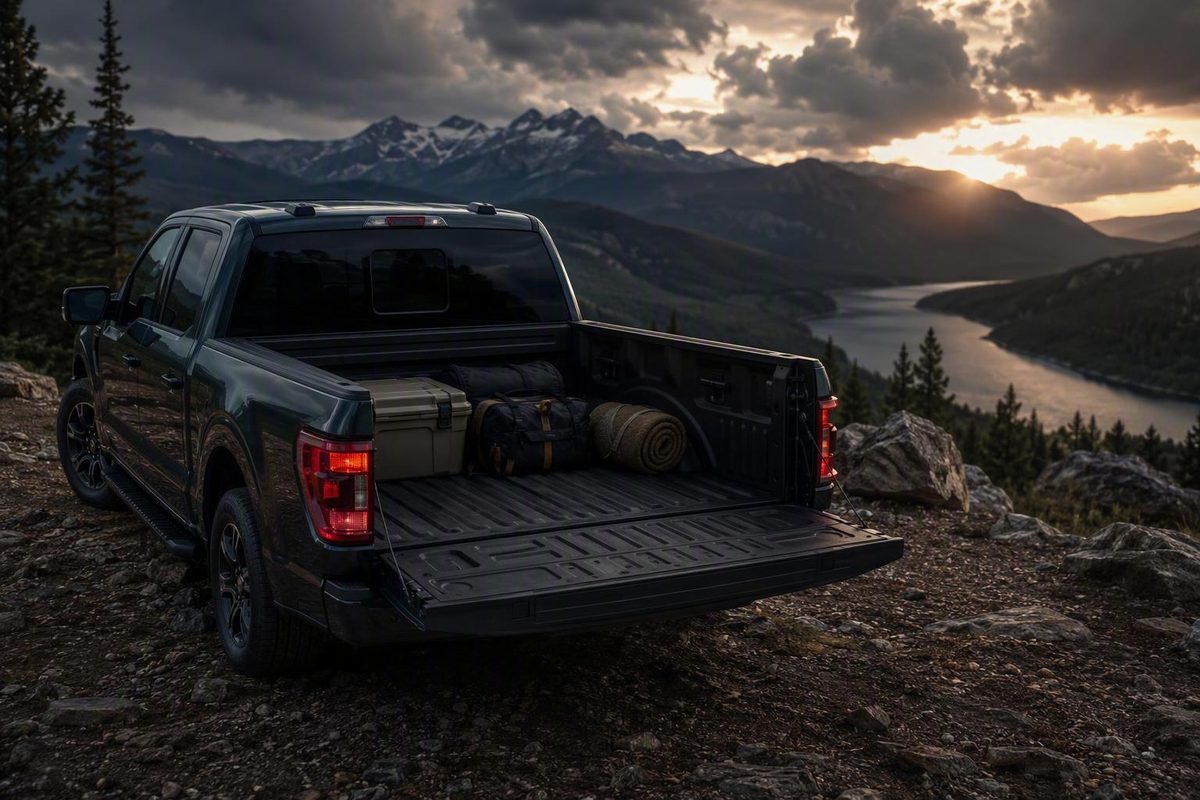
Modern Ford F-150 guides commonly list three nominal bed lengths: 5.5 feet, 6.5 feet, and 8 feet. For recent model years, the repeatedly reported inside-floor lengths are 67.1, 78.9, and 97.6 inches, respectively. A 2025 dealership specifications guide reports those measurements along with model-year-specific cab combinations and cargo volumes.1
Those figures are useful starting points, not universal specifications for every F-150 generation. Model year, cab style, trim, drivetrain, powertrain, packages, and production changes can affect availability. If you are identifying a used truck, ordering an accessory, or planning a width-sensitive installation, verify the exact configuration and measure the truck directly.
Evidence note: The dimensions and compatibility tables below summarize dealership and retailer guides rather than an official Ford dimensional diagram or ordering guide. They are therefore labeled as reported recent-model figures, not authoritative specifications for every truck.
F-150 bed lengths at a glance
The three commonly listed F-150 bed lengths are:
- 5.5-foot box: approximately 5 feet 7 inches inside
- 6.5-foot box: approximately 6 feet 7 inches inside
- 8-foot box: approximately 8 feet 2 inches inside
The following figures are repeatedly published for recent F-150 model years. The 50.6-inch measurement is identified by the 2025 source as clearance between the wheelhouses.1
| Nominal F-150 bed size | Reported inside-floor length | Approximate feet and inches | Reported height | Reported cargo volume | Reported wheelhouse clearance |
|---|---|---|---|---|---|
| 5.5-foot box | 67.1 in. | 5 ft. 7.1 in. | 21.4 in. | 52.8 cu. ft. | 50.6 in. |
| 6.5-foot box | 78.9 in. | 6 ft. 6.9 in. | 21.4 in. | 62.3 cu. ft. | 50.6 in. |
| 8-foot box | 97.6 in. | 8 ft. 1.6 in. | 21.4 in. | approximately 77.4 cu. ft. | 50.6 in. |
Read this table with several qualifications:
- The nominal labels are rounded. A “5.5-foot” box does not have an interior floor exactly 66 inches long.
- The width is not maximum wall-to-wall width. It is the reported clearance between the wheelhouses, often the limiting width for cargo placed directly on the bed floor.
- The eight-foot volume is approximate. Recent guides commonly publish 77.4 cubic feet, while another dealership guide lists 77.3 cubic feet. The difference may reflect rounding or transcription rather than a distinct bed.
- Dimensions can change by generation. Do not assume that a recent-model measurement applies to an older truck carrying the same rounded bed label.
- Conventional F-150 and F-150 Lightning configurations require separate checks. A bed measurement may be similar even when ordering combinations and accessory applications differ.
For initial identification, a bed measuring about 67 inches inside corresponds to the nominal 5.5-foot box. A measurement near 79 inches indicates the 6.5-foot box, while one near 98 inches indicates the eight-foot box.
Why the advertised size differs from the measured length
The labels 5.5 feet, 6.5 feet, and 8 feet describe product categories. They are not exact conversions of the usable interior floor length.
A literal conversion produces 66 inches, 78 inches, and 96 inches. Recent-model guides instead commonly report 67.1, 78.9, and 97.6 inches. A retailer’s F-150 fitment guide similarly associates measurements near 67, 79, and 98 inches with the three nominal categories while warning that exact specifications can vary by generation.2
| Direct interior measurement | Nominal bed category |
|---|---|
| Near 67 inches | 5.5-foot bed |
| Near 79 inches | 6.5-foot bed |
| Near 98 inches | 8-foot bed |
This difference does not mean a truck has the wrong bed. The nominal name is convenient for comparing configurations; the measured interior length is more useful when evaluating cargo or ordering a cover, liner, rack, drawer system, mat, or shell.
Do not convert a rounded bed label into inches and treat the result as an accessory-fitment measurement. A buyer who assumes a 5.5-foot box is exactly 66 inches may compare the wrong applications, especially when a manufacturer identifies products by model year and precise bed category.
Listings may also use these generic terms:
- Short bed: usually the nominal 5.5-foot option
- Standard bed: often the nominal 6.5-foot option
- Long bed: usually the nominal eight-foot option
These descriptions are not sufficiently precise for fitment. “Short bed” can mean different things across manufacturers, truck classes, generations, and marketplaces. One seller may reserve it for the 5.5-foot F-150 box, while another may use it loosely for any bed shorter than eight feet.
When evaluating a used-truck listing, look for the model year, cab style, window sticker, configuration-specific records, clear photographs, and a direct interior measurement. If those sources disagree, do not rely on the generic bed name or visual proportions alone.
Which beds pair with each F-150 cab?
Not every cab can be combined with every bed. Cab-and-bed availability is model-year specific, so no single matrix should be treated as a rule for the entire history of the F-150.
For 2023, Pine Belt Ford reported the following combinations.3
| 2023 cab style | 5.5-foot box | 6.5-foot box | 8-foot box |
|---|---|---|---|
| Regular Cab | — | Yes | Yes |
| SuperCab | — | Yes | Yes |
| SuperCrew | Yes | Yes | — |
A Ford of Latham guide reported the same pattern for 2024.4
| 2024 cab style | 5.5-foot box | 6.5-foot box | 8-foot box |
|---|---|---|---|
| Regular Cab | — | Yes | Yes |
| SuperCab | — | Yes | Yes |
| SuperCrew | Yes | Yes | — |
A 2025 Lake Keowee Ford guide reported a narrower eight-foot-box application for that model year: the 5.5-foot box with SuperCrew, the 6.5-foot box with all three conventional cab styles, and the eight-foot box with Regular Cab.1
| 2025 cab style | 5.5-foot box | 6.5-foot box | 8-foot box |
|---|---|---|---|
| Regular Cab | — | Yes | Yes |
| SuperCab | — | Yes | — |
| SuperCrew | Yes | Yes | — |
Read the 2025 table by bed:
- The 5.5-foot bed is reported with SuperCrew.
- The 6.5-foot bed is reported with Regular Cab, SuperCab, and SuperCrew.
- The eight-foot bed is reported with Regular Cab.
These are dealership-reported matrices, not substitutes for a Ford order guide. Local inventory is a separate issue: it affects what shoppers can find nearby, not necessarily what combinations the manufacturer offers.
The supplied evidence also contains a conflict for 2026. A J.C. Lewis Ford dimensions page lists an eight-foot SuperCrew, contrary to the 2023–2025 patterns above, and its exterior-dimension table contains entries that warrant confirmation.5 That combination should not be treated as established without an applicable Ford order guide, window sticker, or inspection of an actual truck.
For used-truck shopping, cab style can narrow the possibilities but may not identify the box. A SuperCrew from the recent years above points toward a 5.5- or 6.5-foot bed, but direct measurement is still needed to determine which one is present.
What changes when you move from 5.5 to 6.5 to 8 feet?
The main dimensional gains are floor length and cargo volume. Based on the reported recent-model figures of 67.1, 78.9, and 97.6 inches and 52.8, 62.3, and approximately 77.4 cubic feet, the differences are:
| Comparison | Added reported inside length | Added reported cargo volume |
|---|---|---|
| 5.5-foot to 6.5-foot | 11.8 in. | 9.5 cu. ft. |
| 6.5-foot to 8-foot | 18.7 in. | approximately 15.1 cu. ft. |
| 5.5-foot to 8-foot | 30.5 in. | approximately 24.6 cu. ft. |
Moving from the 5.5-foot to the 6.5-foot box therefore adds just under one foot of reported interior floor length. Moving from the 6.5-foot to the eight-foot box adds more than a foot and a half. Across the complete range, the longest box provides about 30.5 additional inches of reported floor length.
In the recurring recent-model measurements, height remains 21.4 inches and wheelhouse clearance remains 50.6 inches across the three boxes. The longer beds therefore add length and enclosed volume, not extra clearance between the wheelhouses.
That distinction affects what the additional space can accomplish:
- Long tools, cases, or lumber may lie flatter.
- Camping gear can be arranged with more room between storage zones.
- A sleeping platform can be longer.
- Some loads may extend less far onto or beyond an open tailgate.
- A longer box will not make a wide object fit between the wheelhouses.
- Length alone does not prove that a motorcycle, ATV, camper, toolbox, or drawer system will fit.
Dealer guidance describes an eight-foot bed as long enough to carry a nominal 4-by-8-foot sheet lengthwise with the tailgate closed.6 The reported 97.6-inch floor exceeds the sheet’s nominal 96-inch length, but the available margin is small enough that the exact truck, liner, bulkhead equipment, tailgate geometry, and actual sheet dimensions still matter.
Bed length also does not reveal the complete exterior footprint. Cab style and wheelbase affect overall length, turning behavior, passenger space, and garage fit. A Regular Cab with a long box and a SuperCrew with a shorter box present different compromises even if one has more cargo-floor length.
Treat the calculated gains as measurements, not recommendations. An additional 11.8 inches may be valuable for a sleeping platform or regularly carried cases. It may matter much less to a driver who mainly carries compact bins but must park in a short garage.
Choosing a bed for daily driving, work, and road trips
There is no universally best F-150 bed length. The practical choice is the one that handles recurring cargo without creating an avoidable problem in the places where the truck must be stored and driven.
Ask two questions:
- How much interior bed length do you regularly need?
- What complete cab-and-bed configuration can you comfortably park, store, and drive?
The 5.5-foot bed
The 5.5-foot box is the shortest of the three recent-model categories and is commonly associated with SuperCrew. It deserves consideration when rear-seat space, garage depth, parking convenience, and a shorter overall configuration matter more than maximum floor length.
Its reported 67.1-inch floor can accommodate many ordinary loads, including luggage, coolers, storage bins, tools, and compact outdoor equipment. Longer cargo may require an open tailgate, an appropriate support system, or a trailer. That can be an acceptable compromise when oversized loads are uncommon.
For road trips, make a realistic packing plan rather than evaluating each item separately. Coolers, water containers, folding chairs, recovery equipment, suitcases, cooking gear, and bicycles can consume usable floor area quickly, even when none is especially long.
The 6.5-foot bed
The 6.5-foot box adds a reported 11.8 inches of floor length and 9.5 cubic feet of volume over the 5.5-foot box. It also appears across the broadest range of cab styles in the recent-year dealership guides, although exact ordering availability still requires model-year verification.
The extra space may have a recurring purpose if you need to:
- Carry longer tools or equipment cases
- Build a longer sleeping platform
- Store more camping equipment below a tonneau cover
- Load a motorcycle with less dependence on an open tailgate
- Install drawers while preserving uncovered floor space
- Carry work supplies without moving to the longest bed
The tradeoff is the complete truck’s footprint. The additional bed length can matter in a residential garage, parking structure, drive-through, crowded trailhead, or parallel-parking space. Compare overall dimensions and test the exact cab-and-bed configuration rather than evaluating the box by itself.
The eight-foot bed
The eight-foot box offers the greatest interior length among the three categories. It is the size to investigate when long materials, bulky work equipment, an extended drawer system, or a sleeping-and-storage layout creates a genuine recurring need.
Its reported 97.6-inch interior length provides an advantage for nominal eight-foot sheet goods and other long cargo. The cab paired with the box still determines passenger space, while the combined cab, wheelbase, and bed determine the truck’s total footprint.
Owner reports can provide context but are not measurements. In a 2021-and-newer F-150 forum discussion, some owners said the longer configuration required more care with parking and multi-point turns, while others preferred the additional room for camping, work, or motorcycles.7 Those experiences depend on cab, wheelbase, driver, roads, garage dimensions, and parking environment.
Camping requires more than comparing your height with the bed’s advertised length. Measure the proposed platform and allow for the front wall, closed tailgate, liner, insulation, storage structures, and bedding. If you intend to use a topper, include its rails, interior taper, window hardware, installed height, and garage-door clearance.
Before purchasing, work through this checklist:
- Measure the garage. Record usable depth, door height, door width, and the space needed to move around the parked truck.
- Measure recurring parking areas. Consider gates, carports, work lots, parking decks, and drive-throughs.
- List the longest recurring cargo. Separate weekly or monthly needs from hypothetical or once-a-year loads.
- Decide how much cab space is necessary. Include passengers, child seats, pets, and weather-sensitive luggage.
- Consider any trailer you already use. If it routinely handles oversized cargo, maximum bed length may be less important.
- Sketch camping layouts. Include water, cooler, stove, chairs, sleeping platform, topper, bicycles, and access space.
- Measure equipment at its loading points. Motorcycle length alone does not account for chocks, handlebars, ramps, or tie-down angles.
- Inspect and test-drive the exact configuration. A specification table cannot show how a particular wheelbase feels in your normal parking environment.
The choice usually becomes clearer once recurring cargo is separated from occasional possibilities. Buy enough bed for what you repeatedly carry, then make sure the resulting truck works where it must be parked and driven.
How to measure an F-150 bed correctly
Direct measurement is the simplest way to identify an unknown F-150 bed when a listing is incomplete or documentation is ambiguous.
Use a straight tape measure long enough to span the bed:
- Clear the measurement path. Remove cargo that would bend or deflect the tape.
- Close the tailgate completely.
- Place one end of the tape against the inside face of the tailgate.
- Run the tape straight along the bed floor.
- Measure to the front bulkhead, the inside wall immediately behind the cab.
- Record the result in inches.
- Repeat the measurement to catch a tilted tape or inconsistent contact point.
This method follows a retailer’s measurement guide, which recommends measuring from the inside edge of the closed tailgate to the front of the bed and recording the result in inches.8
Match the result to the nearest category:
- Approximately 67 inches: nominal 5.5-foot bed
- Approximately 79 inches: nominal 6.5-foot bed
- Approximately 98 inches: nominal eight-foot bed
A small discrepancy does not necessarily indicate a different box. A thick liner, bed mat, bulkhead accessory, tape angle, or slightly different contact point can change a casual reading. If the result is close to one category, repeat the measurement with the tape level and centered.
Keep the measurement in inches when shopping for accessories. “About six and a half feet” is less useful than the model year, cab style, nominal box category, and an interior reading near 78.9 inches.
Secondary cross-checks may include:
- The original window sticker
- Model-year sales or ordering documentation
- Vehicle records tied to the VIN
- Inventory listings that specify cab and box
- Dealer parts or service assistance
Treat those methods as cross-checks rather than substitutes for inspection. Online listings can contain errors, and generic terms such as “short box” may be ambiguous.
Wheelbase can sometimes help identify a known historical configuration, but the mapping must remain model-year specific. A 2017 owner-forum discussion used cab style and wheelbase shown on a window sticker to infer bed length, but those user-reported combinations should not be generalized to newer trucks.
If documentation and measurement disagree, confirm that the tailgate was closed, the tape followed the interior floor, and the correct model year was identified. For an accessory purchase, ask the manufacturer to validate the application before ordering.
Check more than length before ordering bed accessories
Bed length is essential for accessory fit, but it is not the only required information.
Before ordering a tonneau cover, camper shell, rack, liner, drawer system, mat, or toolbox, confirm:
- Model year
- Conventional F-150 or F-150 Lightning
- Cab style
- Nominal box category
- Directly measured inside length
- Accessory mounting method
- Bedrail shape and usable rail length
- Existing liner, mat, or rail caps
- Factory cargo-management equipment
- Tailgate design
- Toolboxes, tie-downs, steps, lighting, or other interfering equipment
An accessory listed for a 5.5-foot box should not be assumed to fit a 6.5-foot box merely because a marketplace calls both applications “short” or “standard.” Mounting points, rails, panels, liners, and seals may differ. Retailer guidance likewise recommends matching accessories to the exact model year, configuration, and bed length rather than relying on the generic bed name.2
Width must be checked independently. Recent guides commonly report 50.6 inches between the wheelhouses across the three bed lengths.9 That clearance may limit:
- Drawer-system width
- Sleeping-platform supports
- Low-mounted water tanks
- Tool chests positioned near the floor
- Wide equipment cases
- Mattresses placed directly on the bed floor
- Cargo that cannot bridge the wheelhouses
Do not assume that a conventional full-size mattress will lie flat between the wheelhouses. Its conventional width exceeds the reported clearance. A sleeping setup may need a custom-cut mattress, narrower components, or a platform positioned above the wheelhouses.
Exact sizing is especially important for:
- Tonneau covers: rail length, clamps, panels, seals, and tailgate contact must match the application.
- Caps and camper shells: box length, rails, cab profile, and mounting points matter.
- Bed mats and molded liners: floor contours and wheelhouse shapes must align.
- Bed racks: mounting feet must fit compatible rails and clear factory equipment.
- Drawer systems: floor length, width, wheelhouse position, and tailgate access all matter.
- Toolboxes: the box must clear the bed walls, wheelhouses, cover, and cab.
- Cargo-management hardware: tracks and tie-downs may require specific mounting positions.
- Bed-mounted campers: dimensional fit is only one part of a configuration-specific weight and compatibility assessment.
Use the accessory manufacturer’s application data as the final fitment check. If its table is ambiguous, provide the measured length, model year, cab style, relevant configuration details, and photographs of existing bed equipment before ordering.
Bed length does not determine payload or towing by itself
A longer F-150 bed does not automatically provide a higher payload or towing rating.
Capacity depends on the complete vehicle configuration, which may include:
- Engine or powertrain
- Cab and wheelbase
- Bed configuration
- Two-wheel drive or four-wheel drive
- Axle ratio
- Trim and installed options
- Factory towing or payload equipment
- Tires and wheels
- Occupants and cargo
- Added accessories
- Trailer and hitch setup
The 2025 dealership guide itself ties its published maximums to particular equipment and cautions that payload and towing maxima vary by configuration and may not be achieved together.1 An isolated maximum should therefore never be treated as the rating of every F-150 with the same bed length.
For an actual truck, use the labels attached to that vehicle and the applicable model-year owner and towing documentation. If the terminology or configuration is unclear, obtain vehicle-specific assistance before loading or towing.
Keep physical fit separate from permissible weight:
- An object fitting in the bed does not establish that its weight is acceptable.
- A longer box does not prove that the truck can carry a heavier load.
- Cargo volume does not equal payload.
- A trailer connecting to the hitch does not establish an acceptable towing configuration.
- Caps, racks, drawers, toolboxes, and campers add weight and reduce the capacity available for other cargo.
A practical selection sequence is:
- Choose the required interior length. Start with recurring cargo or the planned work, sleeping, or storage layout.
- Check the complete footprint and cab needs. Confirm garage fit, parking practicality, passenger space, and maneuverability.
- Verify capacity and accessory fitment before buying. Use information tied to the exact truck and the accessory manufacturer’s application.
F-150 bed-length FAQ
What are the exact lengths of the 5.5-, 6.5-, and 8-foot F-150 beds?
For recent model years, dealership guides commonly report inside-floor lengths of 67.1 inches for the 5.5-foot box, 78.9 inches for the 6.5-foot box, and 97.6 inches for the eight-foot box.10 These are reported recent-model measurements, not guaranteed specifications for every F-150 generation.
The rounded labels are nominal categories rather than exact conversions. Measure the specific truck when accessory fit or cargo clearance depends on the result.
Can an F-150 SuperCrew have an eight-foot bed?
The 2023 and 2024 dealership guides cited above list SuperCrew with 5.5- or 6.5-foot boxes, not the eight-foot box. The 2025 guide reports the same SuperCrew choices.
A 2026 dealership page lists an eight-foot SuperCrew, but that entry conflicts with the preceding recent-year pattern and appears in a table containing other dimensions that warrant confirmation.5 Do not treat an eight-foot SuperCrew as confirmed for that model year without checking applicable Ford ordering documentation, a window sticker, or an actual vehicle.
How wide is an F-150 bed between the wheelhouses?
Recent guides commonly report 50.6 inches between the wheelhouses for all three bed lengths.9 That is the relevant clearance for cargo or structures that must sit directly on the bed floor.
It is not necessarily the maximum wall-to-wall width higher in the box. Verify the model year and measurement location before designing a mattress platform, drawer system, toolbox, or other width-sensitive installation.
Will a 4-by-8-foot sheet fit in an F-150 bed with the tailgate closed?
A nominal 4-by-8-foot sheet is 96 inches long, while the commonly reported recent-model eight-foot F-150 bed is 97.6 inches long inside. Dealer guidance consequently describes the eight-foot bed as able to carry a standard sheet lengthwise with the tailgate closed.6
Confirm the exact loading geometry before relying on that small margin. A liner, bulkhead accessory, tailgate shape, actual sheet dimensions, or other cargo can reduce usable space. The 5.5- and 6.5-foot boxes are shorter than a nominal eight-foot sheet.
What bed length is listed for the F-150 Lightning?
The 2026 J.C. Lewis Ford dimensions page lists the F-150 Lightning with a 5.5-foot bed measuring 67.1 inches inside.11 Because that page is a dealership guide—and its conventional F-150 table includes entries requiring confirmation—this should be treated as a dealer-reported 2026 specification rather than an official model-year-wide determination.
Check model-year-specific Ford documentation and the accessory manufacturer’s application before ordering Lightning bed equipment.
The F-150 bed-length buying rule
Recent F-150 beds are commonly labeled 5.5, 6.5, and 8 feet and measure about 67, 79, and 98 inches inside. Verify the exact model year and cab combination, measure from the front bulkhead to the inside face of the closed tailgate, check your garage and recurring cargo, and confirm vehicle-specific load limits and accessory fitment before buying.
-
Lake Keowee Ford: 2025 Ford F-150 bed dimensions and cab availability ↩↩↩↩
-
J.C. Lewis Ford: 2026 F-150 dimensions and reported bed availability ↩↩
-
J.C. Lewis Ford Statesboro: Short-bed and long-bed cargo guidance ↩↩
-
F150 Forum: Owner discussion comparing 5.5- and 6.5-foot beds ↩
-
AutoNation Ford Frisco: F-150 bed dimensions and wheelhouse clearance ↩↩
-
DeYarman Automotive Group: Reported F-150 cargo-box dimensions ↩
-
J.C. Lewis Ford: Reported 2026 F-150 Lightning bed configuration ↩