
How the Two F-250 Beds Compare in Usable Space and Truck Length
Recent listings put short- and long-bed floor lengths at 81.9 and 98.1 inches. Accessory fit needs the right measurement point. Garage fit needs the complete truck.
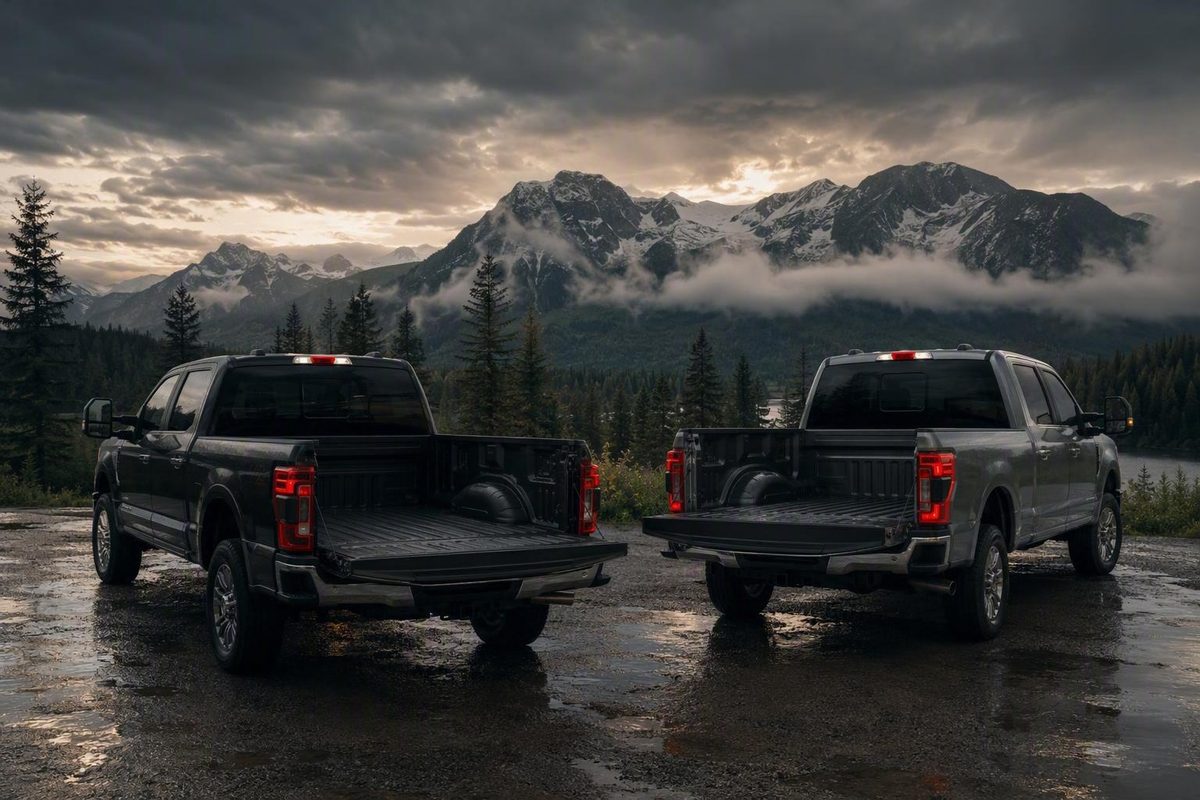
Recent 2024–2026 dealership guides commonly list two nominal Ford F-250 bed lengths: 6.75 feet and 8 feet. The shorter option is variously called the short or standard bed; the 8-foot version is the long bed.
Several of those guides report inside floor lengths of 81.9 inches and 98.1 inches, respectively. Using those figures, the long bed adds 16.2 inches of floor length and 13.1 cubic feet of cargo volume. These are repeated third-party listings, however—not independently confirmed Ford factory specifications—and other supplied sources publish different lengths.
The practical choice involves more than the bed label. Cab style, complete vehicle length, recurring cargo, garage depth, fitted equipment, payload and fifth-wheel clearance all matter. Use nominal sizes for initial shopping, but verify the model year and physically measure the exact truck before making a close-clearance decision.
F-250 bed lengths at a glance
For recent F-250s, the direct answer is:
- 6.75-foot bed: the shorter bed, also commonly called the standard bed
- 8-foot bed: the long bed
The table below summarizes dimensions repeatedly listed in detailed 2024–2026 dealership guides. They should be treated as third-party listed measurements rather than independently confirmed Ford specifications.
| Nominal F-250 bed length | Common name | Reported inside floor length | Reported cargo volume | Reported maximum inside floor width | Reported width between wheelhouses | Reported height |
|---|---|---|---|---|---|---|
| 6.75 feet | Short or standard bed | 81.9 in | 65.4 cu ft | 66.9 in | 50.5 in | 21.1 in |
| 8 feet | Long bed | 98.1 in | 78.5 cu ft | 66.9 in | 50.5 in | 21.1 in |
Table source: A detailed 2024 dealership guide lists the floor lengths, maximum widths, wheelhouse widths, heights and volumes shown above while distinguishing floor length from length at the top of the box. Review the 2024 F-250 bed-dimension table.
The terms “6.75-foot bed” and “8-foot bed” are product-size categories. They help identify the broad configuration, but they do not define where an interior measurement was taken.
Model year also matters. Although 81.9 and 98.1 inches appear repeatedly in recent listings, other sources publish 80.2 and 96.4 inches. Those differences could involve model years, measurement points, rounding, copied data or source errors. The supplied evidence does not establish one explanation for every conflicting page.
Use the table as a recent-model comparison, not as proof that every F-250 generation or configuration has an identical cargo box.
Why the nominal bed names do not match the measured lengths exactly
A nominal bed name is a convenient category, not a promise that every measurement of the box will equal the label exactly.
Converting the commonly listed floor lengths illustrates the difference:
- 81.9 inches ÷ 12 = 6.825 feet, or about 6.83 feet
- 98.1 inches ÷ 12 = 8.175 feet, or about 8.18 feet
Neither conversion exactly equals the nominal 6.75- or 8-foot designation. That is not inherently contradictory: the labels identify product classes, while the inch figures describe particular interior measurements.
Measurement location can also change the result. One 2024 dealership guide lists the short box as 81.9 inches at the floor and 80.3 inches at the top. It lists the long box as 98.1 inches at the floor and 96.4 inches at the top. The guide identifies the floor and top-of-bed dimensions separately.
An unlabeled number such as “96.4 inches” therefore might refer to:
- Length along the inside floor
- Length near the top of the box
- A general or “usable” length defined by the publisher
- A rounded or copied specification
- A measurement for a different model year
Do not assume that every conflicting number describes the same part of the box.
For ordinary truck shopping, the nominal bed name is usually sufficient to separate the two choices. For fitted equipment, it may not be.
Before ordering a fitted accessory:
- Confirm the truck’s model year, cab and nominal box size.
- Follow the accessory maker’s measurement instructions.
- Determine whether it requires floor length, upper-box length, rail length or mounting-hole spacing.
- Account for existing liners, hitches, toolboxes and cargo-management hardware.
- Measure the actual truck instead of converting the nominal bed label.
The label narrows the search but does not establish fit by itself.
Short-bed and long-bed interior dimensions compared
Using the commonly reported recent-model figures, both beds have the same listed cross-sectional dimensions:
- Maximum inside floor width: 66.9 inches
- Width between wheelhouses: 50.5 inches
- Inside height: 21.1 inches
They differ principally in floor length and resulting cargo volume. A detailed 2026 F-250 guide lists 81.9 inches and 65.4 cubic feet for the 6.75-foot bed, compared with 98.1 inches and 78.5 cubic feet for the 8-foot bed. See the 2026 bed-dimension comparison.
| Comparison | 6.75-foot bed | 8-foot bed | Long-bed difference |
|---|---|---|---|
| Inside floor length | 81.9 in | 98.1 in | +16.2 in |
| Cargo volume | 65.4 cu ft | 78.5 cu ft | +13.1 cu ft |
| Maximum inside floor width | 66.9 in | 66.9 in | No listed difference |
| Width between wheelhouses | 50.5 in | 50.5 in | No listed difference |
| Inside height | 21.1 in | 21.1 in | No listed difference |
Based on those inputs, the volume increase relative to the listed short-bed volume is approximately:
13.1 ÷ 65.4 × 100 ≈ 20.0%
That percentage describes added box volume. It does not mean a long-bed F-250 can carry 20% more weight. Cargo volume measures space; payload is a vehicle-specific weight limit affected by the complete configuration and installed equipment.
Because the cited width, wheelhouse gap and height remain the same, the listed volume increase comes primarily from the additional 16.2 inches of length. The long bed is therefore most useful when cargo is lengthy, must be arranged in a line rather than stacked, or needs to remain inside the box with the tailgate closed.
The wheelhouse figure is not completely unanimous. Most detailed recent listings give 50.5 inches, while one general 2026 Ford truck-bed comparison publishes 50.6 inches between the wheel wells for the F-250 and F-350. University Ford Durham reports the 50.6-inch figure.
A tenth-inch discrepancy may reflect rounding or another difference in source data, but the evidence does not identify the cause. For cargo or equipment with little clearance, measure the narrowest point in the actual box.
Published dimensions also describe an empty bed more neatly than many trucks exist in practice. Usable space may be reduced or reshaped by:
- Drop-in or spray-in liners
- Bed mats
- Fifth-wheel or gooseneck hardware
- Cross-bed toolboxes
- Fuel or transfer tanks
- Drawer systems and cargo slides
- Tie-down fittings
- Tonneau-cover rails
- Camper mounts
- Service-body or other upfit components
A toolbox can consume much of the added fore-and-aft space that motivated choosing the long bed. Hitch rails may leave the nominal volume largely unchanged while interfering with flat cargo or equipment placement. Compare the space remaining after planned equipment is installed, not only the empty-bed dimensions.
Cab and bed combinations
Cab and bed choices cannot be separated. Together they determine passenger space, overall truck length and which configurations are listed as available.
The better-supported pattern in the detailed recent dealership tables is:
| F-250 cab style | 6.75-foot bed | 8-foot bed |
|---|---|---|
| Regular Cab | — | Yes |
| SuperCab | Yes | Yes |
| Crew Cab | Yes | Yes |
Detailed 2024 and 2026 tables list the Regular Cab only with the 8-foot bed, while listing both beds for the SuperCab and Crew Cab. A 2026 configuration table also provides complete vehicle dimensions for those five combinations. See the listed 2026 F-250 configurations.
That pattern creates five distinct choices:
- Regular Cab, 8-foot bed: long cargo floor with the smallest listed cab
- SuperCab, 6.75-foot bed: a shorter overall package with more interior room than a Regular Cab
- SuperCab, 8-foot bed: long cargo floor without the complete length of a Crew Cab long-bed truck
- Crew Cab, 6.75-foot bed: maximum listed rear passenger space with the shorter box
- Crew Cab, 8-foot bed: maximum listed rear passenger space and box length, but also the longest configuration
The evidence is not unanimous. One supplied 2026 dealer page says both bed configurations can be paired with any cab, which conflicts with the more detailed tables restricting the Regular Cab to the long bed. Westfield Ford publishes the conflicting cab-and-bed statement.
Because the available sources are dealership research pages rather than a supplied Ford order guide, that conflict should not be resolved by assumption. Before buying or ordering, confirm the configuration through the applicable model-year order guide, window sticker, VIN-specific inventory record, current configuration tool or written order documentation.
Do not extend the recent compatibility matrix to every earlier F-250. Familiar cab and bed names can persist even when trim, drivetrain and ordering restrictions change.
For a used truck, the physical vehicle settles the basic cab-and-bed question, but documentation still matters. Photographs, a window sticker and a physical measurement are stronger checks than a listing title alone.
Overall truck length and garage planning
A truck bed does not park by itself. Garage, driveway and street-parking decisions must use the complete F-250 length, including both cab and bed.
One detailed 2026 dealership table reports:
| 2026 F-250 configuration | Reported overall length | Approximate feet and inches |
|---|---|---|
| Regular Cab, 8-foot bed | 231.8 in | 19 ft 3.8 in |
| SuperCab, 6.75-foot bed | 238.2 in | 19 ft 10.2 in |
| SuperCab, 8-foot bed | 254.4 in | 21 ft 2.4 in |
| Crew Cab, 6.75-foot bed | 250.0 in | 20 ft 10 in |
| Crew Cab, 8-foot bed | 266.2 in | 22 ft 2.2 in |
The cited Crew Cab configurations differ by 16.2 inches overall, matching the difference between the commonly reported bed-floor lengths. The full listed range is 231.8 to 266.2 inches, depending on cab and bed. T&S Ford’s 2026 exterior-dimension table lists all five lengths.
A nominal 20-foot garage equals 240 inches. Compared with that nominal depth:
- Regular Cab with 8-foot bed: 8.2 inches shorter than 240 inches
- SuperCab with 6.75-foot bed: 1.8 inches shorter
- SuperCab with 8-foot bed: 14.4 inches longer
- Crew Cab with 6.75-foot bed: 10 inches longer
- Crew Cab with 8-foot bed: 26.2 inches longer
Even the two configurations numerically below 240 inches would have little practical margin in a space containing interior trim, shelving, steps, a closed door or rear hitch hardware.
Before treating a configuration as garage-compatible, check:
- Clear interior depth: Measure from the nearest fixed front obstruction to the fully closed garage door.
- Door-opening width: The opening may be narrower than the interior.
- Door-opening height: Measure the actual truck with its tires, suspension and roof-mounted equipment.
- Mirror clearance: Account for both folded and extended positions.
- Front margin: Include the bumper, tow hooks and enough visual space to park consistently.
- Rear equipment: Include any receiver, ball mount, step or accessory extending beyond the body.
- Fixed obstacles: Locate shelving, appliances, stairs, bollards, benches and water heaters.
- Door movement: Confirm that braces, handles or door sections do not move into the parking envelope.
- Human access: Leave enough room to exit the truck and move around it.
Parking-lot usability follows the same principle. The long bed adds a readily understood 16.2 inches on the commonly listed dimensions, but complete vehicle length determines how far the truck projects from a space and how much maneuvering room remains.
These numbers are planning figures rather than fit guarantees. Equipment can change the real vehicle envelope, so measure the truck in the condition in which it will be parked.
Choosing a bed for cargo and road use
Neither F-250 bed is universally better. The choice is a trade-off between cargo-floor length and the footprint of the complete truck.
When the 6.75-foot bed makes more sense
The shorter bed is the stronger candidate when these priorities dominate:
- A shorter overall configuration
- Urban parking or congested jobsite access
- Limited driveway or garage depth
- Crew Cab passenger room without the longest possible truck
- Cargo that is bulky but rarely longer than the short box
- Frequent everyday driving with only occasional long loads
The shorter box retains the same commonly reported maximum inside floor width, wheelhouse clearance and height as the long box. Its principal trade-off is reduced length and volume rather than a narrower path between the wheelhouses.
That can make it a practical compromise for coolers, bins, recovery equipment, camping supplies and luggage that can be stacked or arranged vertically. A cross-bed toolbox, auxiliary tank or hitch can substantially shorten the remaining floor area, however, so lay out recurring equipment by footprint before deciding.
When the 8-foot bed makes more sense
The long bed is the stronger candidate when these needs take priority:
- Maximum enclosed floor length
- Approximately 20% more listed box volume
- More separation between tools, luggage and recreation equipment
- Carrying long material with less reliance on the open tailgate
- Preserving cargo room after adding a toolbox or hitch
- Reducing how often cargo must rest on or extend beyond the tailgate
A nominal 4-by-8-foot sheet measures 48 by 96 inches. Those dimensions are smaller than the commonly listed 50.5-inch wheelhouse gap and 98.1-inch long-bed floor, and one general Super Duty comparison describes the 8-foot box as able to carry full 4-by-8 sheets with the tailgate closed. See the dealership’s short-bed and long-bed cargo comparison.
Treat that as a dealership-reported use case, not a universal fit guarantee. The cited floor measurement differs from the shorter upper-box measurement reported elsewhere, and liners, tailgate accessories, dividers or fitted hardware can reduce clearance. Measure the actual box and the material before relying on a narrow dimensional margin.
Measure the cargo you actually carry
A useful buying exercise is to list recurring loads and measure the space they occupy. Examples include:
- Motorcycle wheelbase and handlebar width
- Coolers with handles extended
- Fuel and water containers
- Recovery boards, jacks and tool cases
- Cross-bed toolboxes
- Camping bins and sleeping platforms
- Generators and compressors
- Ladders and long-handled tools
- Road-trip luggage
- Hitch equipment that remains installed
On a floor, mark rectangles measuring 81.9 by 50.5 inches and 98.1 by 50.5 inches. Arrange the recurring equipment inside each outline. This does not reproduce every contour of the box, but it shows whether the additional length solves a real packing problem.
Cargo volume does not establish payload capacity. Trucks with the same nominal bed can have different available payload because of their cabs, drivetrains, engines, trims and installed equipment. Use the exact truck’s labels and configuration-specific documentation rather than inferring allowable weight from bed length or empty volume.
Bed length and fifth-wheel towing
An F-250 does not automatically need an 8-foot bed for every fifth wheel, but bed length alone cannot establish compatibility.
The supplied owner discussion includes individual reports of fifth wheels used with both 6.75-foot and 8-foot trucks. Short-bed owners discuss slider hitches and trailers shaped to provide additional cab clearance, while long-bed owners emphasize extra cargo room. The page itself identifies the discussion as owner experience and warns that its displayed summary may contain inaccuracies. See the Jayco Owners Forum discussion.
Those anecdotes are not manufacturer specifications, controlled tests or permission to duplicate a setup. The supplied evidence pack does not include Ford towing documentation or primary technical instructions from the relevant hitch and trailer manufacturers. It therefore cannot establish whether a particular combination requires a slider or has adequate clearance.
At minimum, a compatibility review needs to consider the exact:
- Truck configuration and available payload
- Hitch model, mounting system and pivot position
- Trailer front-cap profile
- Pin-box design
- Cab-to-trailer clearance through the required steering range
- Bed-mounted toolbox, tank or other hardware
- Loaded pin weight, occupants and cargo
An 8-foot bed should not be treated as a universal guarantee of cab clearance, and a 6.75-foot bed should not be assumed incompatible solely because it is shorter. Physical fit also does not establish that the truck has enough payload or that the combination complies with all manufacturer limits.
Before purchasing a fifth-wheel system, obtain compatibility confirmation based on the exact truck, hitch, pin box and trailer from the applicable manufacturers or a qualified installer. Do not base a consequential towing decision on another owner’s outwardly similar combination.
Model-year conflicts and how to verify an exact F-250
The measurement conflict is straightforward:
- Several 2024–2026 listings report 81.9 inches for the short-bed floor and 98.1 inches for the long-bed floor.
- Other pages discussing a 2024 or unspecified recent F-250 report 80.2 and 96.4 inches.
One dealership research page explicitly separates the figures by model year. It lists 80.2 and 96.4 inches for 2022 Super Duty beds, then 81.9 and 98.1 inches for 2024, while giving the same stated volumes of 65.4 and 78.5 cubic feet. DeYarman Ford presents separate 2022 and 2024 measurements.
The supplied evidence does not conclusively explain the disagreement. Possible categories include:
- A genuine model-year difference
- Floor length versus upper-box length
- Different definitions of usable length
- Rounding conventions
- Specifications copied from an older page
- Data-entry or source error
These are possibilities, not established findings. One source’s 96.4-inch figure matches another source’s long-box top measurement, but that coincidence does not prove every 96.4-inch listing uses the same measurement point.
A separate 2024 dealership article gives 80.2 inches for the 6.75-foot bed and 96.4 inches for the 8-foot bed, even though other 2024 pages use the longer pair. It also reports the familiar 65.4- and 78.5-cubic-foot volumes. See the conflicting 2024 measurements from Ciocca Ford of Red Lion.
Because the evidence conflicts, it is not reasonable to conclude that F-250 bed dimensions necessarily remained unchanged from 2017 through 2024. A particular older truck may match a recent listing, but one matching configuration does not prove uninterrupted dimensional uniformity across every year.
A reliable verification sequence
For a new order, used-truck purchase or accessory-fit decision:
- Identify the model year and cab. Record whether the truck is a Regular Cab, SuperCab or Crew Cab.
- Confirm the nominal bed size. Use the window sticker, build documentation or VIN-specific listing.
- Consult model-year-specific material. Prefer the applicable order guide, body-builder information or technical documentation.
- Define the measurement required. Floor length, upper-box length, wheelhouse clearance and rail dimensions are not interchangeable.
- Inspect installed equipment. Note liners, mats, cover rails, toolboxes, hitches, tanks, drawers and upfits.
- Physically measure the box. Check the inside floor with the tailgate closed, the narrowest wheelhouse gap and any required mounting points.
- Measure the destination. Verify the actual garage opening, parking envelope or cargo footprint.
- Recheck before ordering. Compare the truck measurements with the accessory manufacturer’s instructions.
Used trucks require particular care. Aftermarket liners can obscure the original box surface, and toolboxes, hitch rails, covers or body modifications can change practical space. Sellers may also use “standard bed” and “short bed” inconsistently.
The concise rule is:
Use 6.75 feet and 8 feet for broad comparison, but use model-year-specific documentation and physical measurements for fit decisions.
Recent listings consistently point to two nominal F-250 bed choices. On the commonly reported 81.9- and 98.1-inch floor figures, the long bed provides 16.2 more inches of length and 13.1 more cubic feet of volume. Choose according to recurring cargo, required cab space, complete-truck parking room and trailer-clearance requirements—not the bed label alone.
Because the supplied third-party measurements conflict, verify the exact truck before buying a liner, rack, cover, camper or hitch, planning garage fit or configuring a fifth wheel.
Frequently asked questions
What is the actual inside length of an F-250 short bed?
Many 2024–2026 dealership listings report an inside floor length of 81.9 inches, or about 6.83 feet, for the nominal 6.75-foot bed. A detailed 2026 guide lists that floor measurement together with a 65.4-cubic-foot volume. See the listed 2026 short-bed dimensions.
That figure is not universal. Some sources publish 80.2 inches, and one detailed page distinguishes an 81.9-inch floor measurement from an 80.3-inch upper-box measurement. Verify the model year and measurement point when fit depends on an inch or two.
Can an F-250 Crew Cab have an 8-foot bed?
Yes. Detailed recent configuration tables list the F-250 Crew Cab with either the 6.75-foot or 8-foot bed. In one 2026 table, the Crew Cab long-bed configuration is 266.2 inches overall, or approximately 22 feet 2.2 inches.
Availability can still depend on model year and ordering restrictions. Confirm the individual truck or applicable order documentation rather than assuming every historical Crew Cab offered both beds.
Can a 4-by-8-foot sheet fit in an F-250 bed with the tailgate closed?
A dealership comparison describes the 8-foot Super Duty box as able to carry a full 4-by-8-foot sheet with the tailgate closed. The commonly listed dimensions support that as a planning indication: a nominal sheet is 48 by 96 inches, compared with a reported 50.5-inch wheelhouse gap and 98.1-inch floor length for the long bed.
It is not a fit guarantee. The upper-box measurement may be shorter than the floor measurement, and liners, tailgate equipment, toolboxes or other hardware can reduce clearance. The commonly reported 81.9-inch short-bed floor is not long enough to contain a 96-inch sheet entirely within the closed box.
Will a Crew Cab F-250 fit in a 20-foot garage?
Based on one detailed 2026 listing, not if “20 feet” means exactly 240 inches of usable depth. The Crew Cab with the 6.75-foot bed is listed at 250.0 inches, while the Crew Cab with the 8-foot bed is 266.2 inches overall. Both exceed 240 inches before allowing for the garage door, shelving, walking room or hitch equipment.
Measure the garage’s unobstructed depth and the actual truck. A nominal garage size and the usable closed-door parking envelope are not necessarily the same.
Why do some F-250 bed specifications say 80.2 and 96.4 inches instead of 81.9 and 98.1 inches?
The supplied third-party sources do not provide a definitive explanation. The disagreement may involve model-year changes, different measurement points, rounding, copied specifications or source error.
One page assigns 80.2 and 96.4 inches to 2022 Super Duty boxes, but 81.9 and 98.1 inches to 2024. Other pages apply the shorter figures to 2024 or to unspecified recent F-250s. Do not treat the two pairs as equivalent without checking the model year, measurement definition and exact truck.