
Situations Where Acceleration Causes Road Accidents
Acceleration can be dangerous even below the speed limit when its timing is wrong, such as gunning the engine out of a parking space or into a small gap.
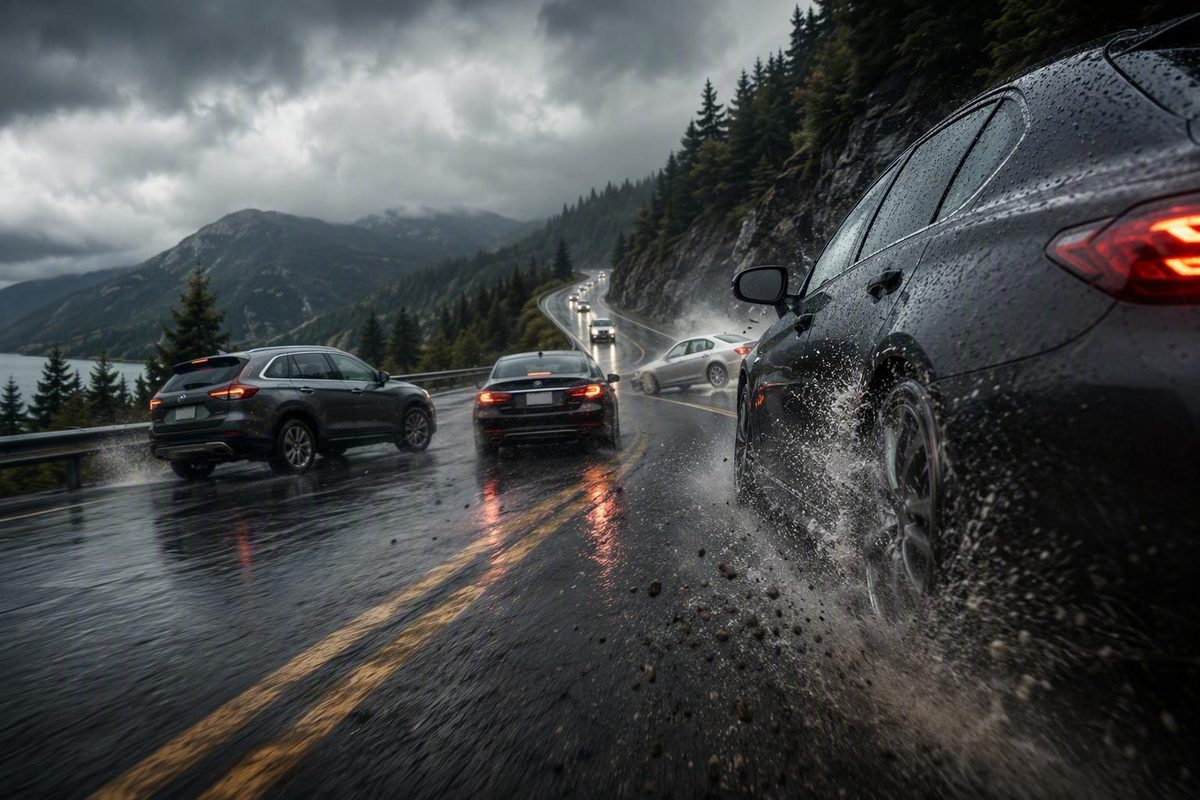
Situations Where Acceleration Causes Road Accidents
Overview
Acceleration contributes to road accidents in five main ways: deliberate hard acceleration that outpaces a driver’s ability to react, accelerating at the wrong moment (such as into a merge or turn), acceleration that breaks the tires’ grip on the road, sudden unintended acceleration the driver never chose, and the higher speeds acceleration produces, which make any collision harder to avoid and more severe.
This article walks through each of those situations in plain language. It explains how acceleration differs from speeding and from the violent deceleration of an impact, maps common driving scenarios to the type of risk involved, and offers general prevention and post-crash guidance. The framing here is educational, drawing on public safety guidance such as the NHTSA overview of speeding and aggressive driving, which states plainly that speeding endangers everyone on the road. It is not legal advice, and it cannot tell you what caused any specific crash — that requires a qualified review of the actual evidence.
Acceleration, speeding, sudden unintended acceleration, and crash deceleration are different
These four terms get mixed together after a crash, but they describe different things, and the difference matters for both prevention and responsibility.
Acceleration is simply a change in speed — pressing the pedal to go faster. Acceleration can be dangerous even below the speed limit if it happens at the wrong time or place, such as gunning the engine out of a parking space or into a gap in traffic that is smaller than it looked.
Speeding is traveling too fast — either above the posted limit or too fast for conditions such as rain, darkness, or heavy traffic. NHTSA’s speeding and aggressive driving guidance treats speeding as a risky-driving behavior with real dangers and consequences, and often links it to aggressive driving. Acceleration is how a vehicle reaches an unsafe speed; speeding is the state of being at one. A driver can accelerate hard without ever speeding, and can speed without accelerating at all.
Sudden unintended acceleration is different again: the vehicle accelerates when the driver did not intend it to. The Labrum Law Firm’s discussion of sudden unintended acceleration describes incidents where a vehicle continues accelerating even after being placed into park or neutral — and points to causes ranging from floor mats and debris to pedal mistakes and vehicle malfunction.
Crash deceleration is the rapid slowing that happens during impact. It is what actually causes much of the harm in a collision, but it is a consequence of the crash, not a driving behavior.
Keeping these apart helps you ask the right question after an incident: did the driver choose to accelerate, was the acceleration unintended, or is “acceleration” being used loosely to mean the vehicle was simply going too fast?
Common situations where acceleration can contribute to a crash
Acceleration becomes dangerous in specific, recognizable situations — usually when a driver adds speed at a moment that demands more grip, more visibility, or more reaction margin than is actually available. The situations below reflect the general risk mechanisms described in public safety guidance on speeding, explanations of crash causes and physics, and coverage of sudden unintended acceleration.
The matrix below maps each situation to the main type of acceleration risk, the crash pattern it can produce, and the prevention cue that addresses it. It is qualitative — none of these situations is ranked by frequency, and any single crash needs its own investigation.
| Situation | Main acceleration risk | Likely crash pattern | Prevention cue |
|---|---|---|---|
| Pulling into traffic or merging | Accelerating into a gap that is too small or misjudged | Side or angled impact with through traffic | Wait for a clearly adequate gap; accelerate smoothly, not abruptly |
| Passing on a two-lane road | Committing to hard acceleration with limited visibility ahead | Head-on or sideswipe collision | Pass only with clear sight lines and abort early if unsure |
| Accelerating through an intersection | Trying to “beat” a light or cross traffic | Intersection impact with crossing vehicles or pedestrians | Treat a stale green or yellow as a cue to slow, not accelerate |
| Accelerating in a turn or curve | Demanding more tire grip than the curve allows | Loss-of-control or run-off-road crash | Finish most braking and accelerating before the curve, not in it |
| Stop-and-go traffic | Rapid acceleration into a shrinking following gap | Rear-end collision | Leave space and accelerate gently between slowdowns |
| Parking lots and driveways | Pedal misapplication or bursts of speed near pedestrians | Low-speed impact with pedestrians, vehicles, or structures | Move slowly, check pedal position, and cover the brake |
| Rain, snow, ice, gravel, or worn pavement | Acceleration exceeding available traction | Wheel spin, skid, or loss-of-control crash | Ease onto the accelerator and drive slower than the posted limit when conditions demand it |
| Hills and blind crests | Adding speed where hazards are hidden | Rear-end or run-off-road crash beyond the crest | Hold steady speed until you can see what is ahead |
| Vehicle accelerates on its own | Sudden unintended acceleration from mats, debris, pedal error, or malfunction | Impact with whatever is ahead, often at close quarters | Keep floor mats secured, footwear appropriate, and know how to shift to neutral |
Three themes run through the table. First, most of these situations involve accelerating into something unknown — a gap, a curve, a crest, a crosswalk. Second, several involve conditions where the road offers less grip than the driver assumes, which is why NHTSA’s broader concept of driving too fast for conditions applies even below posted limits. Third, one row is different in kind: unintended acceleration is not a judgment error about when to speed up, and it deserves the separate treatment it gets below.
Why rapid acceleration can make a crash harder to avoid
Rapid acceleration shrinks a driver’s margin for error in several connected ways, even before any speed limit is broken.
The first is reaction margin. When you accelerate hard, the situation ahead changes faster than your eyes and brain can update. A gap that was safe when you pressed the pedal may already be closing by the time you are committed. Hazards effectively arrive sooner, and the time available to notice and respond gets compressed.
The second is stopping demand. The faster a vehicle is moving, the more distance it needs to stop — a core reason NHTSA treats speeding as a danger to everyone on the road. Rapid acceleration means you reach that higher-demand state quickly, often before you have re-checked the space in front of you. In stop-and-go traffic, this is exactly how a routine slowdown ahead becomes an unavoidable rear-end impact.
The third is traction. Tires have a finite amount of grip, and accelerating consumes part of it. Ask the tires to accelerate hard and turn — merging onto a curved ramp, for example — and there may not be enough grip left for steering, which is how acceleration in a curve becomes a loss-of-control crash, especially on wet or loose surfaces.
Finally, there is crash energy. As the explanation of car crash causes and physics from 1800Law1010 describes, a vehicle’s momentum and the forces involved in a collision grow with its velocity. Acceleration is what builds that momentum. A crash that happens moments after hard acceleration tends to involve more energy than the same crash at a gentler pace — which means more force to be absorbed by vehicles and the people inside them.
None of this requires formulas to act on: hard acceleration trades away reaction time, stopping room, steering grip, and impact severity all at once.
Sudden unintended acceleration and pedal mistakes
Sometimes the acceleration that causes a crash was never the driver’s choice. Sudden unintended acceleration, as described by Labrum Law Firm, refers to incidents where a vehicle accelerates unexpectedly — including cases where it continues accelerating even after being shifted into park or neutral.
The causes described in that coverage fall into a few practical categories:
- Floor mat interference — an unsecured or ill-fitting mat slides forward and pins or traps the accelerator pedal.
- Debris or objects in the footwell — a bottle, tool, or other loose item lodges against or under the pedal.
- Pedal misapplication — the driver presses the accelerator believing it is the brake, a mistake most common in parking lots, driveways, and other low-speed maneuvering where the driver’s foot is moving between pedals.
- Vehicle malfunction — a mechanical or electronic problem with the throttle or related systems causes the vehicle to accelerate without driver input.
The distinction between these categories matters more than it might first appear. A pedal mistake is a driver error, even though it is unintentional; a trapped floor mat may point to how the vehicle was equipped or maintained; a genuine malfunction may point to a defect. From the outside — and often from inside the car — these can look identical: the vehicle surged forward and hit something.
That is why a specific incident cannot be classified from the crash outcome alone. Whether a particular surge was pedal error, an obstruction, or a malfunction is a question of investigation, not assumption, and it is one of the main reasons the post-crash observations discussed below are worth preserving.
Crash patterns linked to acceleration
Different acceleration situations tend to produce different kinds of collisions. Connecting the two helps make sense of how a crash unfolded, though no pattern here is more or less common than another based on the sources available — these are qualitative categories, not rankings.
- Rear-end collisions. Rapid acceleration in traffic closes the following gap faster than the driver can react when the vehicle ahead slows. Because stopping demand rises with speed, the acceleration that closed the gap also lengthens the distance needed to avoid the impact.
- Loss-of-control crashes. Accelerating in a turn, on a curve, or on a low-traction surface can exceed the grip the tires have available, producing skids and spins consistent with the traction and momentum concepts covered in crash physics explanations.
- Intersection impacts. Accelerating to beat a light or cross a gap puts a vehicle into the path of crossing traffic with little time for either driver to respond.
- Pedestrian and bicyclist impacts. Bursts of acceleration in parking lots, driveways, and residential streets — including pedal-misapplication surges — happen exactly where people on foot and on bikes are closest to vehicles.
- Single-vehicle run-off-road crashes. Hard acceleration over a crest, out of a curve, or on loose pavement can carry a vehicle off the roadway with no other vehicle involved.
Reading a crash through this lens is useful but limited. A rear-end impact does not prove hard acceleration, and a parking-lot surge does not prove pedal error; the pattern narrows the plausible explanations, while the actual cause depends on the evidence in that specific incident. NHTSA’s framing of speeding and aggressive driving is a reminder that behavior, not just circumstance, often sits behind these patterns.
What to look for after an acceleration-related crash
If you suspect acceleration played a role in a crash, the most useful thing a layperson can do is preserve observations and records early — not draw technical conclusions. The categories below are general starting points, not an expert methodology, and firm conclusions about vehicle behavior require qualified professional review.
- The state of the footwell. Note where the floor mat sat after the crash, whether anything loose was near the pedals, and whether the accelerator moved freely — and photograph it before anything is moved.
- What the driver experienced. Write down, as soon as possible, what the driver felt and did: which pedal they believed they pressed, whether braking seemed to work, whether the vehicle surged or built speed gradually.
- Independent accounts and footage. Witness statements, dashcam video, and nearby security cameras can show whether a vehicle accelerated abruptly, and roughly when.
- The vehicle itself. Avoid repairs or disposal before the vehicle can be examined; modern vehicles may hold data about the moments before a crash, and pedals and throttle components can be inspected by a mechanic or other qualified professional.
- Maintenance and recall history. Service records and any open recall or service-bulletin notices for the vehicle can be relevant to whether a mechanical explanation is plausible.
The purpose of preserving these things is to keep options open. Whether they ultimately point toward driver behavior, an obstruction, or a malfunction is a determination for professionals — a mechanic, an investigator, an insurer, or an attorney — working from the actual evidence rather than from the crash’s outward appearance.
How drivers can reduce acceleration-related risk
Most acceleration-related risk is avoidable with habits that cost only a few seconds. The core principle is to add speed only when you can see and afford what comes next, echoing the safety orientation of NHTSA’s speeding guidance and the “understand the forces, drive safer” framing of crash physics explainers.
Practical habits, organized by situation:
- Merging and pulling out: wait for a gap that is clearly big enough, then build speed smoothly rather than lunging into traffic.
- Intersections: treat a light that has been green for a while as one that may change — slow and assess instead of accelerating through.
- Curves and turns: do your slowing before the curve and your accelerating after it, so the tires are never asked to grip and turn at their limit simultaneously.
- Traffic: leave a following gap generous enough that you never need hard acceleration or hard braking to keep pace.
- Bad surfaces: on rain, snow, ice, or gravel, ease onto the accelerator and accept a pace below the posted limit when conditions demand it.
- Parking areas and driveways: move slowly, keep your foot position deliberate, and cover the brake near pedestrians.
- Unintended-acceleration prevention: keep floor mats properly secured and correctly sized, keep the footwell clear of loose objects, wear footwear that does not catch on pedals, and know in advance how to shift your vehicle into neutral if it ever accelerates on its own.
One further habit comes directly from NHTSA’s guidance on aggressive drivers: do not compete with them. If another driver is accelerating aggressively around you, give way and create space rather than matching their pace. Restraint in those moments protects you from both their acceleration and your own.
Responsibility can depend on driver behavior, vehicle condition, and road context
When acceleration contributes to a crash, responsibility is not automatic — it depends on why the acceleration happened, and several distinct pathways are possible. Coverage of sudden unintended acceleration and car accidents illustrates how liability questions can attach to these incidents, though outcomes always depend on the specific facts and the law that applies where the crash occurred.
At a general level, the possible categories look like this. If a driver chose to accelerate hard at a bad moment — into a merge, through an intersection, in a parking lot — the question centers on that driver’s behavior, and a driver can face responsibility for unsafe acceleration even without exceeding a speed limit. If the acceleration was a pedal mistake, it is still driver error, though an unintentional one. If a floor mat, debris, or a poorly performed repair interfered with the pedals, questions may extend to how the vehicle was equipped or maintained. If a genuine mechanical or electronic defect caused the vehicle to accelerate on its own, responsibility questions may reach the manufacturer or whoever serviced the relevant components. And in some crashes, another road user’s actions or the road environment itself contributes, so fault may be shared across more than one of these categories.
Because the same outward event — a vehicle surging into a collision — can arise from any of these pathways, the documentation described earlier matters: it is what allows insurers and, where needed, legal professionals to sort out which explanation the evidence actually supports. For any specific crash, treat this section as a map of the questions worth asking, and rely on qualified professionals in your jurisdiction for the answers.