
Slippery When Wet Traffic Sign: Meaning, Recognition, and Safe Response
It warns that the road ahead may lose traction during rain or other wet conditions. Slow down smoothly, leave more space, and avoid sudden braking or steering.
Overview
A Slippery When Wet traffic sign warns that the road ahead may lose traction during rain or other wet conditions. Treat it as a prompt to slow down smoothly, leave more space behind the vehicle ahead, and avoid sudden braking or steering until you have passed the affected roadway.
Rice Signs describes the warning as indicating a roadway that may become especially slick and hazardous when wet or raining. A commercial sign listing from Signature Streetscapes adds the practical consequence: moisture can reduce tire traction and increase stopping distance.
The message is caution, not a fixed speed instruction. The appropriate reduction depends on the road, weather, visibility, traffic, and how your vehicle is responding. The supplied evidence does not establish a universal speed reduction, so focus on slowing gradually and creating enough room to react without abrupt inputs.
How to recognize the Slippery When Wet sign
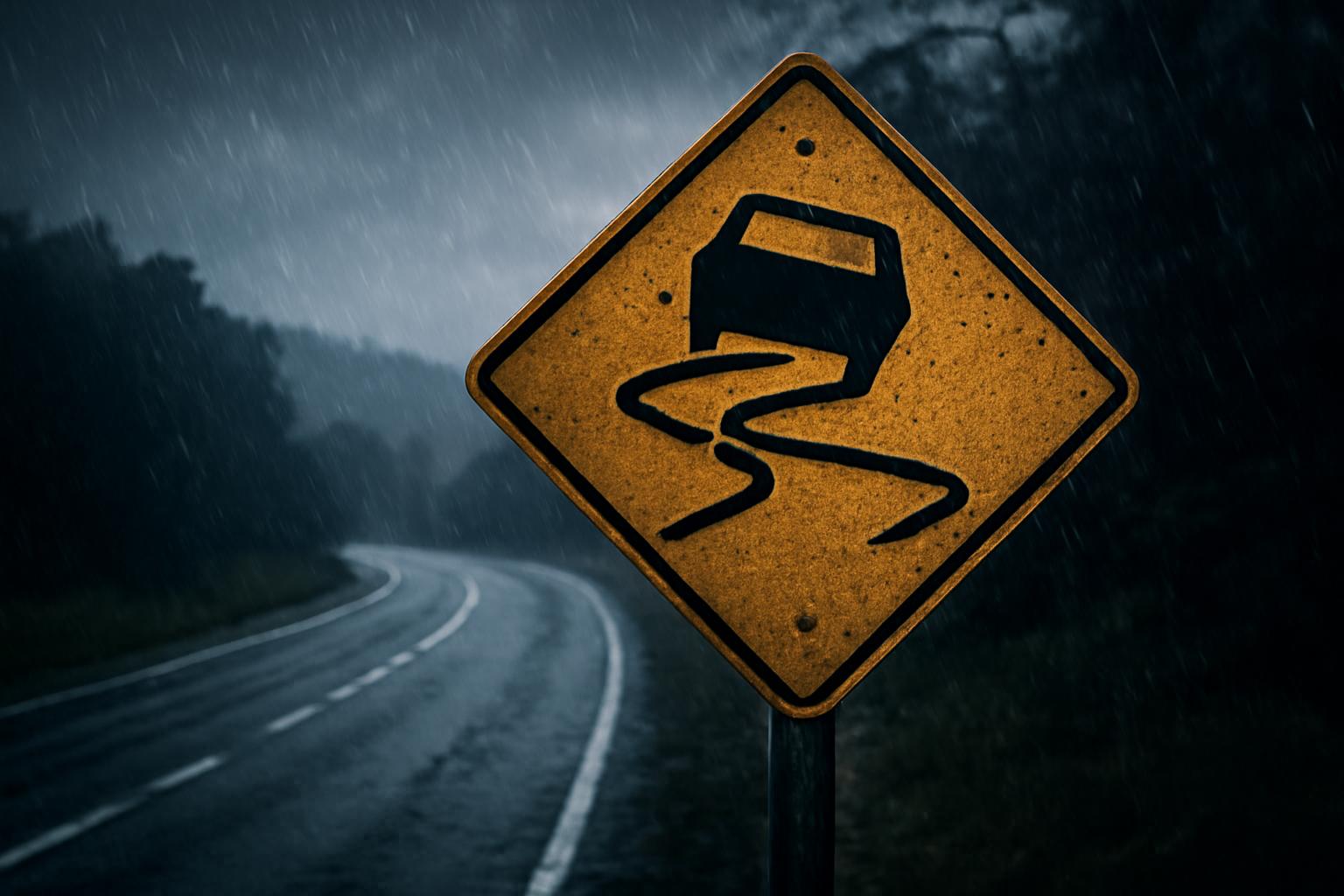
The recurring presentation is a yellow diamond-shaped warning sign with black markings. Rice Signs identifies its W8-5 product as a black-on-yellow diamond, while driving-test explainers describe a black car viewed from behind.
The most recognizable graphic is the skidding-car symbol. Two wavy or squiggly lines extend from behind the car’s rear wheels. According to DMV-Permit-Test.com, those lines represent a slippery surface. They do not show a winding road or indicate that the driver should weave. They depict the path of a vehicle that is losing stable traction.
That symbol is a useful recognition cue, especially for a learner driver or anyone trying to identify the sign quickly. However, the supplied source set also includes commercial products that use text, different colors, and different physical formats. It therefore does not establish that every product sold as “Slippery When Wet” has one identical or officially equivalent face. When you are interpreting a roadside warning, pay attention to the complete sign rather than relying only on a product name.
What to do when you see the sign
Respond before you reach the slippery section. NHTSA’s rain-driving guidance says to drive slowly because controlling or stopping a vehicle is harder on a slick road, and to increase following distance so there is more time to stop.
Use this short checklist:
- Ease off your speed smoothly instead of making a sudden reduction.
- Increase the gap between your vehicle and the one ahead.
- Keep steering movements gradual and controlled.
- Avoid hard braking when a gentler reduction is available.
- Make turns cautiously and at a speed appropriate for the conditions.
These actions reflect the consistent guidance in the supplied sources. DMV-Permit-Test.com advises drivers to reduce speed, avoid abrupt direction changes, avoid hard braking, and increase following distance. Driving-Tests.org similarly advises slowing down and avoiding sudden changes in direction when conditions are wet or icy.
Do not turn that guidance into an unsupported formula. The evidence does not provide one following interval or percentage speed reduction that applies to every passenger vehicle, road, and storm. Your goal is to leave enough space and control margin that you do not need to brake, steer, or accelerate sharply.
Why wet pavement changes vehicle control
Wet pavement can reduce the grip available between the tires and the road. The Signature Streetscapes product explanation connects rain or moisture with reduced tire traction and increased stopping distance. NHTSA likewise explains that a vehicle is harder to control or stop on a slick road.
That reduction matters whenever you ask the tires to change the vehicle’s speed or direction. Braking, turning, and accelerating all depend on available traction. If you make a sudden input while grip is reduced, the vehicle may be less able to follow the path or stopping action you intended. This is why gentle inputs are practical, not merely cautious-sounding advice.
Slower travel also gives you more time to notice a curve, queue, surface change, or vehicle braking ahead. Additional following distance reduces the chance that an ordinary traffic change will force an aggressive response. NHTSA notes that vehicles handle differently on wet roads, so a driver should not assume that another vehicle’s pace proves the same pace is safe for their own.
Some general explanations claim that a particular early period of rainfall is always the most slippery. The supplied evidence does not verify a universal timing rule or the proposed oil-and-residue mechanism. The sound takeaway is narrower: take the warning seriously whenever the pavement is wet or conditions indicate reduced traction.
Where the warning appears and what conditions it may indicate
The warning appears before or alongside roadway sections known to become slippery under certain conditions. DMV-Permit-Test.com describes its location as before areas where the road may be slippery, while Driving-Tests.org says slippery-road warnings are posted along roadsides prone to rain and ice.
That placement gives you time to adjust before reaching the problem area. The hazard may not be obvious from inside the vehicle, and the surrounding pavement may appear normal. Reduce speed smoothly when you see the warning rather than waiting for the vehicle to slide or for standing water, ice, or another surface problem to become visually clear.
The strongest common meaning in the source set concerns wet pavement. Some sources also discuss cold weather and ice, but the evidence does not fully establish which conditions belong to the exact Slippery When Wet warning rather than to a broader slippery-road warning. Read any accompanying text or nearby warning as part of the message.
Bridges and overpasses
Bridges and overpasses are repeatedly cited as locations where drivers may encounter slippery-road warnings. DMV-Permit-Test.com says the sign is commonly installed before these structures because they tend to freeze before the rest of the road. Driving-Tests.org similarly describes bridges and overpasses as the first to freeze and last to thaw in cold weather.
The useful driving lesson is that a localized section can be slick even when the approaching pavement feels manageable. Avoid making an abrupt speed or steering change as you enter the structure. Establish a controlled pace and added following distance beforehand.
Wet pavement versus broader slippery-road hazards
Do not assume every sign showing a car with wavy tracks identifies exactly the same surface condition. The supplied sources reliably connect the warning with rain, moisture, and wet pavement. Some driving-test pages extend similar slippery-road language to ice or cold weather, while the broader source set also discusses products and categories without resolving the precise hazard represented by each face.
The evidence does not confirm that warnings associated with snow, mud, gravel, or other loose or slippery surfaces are official equivalents of the exact wet-pavement warning. It also does not establish that every commercial sign bearing the same product name has the same permitted roadway use.
For a driver, the immediate response remains consistent: expect reduced traction and adjust smoothly. For sign selection, installation, or compliance work, however, a similar name or graphic is not enough to prove equivalence. That determination requires current guidance from the authority responsible for the road.
Permanent, temporary, and commercial sign variants
The source set documents several products called Slippery When Wet, but their colors, materials, dimensions, and layouts differ. Those differences matter because a shared sales label does not establish a shared official status or application.
Rice Signs lists a yellow, black-on-yellow diamond product under the code W8-5. Grainger also lists an aluminum product described as a 24-by-24-inch W8-5 MUTCD sign. These are documented commercial descriptions of permanent-style products, not enough by themselves to confirm the current official designation, required face, installation rules, or permitted applications.
A different format appears in the TrafficConesForLess roll-up listing. It describes a fluorescent-orange roll-up sign, available in reflective or non-reflective material, and labels it “MUTCD W8-5.” Its orange color and portable roll-up construction distinguish it visibly from the yellow diamond products in the source set. The evidence supports describing that difference, but not declaring the products interchangeable.
Commercial listings may also use text-oriented or rectangular presentations. The supplied corpus does not resolve whether those signs function as official roadway warnings, supplementary messages, facility signs, or products intended for another context. A text label such as “Slippery When Wet” should therefore not be treated as proof that the product is equivalent to the car-and-wavy-tracks warning.
For ordinary drivers, the practical distinction is simple: yellow diamond signs are represented in the sources as permanent-style warnings, while fluorescent-orange roll-up signs are represented as temporary portable products. For anyone choosing or installing a sign, the commercial records are insufficient to confirm current MUTCD treatment, plaque status, or legal suitability. Verify those details with the road authority or the current traffic-control standard applicable to the location.