
Which California Burn Scars May Never Return to Forest
Plan Sierra Nevada and Northern California drives by recognizing burn scars with viable tree regrowth and those trending toward persistent brushland.
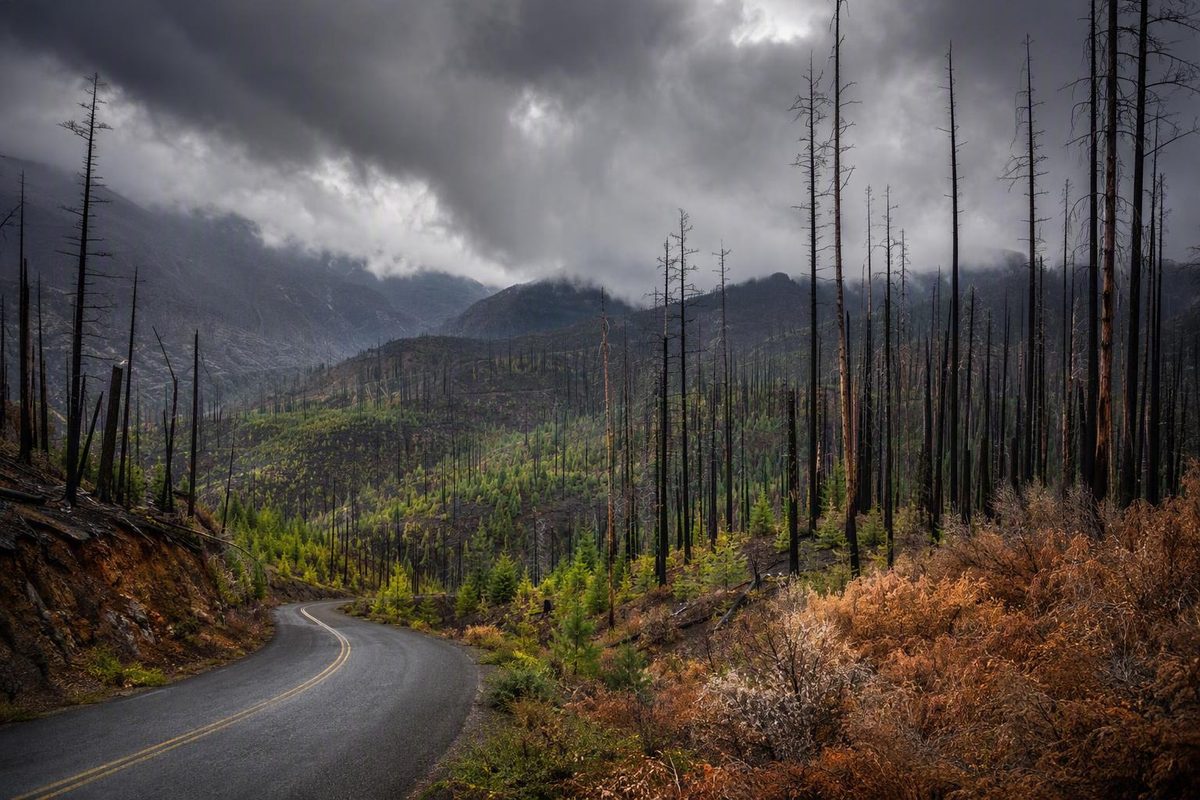
Over the last 25 years, high-severity wildfire burned about 2.3 million acres of California forestland so completely that trees are unlikely to return without intervention. The state cannot plant its way out quickly: CAL FIRE says seed-bank capacity must grow roughly 300% to replant even a quarter of the private forestland that needs it. Along Sierra Nevada and Northern California scenic drives, some burn scars are forests in recovery; broad, severely burned interiors with no nearby seed trees may instead be long-term shrubland.
Why The Familiar Recovery Story Is Often Right
The received wisdom is reasonable: wildfire has always been part of California’s forests, and a blackened landscape can recover naturally. A single fire creates a mosaic rather than one uniform result. Lightly burned stands retain mature trees, surviving islands provide seed, hardwoods and coast redwoods may resprout, and seeds already on the site can germinate.
That recovery is visible in places such as Big Basin Redwoods State Park. After the 2020 CZU Lightning Complex Fire, many old-growth coast redwoods produced shoots from dormant buds beneath their bark. Researchers linked some of that growth to stored carbon reserves in a multiyear study summarized by Save the Redwoods League.
A black trunk therefore does not necessarily mark a dead tree. If roots, living tissue, or enough crown survives, a tree may resume growth. Surviving trees also retain forest structure and supply seed to nearby ground.
But coast-redwood resilience does not describe every California forest. Many Sierra Nevada pines and firs rely heavily on seed from living trees. If severe fire kills nearly every mature conifer across a broad patch, the mechanism needed to rebuild that forest has largely disappeared.
The Statewide Numbers Rule Out Automatic Recovery
California’s working reforestation strategy estimated that about 2.3 million forest acres burned over the preceding 25 years were unlikely to regain trees without intervention. California land managers had replanted about 254,000 severely burned acres since 2020, roughly 16% of forest-cover loss from high-severity fires between 2020 and 2024. Federal lands contain more than half of California’s forests and most of the land identified as needing replanting according to the Los Angeles Times report on the working draft.
Those figures come from one reporting chain, and the 2.3-million-acre estimate is from a working draft rather than a finalized inventory. It does not prove that every identified acre should be planted. Percentages also depend on whether the denominator excludes wilderness, land expected to recover naturally, or particular ownership categories.
Even with that qualification, the capacity gap is substantial. Seed-bank capacity would have to grow roughly 300% to cover even one-quarter of the need on private forestland. Non-fire U.S. Forest Service staffing fell 39% from 1998 to 2015, reducing the workforce available for replanting and other forest management. One recent analysis projects that half of California’s forest area could be gone by 2071. The provided reporting does not supply route-by-route acreage or a finalized probability that each named corridor will remain forest.
Planting capacity cannot expand on demand after a major fire. Reforestation requires suitable seed, collection and storage, nursery space, project design, trained workers, transport, planting, vegetation management, monitoring, and sustained funding. Nursery production from seed can take an entire year according to CAL FIRE’s Reforestation Services Program.
That makes reforestation a triage problem. Managers must distinguish sites likely to recover naturally from isolated, severely burned sites where scarce planting resources can change the outcome.
Test Whether A Roadside View Can Reseed Itself
The explorer below applies the same decisive categories used in post-fire assessment: severity, distance to living seed trees, patch position, forest type, post-fire heat and moisture, surviving seedlings, and competing vegetation. No route-specific severity percentages were supplied in the source material, so the route names are navigation choices rather than unsupported classifications. Select “observed burn area” and enter what you can see or verify on a severity map.
Pick a route, then describe the burned stretch; the result shows whether natural forest recovery or conversion to brush is more likely.
Choose a corridor for context, then enter conditions for the specific burned stretch. Route names do not carry preset severity claims because route-level figures were not provided.
| Observed Pattern | 20-Year Direction | Roadside Evidence | Interpretation |
|---|---|---|---|
| Natural Recovery | Young or open forest | Surviving canopy; seedlings across edge and interior | Seed, sprouts, or surviving trees are rebuilding cover |
| Uncertain | Mixed woodland or patchy cover | Some seedlings; variable survival; mixed severity | Monitor through successive dry years |
| Conversion Risk | Persistent brush, scrub, or open vegetation | Dead snags; broad treeless interior; no distributed seedlings; dense grass or shrubs | Natural conifer return is weak without successful assistance |
| Resprouting | Recovering tree cover | Trunk, basal, root, or hardwood shoots | Redwood and hardwood response differs from pine and fir |
Sources: California reforestation-strategy working draft reported by Los Angeles Times/CalMatters; Sierra Nevada regeneration research and UC guidance cited in the article. Values are screening evidence, not route-specific forecasts.
The default represents a high-severity Sierra conifer interior more than 100 meters from surviving trees, with no broadly distributed seedlings and hot, dry conditions. That combination points toward persistent brush or open vegetation without assistance. The tool is a screening aid, not a substitute for field surveys or agency treatment decisions.
A Green Burn Scar May Not Be A Returning Forest
Vegetation recovery, tree regeneration, and restoration of the former forest are different outcomes. Ferns, grasses, shrubs, and hardwood sprouts can rapidly make a burn scar green while replacement conifers remain absent.
In coast redwood country, ferns can emerge from underground rhizomes, while redwoods produce root, trunk, and branch sprouts. These are genuine signs of biological recovery, but they do not establish a timetable for mature forest structure as Sempervirens Fund explains.
Seed-grown trees face a longer sequence. Seed must exist, reach suitable soil, germinate, and survive. A seedling appearing in a moist spring may die during a hot summer. Substantial canopy and mature habitat can take decades or longer even when establishment succeeds.
From the road, the useful distinction is not black versus green. It is whether young trees are distributed through the burn, including its broad interior, and whether they survive successive dry seasons.
A landscape trending away from conifer forest commonly shows standing dead snags over a largely treeless interior, seedlings restricted to surviving forest edges, repeated seedling mortality, and dense grass or shrubs occupying the open ground. Invasive grass is an additional warning sign where identified, but the draft provides no route-level invasive-species inventory.
Active regrowth looks different: living crowns or fresh foliage on surviving trees, trunk or basal sprouts on capable species, and seedlings occurring beyond the immediate edge of intact forest. A few seedlings beneath one living tree show that establishment is possible, not that the whole patch is recovering.
Distance From Seed Trees Separates The Two Outcomes
In studied, severely burned Sierra Nevada conifer forests, natural seed dispersal and seedling production often fall to low levels within roughly 50 to 100 meters of surviving seed sources according to research on severe-fire planting and regeneration.
This is a study-based pattern, not a universal cutoff. Species, wind, slope, elevation, seed year, and microsite all matter. A site at 90 meters is not guaranteed to recover, and one at 110 meters is not certain to fail.
Patch geometry matters with distance. A long, narrow burn can remain close to living forest on both sides. A broad, roughly circular high-severity patch may have a large center beyond effective seed dispersal. A road often follows an edge or drainage, so a promising roadside strip can conceal a poorly regenerating interior.
Burn severity is the first filter. A low- or moderate-severity area may retain canopy, roots, habitat, and seed sources. A high-severity area in which most or all overstory trees died must depend on resprouting, seed arriving from elsewhere, or planting.
Species is the next filter. Coast redwoods and some hardwoods can draw on roots, trunks, stumps, or protected dormant buds. Many pines and firs depend more heavily on seed. The same burn can therefore produce vigorous hardwood sprouts while failing to replace its conifers.
Climate and terrain then determine whether arriving seed survives. Hotter, drier, lower-elevation conifer sites are more vulnerable. One wet year can establish seedlings that a later hot, dry year kills. POSCRPT combines seed availability, climate, forest structure, and environmental conditions to estimate natural conifer regeneration, but its outputs are probabilities, not guarantees according to UC Davis.
Shrubs Can Signal Either Shelter Or Conversion
Shrubs are not proof of failure. They are native components of many post-fire landscapes, provide habitat, and can shade seedlings on exposed sites. Where vegetation is sparse, that shelter can reduce stress.
Shrubs can also consume water, light, nutrients, and growing space. Dense cover can impede later planting and help hold a site in shrubland when conifer seed is scarce. Sierra Nevada research found that planting timing performed differently with shrub abundance: early planting was favored where competition was intense, while delayed planting sometimes performed better where sparse vegetation offered shelter as summarized by UC Davis.
The roadside signal is therefore shrubs plus missing trees, not shrubs alone. Dense shrubs across a broad, snag-filled interior with no surviving conifers and no young trees indicate a much weaker forest trajectory than shrubs interspersed with widespread, surviving seedlings.
A severely burned conifer stand can consequently become shrubland, scrub, open woodland, or a stand dominated by resprouting hardwoods. “Vegetation recovered” may be accurate while “the conifer forest returned” is not. Even natural tree recovery can produce a different species mix and lower density than the pre-fire forest.
The First Five Years Reveal Whether Recovery Is Stalling
The first one to five years are an important monitoring period, not a deadline for declaring a forest recovered or lost. Seed crops, rainfall, heat, and establishment vary by year. Early observations can still show whether trees are spreading through a burn or remaining confined to its margins according to UC Agriculture and Natural Resources guidance.
Look first for trees rather than greenery. Separate conifer seedlings and hardwood resprouts from grasses, ferns, and shrubs. Record species where possible, because a resprouting hardwood and a seed-dependent conifer imply different future stands.
Distribution matters more than an isolated success. Check surviving islands, sheltered pockets, exposed slopes, and the center of the high-mortality patch. Revisit the same places after hot, dry seasons. New seedlings in later years indicate continuing seed input; repeated death or regeneration only beside living trees indicates a bottleneck.
There is no evidence-supported seedling density that defines success for every California forest. Adequacy varies with species, terrain, future climate, desired spacing, management goals, and tolerance for a more open stand.
Planting Helps Most Where Natural Recovery Is Weakest
Planting is assisted regeneration, not another form of natural recovery. It is most relevant where a large, high-severity interior has few surviving trees, lies far from seed sources, experiences hot and dry conditions, lacks resprouting species, and shows sparse or repeatedly failing seedlings.
Across planted and nearby unplanted plots after five severe Sierra Nevada fires, planting increased tree density and the proportion of pines. The largest reported improvement was up to 200% at hotter, drier sites. That result applied to particular studied conditions, and planting still rarely achieved common stocking targets under the modeled conditions.
Planting may be unnecessary where desired seedlings or resprouts are abundant, widespread, and surviving. It may also be unsuitable where access, terrain, ecological goals, or future climate favor monitoring or transition to another vegetation type.
Where shrubs establish densely, early planting may give seedlings a head start. On a harsh site with sparse cover, delay may permit some protective shade. Neither “plant immediately” nor “always wait” works as a statewide rule.
Seed choice, nursery production, site preparation, handling, planting, competition control, protection, and monitoring all affect survival. Poor stock, drought, unsuitable species, or absent follow-up can defeat the project. The state’s working strategy recommends lower-density planting with more natural spacing rather than tightly packed rows, but that remains a proposed resilience approach rather than a proven rule for every forest as reported by CalMatters.
What The View May Become In 20 Years
A lightly or moderately burned stand with surviving canopy and seed trees may remain recognizably forested throughout recovery. A severely burned but narrow strip near intact forest may develop widespread young conifers, though it will not regain mature structure in 20 years.
A broad, high-severity Sierra conifer interior beyond the common 50-to-100-meter seed-source range is a different prospect. If repeated checks find no distributed seedlings while shrubs or grasses fill the site, the defensible expectation is persistent brush, scrub, or open vegetation unless planting succeeds. “Permanent” here means a durable conversion on a road-planning horizon, not proof that a tree can never establish there.
Redwood and resprouting-hardwood landscapes require a separate reading. Shoots from trunks, bases, or roots can indicate genuine tree recovery even where seedlings are scarce. That resilience must not be generalized to dead pine and fir stands.
For Sierra Nevada, Highway 50, and Northern California route planning, severity maps identify where to look, but the fire perimeter alone cannot predict the view. On the ground, combine overstory mortality, patch width, distance from living trees, forest type, surviving young trees, and the post-fire climate. Where those factors all point the wrong way, the burn scar is not simply a forest on pause.