
Ford Explorer Towing Weight by Model Year and Configuration
Ford's 2026 guide lists 5,000 lb of trailer weight and 500 lb of tongue load for the gas and hybrid Explorer applications shown.
Overview
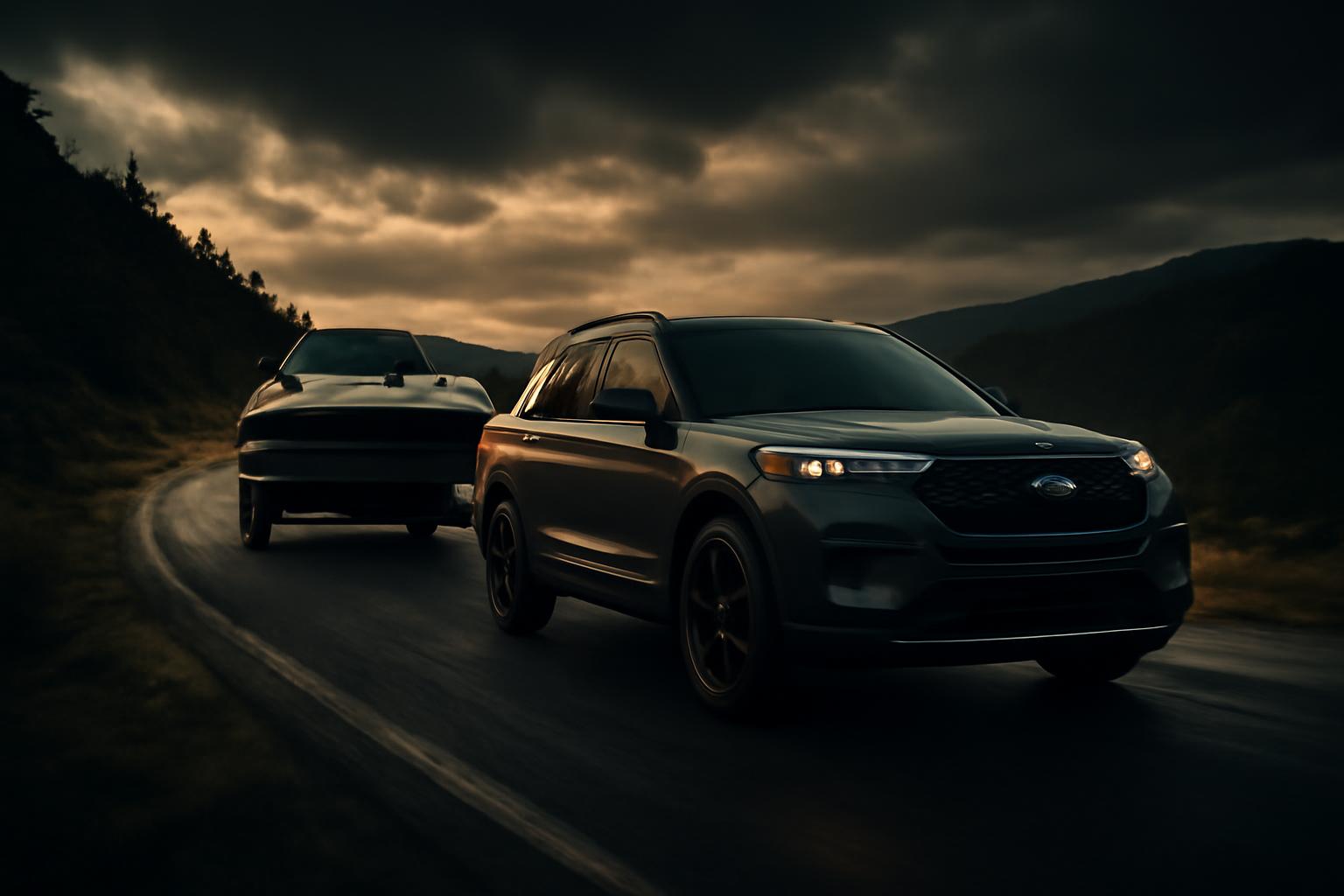
The 2026 Ford Explorer can tow up to 5,000 pounds when properly equipped. Ford lists that maximum for the gas and hybrid applications shown in its guide, including rear-wheel-drive and four-wheel-drive configurations. Your usable limit still depends on the vehicle’s payload, passengers, cargo, equipment, tongue load, and combined weight.
That 5,000-pound figure is the current documented maximum, not a universal Ford Explorer tow rating for every model year. Some 2022 through 2024 configurations are reported at up to 5,300 or 5,600 pounds with the appropriate equipment, while versions without the relevant tow package may be limited to 3,000 pounds. Historical ratings therefore need to be matched to the actual model year, engine, drivetrain, trim, and installed equipment.
Ford’s 2026 Explorer towing guide also makes clear that maximum capability assumes a properly equipped vehicle with limited occupants. Cargo, accessories, options, vehicle configuration, and passenger count can all reduce what a particular Explorer can carry or tow.
For a real towing decision, compare the trailer’s loaded operating weight with every applicable limit. Do not stop after finding a maximum towing number.
Ford Explorer towing capacity by model year
Recent Ford Explorer ratings do not follow one simple historical pattern. The strongest primary evidence in the supplied material is Ford’s 2026 guide. Information for 2022 through 2025 is less complete and, in some cases, comes from secondary model-year comparisons rather than a comprehensive Ford configuration table.
| Model year | Configuration supported by the supplied evidence | Maximum trailer weight with relevant tow equipment | Rating without relevant package | Evidence boundary |
|---|---|---|---|---|
| 2026 | Gas or hybrid applications shown by Ford; listed RWD and 4WD configurations | 5,000 lb | Not listed separately | Ford documents a standard Class III Trailer Tow Package and a 5,000-pound maximum in its 2026 guide. |
| 2025 | Active RWD through ST 4WD, according to one model-year dealer comparison | 5,000 lb | Not applicable in that comparison because the package is described as standard | The 5,000-pound figure comes from Aaron Ford of Poway, not supplied Ford primary documentation. Other secondary pages contain higher Explorer figures without enough authoritative model-year mapping to resolve the discrepancy. |
| 2024 | 2.3L EcoBoost four-cylinder or 3.0L EcoBoost V6, according to the secondary comparison | 5,300 lb with the four-cylinder; 5,600 lb with the V6 | 3,000 lb | The comparison figures come from Aaron Ford of Poway. Ford’s 2024 Explorer towing guide confirms that some applications require the Class IV Trailer Tow Package, but the supplied excerpt does not map every footnote to every configuration. |
| 2023 | 2.3L EcoBoost four-cylinder or 3.0L EcoBoost V6, according to the secondary comparison | 5,300 lb with the four-cylinder; 5,600 lb with the V6 | 3,000 lb | Ford’s 2023 RV and Trailer Towing Guide says Explorers towing trailers over 3,000 pounds need the Class IV Trailer Tow Package (52T). |
| 2022 | 2.3L EcoBoost four-cylinder or 3.0L EcoBoost V6, according to the secondary comparison | 5,300 lb with the four-cylinder; 5,600 lb with the V6 | 3,000 lb | These figures are supported only by the supplied secondary model-year table; a complete Ford configuration table was not provided. |
Treat the table as a bounded lookup, not permission to tow at the largest number in a row. The 2022 through 2024 figures describe maximum equipped configurations. They do not establish that every Explorer with the named engine has that rating.
The 2025 row deserves particular care. One detailed secondary source says every 2025 Explorer is rated at 5,000 pounds with a standard Class III package. Other supplied Explorer pages publish 5,300-pound and 5,600-pound figures, including ratings for Timberline, King Ranch, and particular engines, but the supplied evidence does not establish a reliable 2025 Ford configuration map for those higher numbers. Do not resolve that conflict by choosing the larger figure. Verify a 2025 vehicle against its own Ford materials and equipment.
The evidence also does not support a complete table for 2020 or 2021. If you own one of those Explorers, use documentation for that exact model year instead of copying a later rating.
How configuration and tow packages change the rating
A Ford Explorer’s maximum rating can change with its engine, trim, drivetrain, and towing equipment. These factors need to be read together. An engine associated with a higher maximum in a comparison table does not automatically give every vehicle using that engine the same tow rating.
For 2026, the arrangement is comparatively straightforward. Ford lists a 5,000-pound maximum for the gas and hybrid applications shown in its guide and identifies a standard Class III Trailer Tow Package. A 2026 equipment summary lists a Class III hitch receiver, seven-wire harness, four-pin and seven-pin connections, Tow/Haul Mode, and Trailer Sway Control. The presence of those components still does not remove the payload, tongue-load, GCWR, or frontal-area limits in Ford’s guide.
Older Explorers require closer inspection. Ford’s 2023 guide identifies the Class IV Trailer Tow Package, code 52T, for Explorer trailers over 3,000 pounds. The supplied excerpt from Ford’s 2024 guide says some applications require that package, describes it as standard on Timberline and ST models, and limits another application to King Ranch and Platinum models. Because the excerpt does not preserve the complete table-to-footnote mapping, it cannot support a blanket statement that every listed trim or engine receives the maximum rating.
That distinction matters when shopping for a used Explorer. A receiver hitch by itself is not proof that the vehicle has the factory package or the higher published rating. Some 2024 towing equipment may also have been available only as a dealer accessory for a particular application, according to Ford’s guide. Confirm how the actual vehicle was configured rather than treating visible hardware as a complete package record.
For 2022 through 2024, the supplied secondary comparison reports 3,000 pounds without the relevant package and up to 5,300 or 5,600 pounds with it, depending on the engine. Use those numbers only after matching the model year and equipment. If the configuration cannot be established, the higher maximum is not a defensible assumption.
How to verify your Explorer’s towing setup
Verification starts with the vehicle in front of you, not the largest rating published for the model name. You need the correct model-year documentation, the vehicle’s individual load label, and confirmation of the installed towing equipment.
Use this checklist before comparing your Explorer with a trailer:
- Confirm the model year, engine, drivetrain, and trim. Do not transfer a rating from another year or from a similarly named trim.
- Read the Ford towing guide and owner materials issued for that model year. Check every note tied to the applicable engine, axle, drivetrain, and equipment row.
- Locate the Tire and Loading Information label, usually on the driver-side door jamb. The 2025 model-year guidance says this label identifies the maximum combined weight of occupants and cargo for that vehicle.
- Confirm whether the vehicle has the relevant Class III or Class IV tow package. For 2023 Explorers, Ford specifies the Class IV package, code 52T, for trailers over 3,000 pounds in its 2023 guide.
- Inspect the receiver, wiring harness, four-pin or seven-pin connector, and other required towing components. Match the equipment to the model-year documentation rather than assuming an aftermarket receiver recreates the factory rating.
- Record the applicable maximum trailer weight, payload, tongue-load limit, and GCWR before loading. If a required number or package cannot be confirmed, stop short of using the advertised maximum.
This process is especially important for a used Explorer, where the installed hitch may not tell you how the vehicle originally left the factory. If the vehicle’s labels, equipment, and sales description disagree, rely on the vehicle-specific Ford documentation and resolve the discrepancy before towing.
The published rating is only one towing limit
The maximum trailer weight answers one question: how heavy the trailer may be under the conditions behind that rating. It does not tell you whether your Explorer has enough payload for people, luggage, accessories, and the trailer’s tongue load.
Payload is the weight the vehicle can carry. Passengers, cargo inside the Explorer, accessories added to the vehicle, and trailer tongue load all use that capacity. Ford says its maximum 2026 towing capability assumes a properly equipped vehicle with a 150-pound driver and passenger. The company also says capability varies with cargo, accessories, passenger count, options, and configuration in the 2026 towing guide.
Tongue load is the trailer weight pressing down on the hitch. Ford lists a maximum trailer weight of 5,000 pounds and a maximum tongue load of 500 pounds for the 2026 Explorer gas or hybrid applications shown. A trailer can therefore be below the headline tow rating but still be unsuitable if its actual tongue load exceeds 500 pounds or leaves too little vehicle payload for occupants and cargo.
GCWR, or Gross Combination Weight Rating, limits the combined loaded weight of the Explorer and trailer. That includes the vehicle, its occupants and cargo, and the loaded trailer. Ford states that the combined vehicle and trailer weight cannot exceed the listed GCWR. The 2026 table shows GCWR values of 10,000 and 10,100 pounds for the listed 2.3L EcoBoost configurations, depending on drivetrain.
Trailer frontal area is another independent constraint. Ford limits the maximum trailer frontal area for the 2026 Explorer with the tow package to 40 square feet. A trailer can weigh less than 5,000 pounds and still fall outside Ford’s stated frontal-area limit. This matters when evaluating tall or box-shaped trailers, because weight alone does not describe their towing demand.
The practical limit is the first one your loaded combination reaches. Staying under trailer weight does not excuse exceeding payload, tongue load, GCWR, or the applicable frontal-area limit.
How to account for passengers, cargo, and tongue load
Start with the vehicle’s payload label. Subtract the weight carried by the Explorer, including occupants, luggage, tools, accessories, and the trailer’s actual tongue load. The result shows whether the vehicle remains within its payload rating. Do not subtract those items from the maximum trailer rating and call the result a new tow rating. Payload and trailer weight are separate constraints.
Next, compare the trailer’s actual loaded weight with the tow rating for the verified configuration. Loaded weight includes what travels in or on the trailer, not merely the empty unit. Then compare the trailer’s measured tongue load with both Ford’s tongue-load limit and the Explorer’s remaining payload.
Finally, check the loaded Explorer and loaded trailer together against the applicable GCWR. Every limit has to pass at the same time. A combination that fits under 5,000 pounds of trailer weight can still fail because the Explorer is overloaded or the combined weight is too high.
The supplied evidence does not provide enough vehicle-specific inputs for an honest universal worked example. Your calculation needs the individual payload label, correct model-year GCWR, actual occupant and cargo weights, and measured loaded trailer and tongue weights. Estimates based on brochure dry weight cannot replace those inputs.
What a Ford Explorer can tow
A properly configured Explorer may be suitable for compact campers, small boats, personal watercraft, utility trailers, and some light vehicle-and-dolly combinations. The category name does not decide whether the trailer fits. Its loaded weight, tongue load, dimensions, hitch setup, and the Explorer’s remaining payload do.
Common possibilities include:
- A compact camper whose loaded weight and frontal area remain within the applicable Explorer limits
- A small fishing boat or personal watercraft trailer after accounting for fuel and carried equipment
- A utility trailer loaded with yard equipment, tools, or other cargo
- A tow dolly carrying a compact car or small crossover, if the complete dolly-and-vehicle combination stays within every applicable rating
- A light recreational trailer carrying bikes, coolers, or camping equipment
These are conditional examples, not category-wide approvals. A 2026 towing overview identifies small fishing boats, personal watercraft, compact campers, utility trailers, and yard equipment as plausible loads, while warning that gear, fuel, water, tools, and supplies can increase trailer weight quickly.
Dry weight is therefore the wrong final comparison. A camper’s water and supplies, a boat’s fuel and equipment, or a utility trailer’s tools and materials all travel as part of the load. Compare the Explorer’s rating with the trailer as it will actually be used.
Be equally careful with a towed vehicle. One 2025 Explorer guide says a compact car or small crossover may weigh under 4,000 pounds and does not provide a verified weight for the tow dolly; use its actual specified or measured weight. Those are general examples, not verified weights for your car or dolly. Add the actual weight of both, then check tongue load, payload, GCWR, hitch compatibility, and the verified tow rating.
For boats and campers, size labels are not a substitute for scale weight. Two trailers with similar lengths can have different loaded weights and frontal areas. Make the decision from specifications and measured operating weight, not appearance.
Pre-tow limits and safety checks
Complete the weight and equipment checks before departure, then account for where the combination will operate. Elevation, trailer brakes, wiring, loading, and hitch setup can all affect whether the planned trip stays within Ford’s instructions.
Ford advises reducing Gross Vehicle Weight and Gross Combination Weight by 2% for every 1,000 feet of elevation to approximate sea-level performance in its 2026 Explorer towing guide. At 3,000 feet, applying that instruction means a 6% reduction. This is an operating adjustment to GVW and GCW, not permission to increase another limit.
Before towing, check the following:
- Verify the trailer’s loaded weight and tongue load rather than relying on advertised dry weight.
- Confirm that the Explorer remains within its payload, maximum trailer weight, tongue-load limit, and GCWR.
- Make sure the hitch, receiver, ball mount, electrical connector, wiring, and other towing equipment match the trailer and the vehicle’s documented setup.
- Confirm that the trailer brakes and brake controller setup, when applicable, work correctly.
- Check the trailer’s load distribution and secure its cargo before travel.
- Recalculate for additional passengers, supplies, water, fuel, tools, or other weight added after the initial check.
- Check the model-year Ford towing guide for any altitude-related limits or adjustments that apply to the trip.
Ford notes that some jurisdictions require electric trailer brakes above a specified trailer weight, but the supplied evidence does not identify a universal threshold. Check the rules that apply where the vehicle and trailer will be operated. Do not assume that meeting Ford’s tow rating automatically satisfies local brake requirements.
The final decision is straightforward: use the rating for the exact Explorer, compare it with the trailer’s real loaded condition, and verify every separate vehicle, hitch, brake, and combined-weight limit before moving. The 5,000-pound 2026 maximum is a starting specification, not a personal towing allowance.