
Vancouver to Whistler: Plan the Sea to Sky Drive
Plan the Vancouver to Whistler drive with realistic timing, Highway 99 directions, waterfall stops, winter tire rules and village parking.
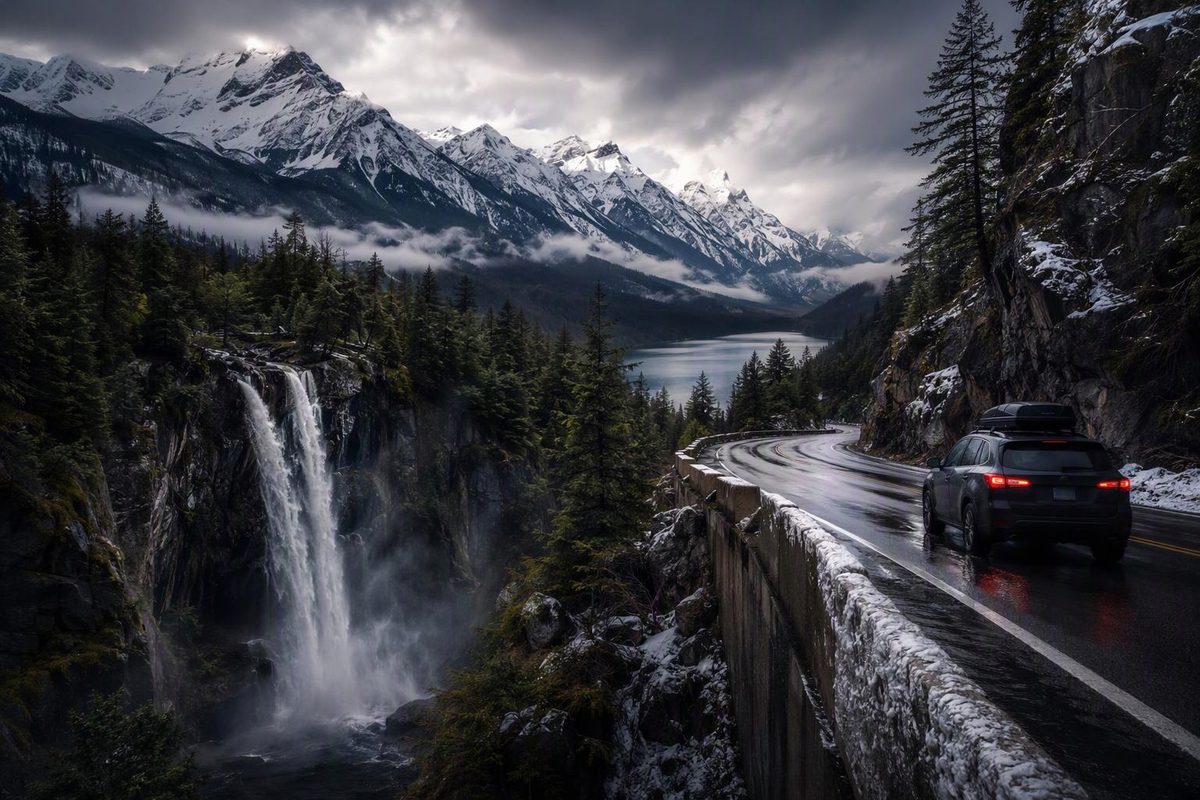
Vancouver to Whistler is about 120 km (75 miles) each way via Highway 99, the Sea to Sky Highway. Tourism Whistler describes it as a two-hour drive, but that is a starting point—not the time needed for waterfall walks, lunch or a busy weekend transfer. (Distance and directions, road and traffic guidance)
| Planning item | What to allow |
|---|---|
| Route | Downtown Vancouver → West Vancouver → Horseshoe Bay → Squamish → Whistler Village |
| One-way distance | About 120 km / 75 miles; your exact address changes the total |
| Driving allowance | Budget 2–2.5 hours in favorable conditions without sightseeing; allow more for peak traffic or weather |
| Scenic transfer | Budget 4–5.5 hours with two waterfall stops and a meal |
| Same-day return | Roughly 240 km / 150 miles; reserve 10–12 hours for a selective outing |
| Fuel planning | No planned fuel stop needed if your starting range comfortably covers the itinerary plus a delay reserve |
| Seasonal preparation | Winter tire rules apply north of Horseshoe Bay October 1–March 31; check live conditions before departure |
The time allowances above are planning budgets, not measured averages or upper limits. A collision, closure or snowstorm can exceed them. For a day trip, the 10–12-hour budget leaves room for roughly 4–5 hours of driving, one short waterfall stop, parking, meals and several hours in Whistler—not a full day on the mountain as well.
Follow Highway 99—not the ferry lanes
From downtown Vancouver, the standard route follows West Georgia Street through Stanley Park and over the Lions Gate Bridge. Take the West Vancouver exit, continue via Marine Drive and Taylor Way to Highway 1 west, then use Exit 2 for Highway 99 north toward Squamish and Whistler. No ferry is involved. Follow Highway 99 through Squamish to Whistler. (Tourism Whistler directions)
Set navigation to your accommodation or chosen parking lot rather than simply “Whistler.” From YVR, use an airport-specific route and budget separately for rental collection and city traffic; the downtown distance does not describe the whole airport transfer.
Friday afternoons and evenings, weekends and holidays are identified peak travel periods. Midweek travel gives you a better chance of avoiding congestion. On the return, leaving with the day-skier rush can add delay—but staying for dinner also means more driving after dark. Choose the tradeoff that suits the weather and your comfort on a mountain road. (Peak-period guidance)
Three practical stops, in northbound order
For a scenic transfer, use the following sequence. For a Whistler day trip, choose just one waterfall stop so the highway does not consume your destination time.
Shannon Falls: allow 30–45 minutes
Shannon Falls Park is beside Highway 99, about 2 km south of Squamish. A 350-metre trail leads to a waterfall view, making this a manageable stretch break rather than a major hike.
BC Parks lists the park as open year-round, but snowfall can limit access and winter services are reduced. Wet walkways, icy stairs and falling ice are reasons to shorten or skip the walk. Park only in designated areas. (Shannon Falls access and safety)
Squamish: allow 45–60 minutes for a meal and supplies
Make Squamish your deliberate service break rather than adding several small stops. Eat, use a washroom and reassess fuel or battery range before continuing. Tourism Whistler identifies Squamish as a convenient place for supplies along the route. (Transfer guidance)
Start with enough fuel or charge for your actual itinerary, including the return if you are not staying overnight. EV drivers should check their charging network’s live status and retain a backup; a mapped charger is not a promise of availability.
Brandywine Falls: allow 40–60 minutes when vehicle access is open
Brandywine Falls Park is off Highway 99, 47 km north of Squamish. BC Parks gives the viewpoint walk as 10–20 minutes each way. Stay on the designated trail, use caution at the railway crossing and do not descend into the canyon: there is no public access to the lower falls area.
For 2026, the park gate is scheduled open May 1–October 31. During the off-season, the gate is closed and trails are not winter-maintained. Do not turn a closed gate into a highway-shoulder parking stop; skip it if legal parking and suitable access are unavailable. Check the park’s current advisories before making it part of your drive. (Brandywine Falls schedule and restrictions)
Winter tires: legal minimum versus useful preparation
As of October 2026, the mandatory winter tire zone begins just north of Horseshoe Bay and applies October 1–March 31. Qualifying tires carry an M+S marking or the three-peak mountain/snowflake symbol, with at least 3.5 mm of tread. (Squamish RCMP route guidance, Tourism Whistler winter requirements)
Legal compliance is not the same as the best equipment for snow. B.C. requires at least two matching winter tires on the primary drive axle and recommends four evenly matched winter tires, favoring the three-peak mountain/snowflake marking for cold-weather driving. AWD does not remove the tire requirement, and chains on summer tires are not an acceptable substitute. (B.C. passenger-vehicle requirements)
For a rental, confirm the tires—not merely the vehicle’s AWD designation—before booking. Carry warm layers, water, food, an ice scraper and a charged phone. Before leaving, check DriveBC for Highway 99 incidents, closures, conditions and recent camera images. Vancouver rain does not tell you what the road near Whistler will look like.
Park once—or leave the car behind
For a village visit, Day Lots 1–5 on Blackcomb Way are a five- to ten-minute walk from the Village and Upper Village. (Lot locations)
As of October 2026, municipal pay parking applies year-round in those lots from 8 a.m. to 5 p.m. Standard-vehicle daily rates are C$21 in Lots 1–3 and C$13 in Lots 4–5; check posted rates when you arrive. From November 1–March 31, ordinary parking is prohibited from 3 a.m. to 6 a.m. for snow clearing, so arrange suitable overnight parking if staying. RVs and vehicles with trailers should use the designated Oversized Lot on the east side of Day Lot 3; trailers cannot be left unhitched. Sleeping in vehicles is not permitted in municipal parking lots. (Municipal parking rates and restrictions)
If your goal is simply to reach Whistler, especially without a suitably equipped rental, a shuttle solves a real constraint. Services run from downtown Vancouver and YVR; match the pickup point and timetable to your trip. They use the same highway, so they do not bypass closures or weather delays. (Bus and shuttle options)