
The Practical Choice: Easier Daily Driving or More Room for People and Luggage
Recent comparisons list 33.5 inches of third-row legroom for the Grand Highlander and 28.0 inches for the Highlander.
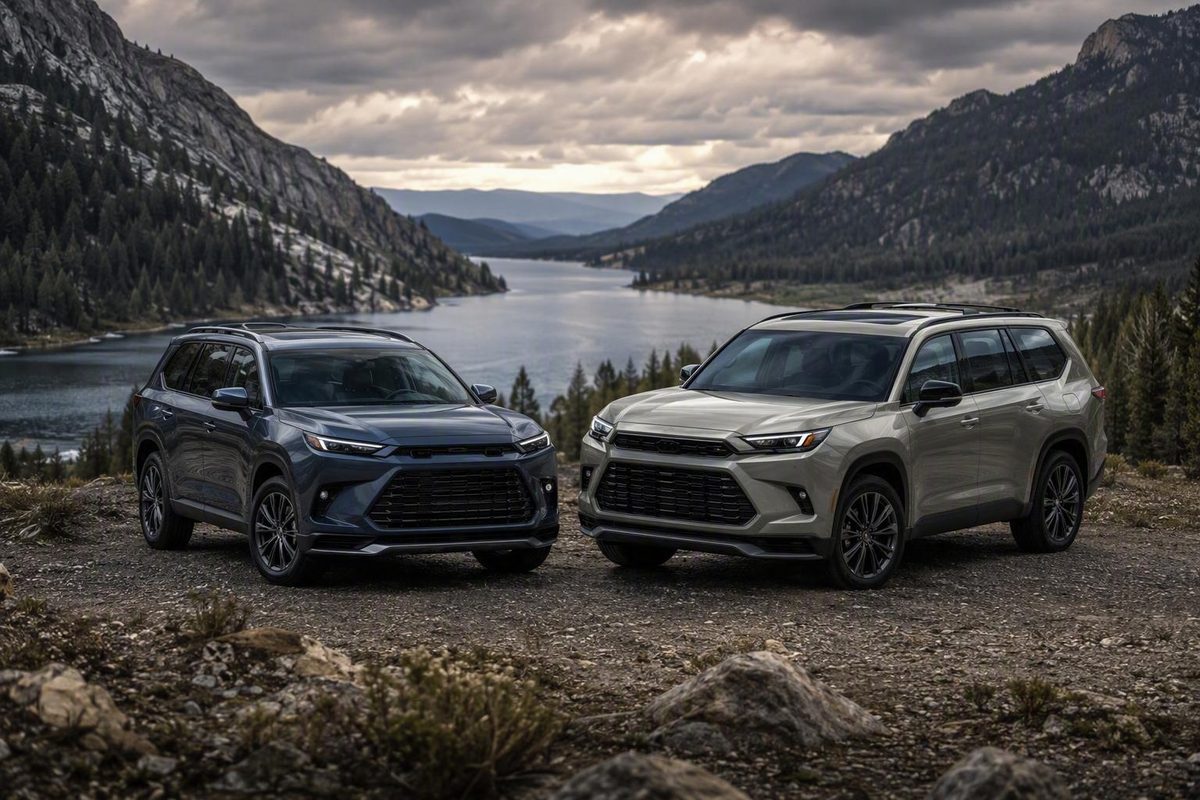
The Short Answer—and the Model-Year Warning
For comparable 2024–2026 models, the Toyota Highlander is the smaller three-row SUV. The Grand Highlander is the larger alternative, with more measured third-row legroom and more cargo capacity. The Highlander is the logical starting point when the third row is an occasional convenience and exterior size matters. The Grand Highlander deserves closer consideration when rear passengers and their luggage routinely travel together.
Despite the shared name, the Grand Highlander is not a Highlander trim or appearance package. It is a distinct vehicle with a longer wheelbase, a wider body, more rear-seat space, and an additional powertrain choice. A dealership-published 2026 comparison lists a 116.1-inch wheelbase for the Grand Highlander versus 112.2 inches for the Highlander, widths of 78.3 and 76.0 inches, respectively, and a Grand Highlander-only Hybrid MAX option. See the model-year-specific comparison.
Both 2026 SUVs are listed in seven- and eight-passenger configurations, depending on the second-row layout and other configuration details. Seating count alone is therefore a poor way to choose: an eight-passenger Highlander does not have the same measured third-row legroom or occupied-seat cargo capacity as an eight-passenger Grand Highlander.
This guide uses 2026 as the primary apples-to-apples comparison year because the available 2026 material covers gas and conventional-hybrid versions of both vehicles. The principal specifications come from dealership-published comparisons rather than a complete set of official Toyota specification documents. Treat them as shopping-reference figures and verify every important measurement, rating, feature, and configuration against current Toyota documentation for the exact vehicle before buying.
The major exception is the 2027 Highlander. A MotorTrend report published in June 2026 describes the redesigned 2027 model as fully electric. That makes it fundamentally different from the gas and conventional-hybrid Highlanders discussed in the main comparison. Its dimensions, seating, cargo capacity, output, range, and ownership requirements must be evaluated separately. MotorTrend explains the reported 2027 powertrain change.
Compact verdict
- Choose a 2024–2026 Highlander if the third row will be used occasionally, garage or parking space is constrained, and you rarely carry a full passenger load with substantial luggage.
- Choose a Grand Highlander if row three will be occupied regularly, carpools are common, or trips require third-row seating and meaningful cargo room at the same time.
- Treat the reported 2027 Highlander as a separate EV decision, not as a continuation of the earlier gas-versus-hybrid comparison.
2026 Highlander vs. Grand Highlander at a Glance
The table below keeps the main comparison within the 2026 model year. Its dimensions, seating, cargo, output, and towing figures are reported by dealership comparison pages, not presented here as independently verified Toyota specifications. The Highlander’s length is shown as a range because the cited 2026 comparison reports different overall lengths across versions. Review the underlying 2026 comparison table.
| 2026 specification | Toyota Highlander | Toyota Grand Highlander | Practical meaning |
|---|---|---|---|
| Length | 194.9–197.4 in | 201.4 in | Grand Highlander is about 4.0–6.5 inches longer, depending on Highlander version |
| Width | 76.0 in | 78.3 in | Grand Highlander adds about 2.3 inches of body width |
| Wheelbase | 112.2 in | 116.1 in | Grand Highlander’s wheelbase is 3.9 inches longer |
| Seating | 7 or 8* | 7 or 8* | Count depends on seating layout and configuration |
| Second-row legroom | 38.7 in | 39.5 in | Difference is 0.8 inch |
| Third-row legroom | 28.0 in | 33.5 in | Grand Highlander adds 5.5 inches |
| Cargo behind third row | 16.0 cu ft | 20.6 cu ft | Grand Highlander adds 4.6 cubic feet with all rows available |
| Maximum cargo capacity | 84.3 cu ft | 97.5 cu ft | Grand Highlander adds 13.2 cubic feet with passenger seats folded |
| Gas powertrain | 265 hp | 265 hp | Comparable listed gas versions have the same output |
| Conventional hybrid | About 243 hp | About 245 hp | Outputs are close; efficiency must be compared by matched configuration |
| Hybrid MAX | Not listed | 362 hp | Higher-output option reported only for Grand Highlander |
| Towing | Up to 5,000 lb for a qualifying, properly equipped gas configuration; generally up to 3,500 lb for a qualifying, properly equipped conventional hybrid* | Up to 5,000 lb for a qualifying, properly equipped gas or Hybrid MAX configuration; generally up to 3,500 lb for a qualifying, properly equipped conventional hybrid* | Larger exterior dimensions do not automatically produce a higher maximum rating |
* Dimensions, seating, drivetrain availability, towing limits, equipment, and efficiency can vary by trim, powertrain, drivetrain, market, and configuration. A second-row bench can permit eight seats, while captain’s chairs generally reduce capacity to seven. Confirm the exact vehicle’s current Toyota specifications, installed equipment, labels, and owner documentation before purchase or towing.
The table’s most important distinction is not the exterior length by itself. It is where the added size appears inside: the reported second-row legroom difference is small, while the third-row and cargo differences are much more substantial.
Exterior Size: What the Added Inches Change in Daily Use
Recent pre-2027 figures place the Grand Highlander at approximately 4.0 to 6.5 inches longer than the Highlander, depending on which Highlander version is compared. The reported width increase is 2.3 inches, and the wheelbase is 3.9 inches longer. One 2026 comparison also lists both vehicles with 8.0 inches of ground clearance, but equal ground clearance does not make their exterior footprints equivalent. The 2026 dimensions are listed side by side here.
These measurements support a narrow but useful conclusion: the Highlander consumes less physical space, while the Grand Highlander requires more clearance. They do not establish a measured advantage in handling, turning circle, ride quality, visibility, or ease of driving. The available evidence does not include controlled tests of those characteristics.
Before buying either SUV, measure the space where it will normally be parked. Record:
- The narrowest garage-door opening
- The usable interior depth, not merely the floor-plan dimensions
- Shelving, stairs, posts, appliances, or stored equipment that reduce clearance
- Space needed to open the passenger doors
- Mirror clearance at the entrance
- Clearance behind the vehicle for the liftgate
- Walking space around the front and rear
- The normal loading position for children or mobility equipment
- Any driveway slope that could affect bumper or liftgate clearance
A vehicle can fit within a garage’s nominal width and still be awkward to use if passengers cannot open their doors or the liftgate cannot rise fully. Likewise, a few inches of unused floor space may not be enough once mirrors, storage, and passenger access are considered.
Parking calls for the same real-world check. A wider body leaves less clearance beside adjacent vehicles, walls, or columns. Added length can matter in short driveways, older parking structures, parallel-parking spaces, and garages where the door closes near the bumper.
Do not assume the Grand Highlander will be inconvenient merely because it is larger. The relevant question is whether it works in your environment. If possible, take both vehicles to the home garage, school pickup lane, workplace structure, or urban lots you regularly use. Bring the passengers who normally enter and exit there instead of judging fit only in an open dealership lot.
Seating and Third-Row Space: Capacity Is Not the Same as Usability
Both 2026 vehicles are reported in seven- and eight-passenger configurations. A second-row bench can provide three seating positions and allow a total of eight, while captain’s chairs generally provide two second-row positions and reduce total capacity to seven. The exact arrangement depends on the vehicle’s trim and configuration.
That tells you how many designated seating positions exist, but it does not answer the more practical question: how usable is row three for your passengers?
A 2025 dealership comparison reports 28.0 inches of third-row legroom in the Highlander and 33.5 inches in the Grand Highlander. The difference is 5.5 inches, meaning the Grand Highlander’s measurement is approximately 20% greater than the Highlander’s. The same source lists second-row legroom at 38.7 and 39.5 inches, a difference of only 0.8 inch. The largest reported passenger-space gain is therefore concentrated in row three. See the cited interior measurements.
Those measurements favor the Grand Highlander for frequent third-row use, but they do not guarantee that every adult—or every child—will be comfortable. Height, leg length, mobility, posture, cushion height, foot space, roof shape, and second-row position all affect the result. A single legroom figure cannot represent every passenger.
The Highlander may be sufficient when row three is used occasionally, trips are short, or the intended passengers fit it well. The Grand Highlander’s additional measured space becomes more relevant when the rear row is used every week, passengers are taller, or the household does not want to reposition the second row before every trip.
Access can matter almost as much as static legroom. During an in-person test, check:
- How the second-row seat moves for entry
- Whether the opening works for the intended passengers
- Whether installed child seats interfere with access or seat movement
- How much second-row space remains when row three is occupied
- Whether rear passengers have workable knee and foot space
- Whether the intended passengers can enter and exit without difficulty
Set the driver’s seat first. Then position the second row where it would normally remain. Only after doing that should someone evaluate row three. Pushing the second row unrealistically far forward can make either SUV appear more accommodating than it will be in daily use.
Evaluate seating layout separately from vehicle size. If you need eight positions, verify that the exact vehicle has the required second-row bench. If you prefer an aisle between captain’s chairs, make sure seven-passenger capacity is sufficient. The model name alone does not determine the seating arrangement.
Cargo Space: The Grand Highlander’s Biggest Road-Trip Advantage
When every passenger row is occupied, the most relevant cargo measurement is the volume behind the third row. A 2026 dealership comparison reports:
- Highlander: 16.0 cubic feet
- Grand Highlander: 20.6 cubic feet
The difference is 4.6 cubic feet. Relative to the Highlander’s reported capacity, that is approximately 29% more room behind the third row. See the 2026 cargo-capacity comparison.
Maximum cargo capacity is reported at 84.3 cubic feet for the Highlander and 97.5 cubic feet for the Grand Highlander. That is a difference of 13.2 cubic feet, or approximately 16% relative to the Highlander figure. Maximum volume is useful when seats can be folded, but it can mislead family travelers because reaching that number requires surrendering passenger seating.
For a six-, seven-, or eight-person trip, begin with behind-the-third-row capacity. Think about the actual combination the vehicle must carry:
- Passengers and suitcases
- A stroller and groceries
- Sports bags, a cooler, and overnight luggage
- Child seats and regularly carried equipment
- A full carpool with school bags
- Road-trip luggage with all required seats upright
Cubic-foot ratings do not prove that a particular stroller, cooler, kennel, or suitcase will fit. Cargo-floor length, width between wheel housings, opening shape, roofline, seatback angle, and liftgate design can determine whether a bulky object works. Two cargo areas with different shapes can handle the same object very differently.
Bring important bulky items to a vehicle inspection when practical. Otherwise, record their length, width, and height and compare those measurements with both the cargo opening and the usable floor. If row three is normally occupied, perform the test with it raised.
Also inspect:
- Whether the cargo floor is flat or stepped
- How the third-row seats divide and fold
- Whether one third-row position can remain available while another is lowered
- Where regularly carried equipment will go
- Whether loaded items obstruct the driver’s rearward view
- Whether the liftgate can open in the home garage
For road-trip shoppers, the Grand Highlander’s practical advantage is not simply its maximum capacity with the cabin converted for cargo. Its more relevant benefit is the additional reported space when row three and the luggage area must function simultaneously.
Gas, Hybrid, Hybrid MAX, Efficiency, and Towing
For the 2025–2026 comparisons in the available evidence, both SUVs are reported with gasoline and conventional-hybrid choices. The Grand Highlander adds Hybrid MAX.
Comparable gasoline versions are listed with a 265-horsepower turbocharged four-cylinder. One 2026 dealership comparison reports approximately 243 horsepower for the Highlander Hybrid, 245 horsepower for the conventional Grand Highlander Hybrid, and 362 horsepower for the Grand Highlander Hybrid MAX. Hybrid MAX is not listed for the regular pre-2027 Highlander. Review the reported 2026 powertrain choices.
That creates three broad shopping paths:
- Conventional hybrid: The appropriate starting point when efficiency is the priority and the exact drivetrain, seating layout, and towing rating meet the buyer’s needs.
- Hybrid MAX: A Grand Highlander-only choice in these comparisons for shoppers prioritizing higher output.
- Gas: A candidate when its available drivetrain, purchase configuration, or properly equipped towing rating better matches the intended use.
The available evidence does not provide a sufficiently authoritative, complete set of matched 2026 fuel-economy ratings for a clean numerical efficiency comparison. It would be misleading to compare a front-wheel-drive hybrid with an all-wheel-drive gas model and then declare one body style universally more efficient.
For a meaningful comparison, match:
- Model year
- Gas or hybrid powertrain
- Front- or all-wheel drive
- Trim
- Relevant wheel and tire configuration
- The same rating methodology
Then consult the current official rating for the exact configurations under consideration. The conventional hybrid may be the efficiency-oriented choice within each lineup, but the available evidence does not justify publishing a universal Highlander-versus-Grand-Highlander efficiency winner.
Exterior size also does not determine towing capacity. A 2025 model-year comparison lists qualifying, correctly equipped gas versions of both SUVs at up to 5,000 pounds. Other supplied comparisons report up to 5,000 pounds for a qualifying, properly equipped Grand Highlander Hybrid MAX and generally up to 3,500 pounds for qualifying, properly equipped conventional-hybrid configurations. Review the matched gas-engine and towing comparison.
Those are model-line maximums, not automatic allowances for every vehicle wearing the badge. Before towing, verify the exact model year, trim, powertrain, drivetrain, installed equipment, and applicable limits in current Toyota documentation for the specific vehicle and trailer combination. Do not rely solely on a dealership comparison or the highest figure advertised for the lineup.
The defensible summary is straightforward: compare conventional hybrids when efficiency is the priority, consider Hybrid MAX when higher output is important, and examine qualifying gas configurations when their drivetrain or towing specifications fit the intended use. The larger body does not automatically deliver a higher tow rating.
Why Price, Trims, and Features Need an Exact-Configuration Check
Starting-price comparisons can be technically accurate and still be unhelpful. The two lineups may begin with different grades, standard equipment, drivetrains, or seating arrangements. A lower advertised entry price does not prove that a comparably equipped vehicle costs less.
One dealership’s 2026 comparison says the Grand Highlander retains an LE entry grade while the Highlander begins at XLE. In that reported lineup, the larger vehicle can display a lower starting price without necessarily being the lower-priced choice after equipment is matched. The same source warns that standard-feature comparisons are complicated by the different entry grades.
A fair price comparison should match:
- Model year
- Gas, conventional-hybrid, or Hybrid MAX powertrain
- Front- or all-wheel drive
- Seven- or eight-passenger seating arrangement
- Trim grade
- Factory packages
- Port- or dealer-installed accessories
- Destination charge
- Non-optional dealer additions
- Incentive eligibility and financing conditions
Do not infer premium equipment from the word “Grand.” A larger infotainment display, wireless charging, panoramic roof, upgraded upholstery, heated or ventilated seating, driver-assistance functions, and power outlets may be standard on one configuration, optional on another, or unavailable in a particular combination.
The available comparison pages also differ by model year in their descriptions of driver-assistance packages. That prevents a reliable blanket claim that the two SUVs use the same system or that either one has better real-world safety performance. Inspect the window sticker and current Toyota documentation for the exact vehicle, and compare the listed functions individually rather than relying only on a package name.
Use a worksheet when requesting quotes so each seller describes the same kind of vehicle:
| Quote field | Vehicle A | Vehicle B |
|---|---|---|
| Model year and vehicle identification number | ||
| Model and trim | ||
| Powertrain | ||
| Drivetrain | ||
| Seating layout and capacity | ||
| Factory packages | ||
| Installed accessories | ||
| Destination charge | ||
| Dealer additions | ||
| Selling price before taxes and registration | ||
| Incentives and eligibility conditions | ||
| Out-the-door total |
This avoids two common mistakes: treating the least expensive advertised vehicle as the best value and assuming that the larger model must always cost more or include better equipment. Neither conclusion is dependable until configurations are matched.
The 2027 Highlander Changes the Comparison
The reported 2027 Highlander must be kept separate from the 2024–2026 specifications used above. MotorTrend’s June 2026 report describes the redesigned Highlander as fully electric, with single-motor front-wheel-drive and dual-motor all-wheel-drive forms. It reports output ranging from 221 to 338 horsepower.
The same report says Toyota claims up to 320 miles of range, depending on battery, trim, and configuration. That is a manufacturer claim reported by MotorTrend—not an established real-world result or an EPA rating in the available evidence. The report also lists six- or seven-passenger seating and cargo capacities of 15.9 cubic feet behind row three and 80.0 cubic feet maximum. MotorTrend reports the preliminary 2027 specifications.
| Reported specification | 2027 electric Highlander | Grand Highlander figures in the same June 2026 report* |
|---|---|---|
| Energy or fuel choice | Fully electric | Gas, conventional hybrid, or Hybrid MAX |
| Drivetrain forms | Single-motor FWD or dual-motor AWD | Varies by powertrain and configuration |
| Reported output | 221–338 hp | Up to 362 hp with Hybrid MAX |
| Seating | 6 or 7 | 7 or 8, depending on configuration |
| Cargo behind third row | 15.9 cu ft | 20.6 cu ft |
| Maximum cargo | 80.0 cu ft | 97.5 cu ft |
| Reported EV range | Toyota-claimed maximum of 320 miles, depending on battery, trim, and configuration | Not applicable |
* The MotorTrend report does not clearly label the Grand Highlander column with a corresponding 2027 model year in the evidence provided. These figures should therefore not be interpreted as independently confirmed 2027 Grand Highlander specifications.
MotorTrend also reports newer multimedia and connectivity features and Toyota Safety Sense 4.0 for the electric Highlander. That indicates a reported equipment-generation difference; it does not establish superior safety performance.
The shopping question consequently changes. With a 2024–2026 Highlander, the central issue is generally a smaller exterior footprint versus more third-row and cargo room. With the reported 2027 Highlander, buyers must also consider:
- Whether routine charging is practical
- Whether six- or seven-passenger capacity is sufficient
- Whether the reported cargo area works with all rows occupied
- Whether electric ownership suits normal routes
- Whether the Grand Highlander’s gas and hybrid choices are preferable
The available evidence does not establish charging speed, cold-weather range, public-charging reliability, or comparative trip time. Those subjects require separate, current research.
Do not transfer the earlier Highlander’s 28.0-inch third-row legroom, 16.0-cubic-foot occupied-row cargo capacity, gas engine, conventional hybrid, or eight-passenger availability to the reported 2027 EV. It is a different vehicle, and its final specifications should be checked against official Toyota documentation when available.
Which One Fits Your Actual Driving?
There is no universal winner because the vehicles address different space requirements.
A 2024–2026 Highlander is the more logical starting point when:
- Row three is needed only occasionally
- Most trips involve four or five occupants
- Garage depth or parking width is constrained
- Passenger-plus-luggage capacity is rarely tested
- Hybrid MAX is not required
- The smaller exterior footprint fits the household’s routines
A Grand Highlander is the stronger candidate for an in-person evaluation when:
- Row three is occupied regularly
- Older children or adults often sit in the back
- Passengers and road-trip luggage travel together
- Carpools are routine
- Bulky equipment frequently remains in the cargo area
- The Hybrid MAX powertrain is desired
Do not automatically choose the larger SUV merely because you sometimes carry bulky cargo. A household that rarely uses row three may find that either vehicle works once the rear seats are folded. Compare the actual cargo-floor dimensions and perform a test fit before paying for exterior space you may not need.
For road trips, evaluate each SUV in its travel configuration rather than its showroom configuration. Prioritize:
- Cargo room behind an occupied third row
- Third-row fit with the second row in its normal position
- Access for the people who will actually sit there
- Fuel or charging stops appropriate to the chosen powertrain
- The exact towing configuration, if relevant
- Room for regularly carried emergency and vehicle equipment
- Liftgate clearance at home and in frequently used parking locations
An optional road-trip vehicle and gear checklist can help identify equipment that must remain accessible instead of being buried under luggage.
Use five questions to make the final decision:
- How often is row three occupied?
- Who sits there, and for how long?
- What must fit behind row three while it remains raised?
- Will the vehicle fit comfortably at home and in regular parking?
- Which powertrain matches normal commuting, longer trips, refueling or charging access, and any towing requirement?
Test both SUVs with representative passengers. Set the front seats first, place the second row where it normally needs to be, and only then evaluate row three. Load a stroller, cooler, luggage, sports equipment, or measured substitutes with every required passenger seat upright.
The Grand Highlander’s meaningful advantage is not merely that it is longer. The reported measurements show substantially more third-row legroom and more cargo capacity when all rows are available. The regular 2024–2026 Highlander remains the more space-conscious choice when three rows are only occasionally necessary. Individual comfort, fit, and value still require an in-person comparison of exact configurations.
Before signing, verify current dimensions, equipment, pricing, efficiency ratings, seating layout, and towing requirements for the exact model year, trim, drivetrain, and powertrain. Anyone considering the reported 2027 Highlander should treat it as a separate electric-vehicle decision rather than applying specifications from earlier Highlanders.
Frequently Asked Questions
Is the Grand Highlander much bigger than the Highlander?
It is meaningfully larger, though the difference depends on the Highlander version being compared. For 2026, dealership comparison data lists the Grand Highlander at 201.4 inches long and the Highlander at 194.9–197.4 inches. That makes the Grand Highlander approximately 4.0–6.5 inches longer. It is also listed as 2.3 inches wider, with a wheelbase 3.9 inches longer. See the reported 2026 exterior dimensions.
The Highlander therefore consumes less physical space, while the Grand Highlander requires additional clearance. Measure your garage and test both vehicles in the parking environments that matter rather than assuming either one will or will not fit.
Do the Highlander and Grand Highlander both seat eight people?
Both 2026 vehicles are reported in seven- and eight-passenger configurations, depending on seating layout. A second-row bench can permit eight seats, while captain’s chairs generally reduce capacity to seven.
Seating count does not measure third-row usability. Recent comparisons list 33.5 inches of third-row legroom for the Grand Highlander and 28.0 inches for the Highlander. Confirm the seating arrangement on the exact vehicle rather than relying on the model name.
Which has more cargo space with the third row in use?
The Grand Highlander has more reported space behind row three: 20.6 cubic feet versus 16.0 cubic feet in the Highlander. The difference is 4.6 cubic feet, or approximately 29% relative to the Highlander figure. Review the reported cargo measurements.
Those figures are more relevant than maximum cargo capacity when all passenger rows must remain available. Test bulky items in person because volume alone does not guarantee that a particular object will fit.
Can the Highlander and Grand Highlander tow the same amount?
Some qualifying configurations have the same reported maximum, but not every version does. Properly equipped qualifying gas configurations of both SUVs are generally listed at up to 5,000 pounds. A qualifying, properly equipped Grand Highlander Hybrid MAX is also reported at up to 5,000 pounds, while qualifying, properly equipped conventional hybrids are generally listed at up to 3,500 pounds.
Verify the exact model year, powertrain, drivetrain, installed equipment, and applicable limits in current Toyota documentation. A maximum advertised for the model line does not automatically apply to every vehicle.
Is the 2027 Highlander electric?
According to MotorTrend’s June 2026 report, the redesigned 2027 Highlander is fully electric, with single-motor front-wheel-drive and dual-motor all-wheel-drive versions.
That information should be treated as reported 2027 product information until confirmed against complete official Toyota specifications. It should not be confused with 2024–2026 Highlanders offering gas and conventional-hybrid powertrains. MotorTrend also reports a Toyota-claimed maximum range of 320 miles depending on battery, trim, and configuration; that figure is not presented here as an EPA rating or a guarantee of real-world range.